



The Shadow Hand: Inside Ali Khamenei's Inner Circle and the Disappearance of His Most Trusted Operative
A close aide to Iran's Supreme Leader vanishes after espionage scandal rocks ruling elite.
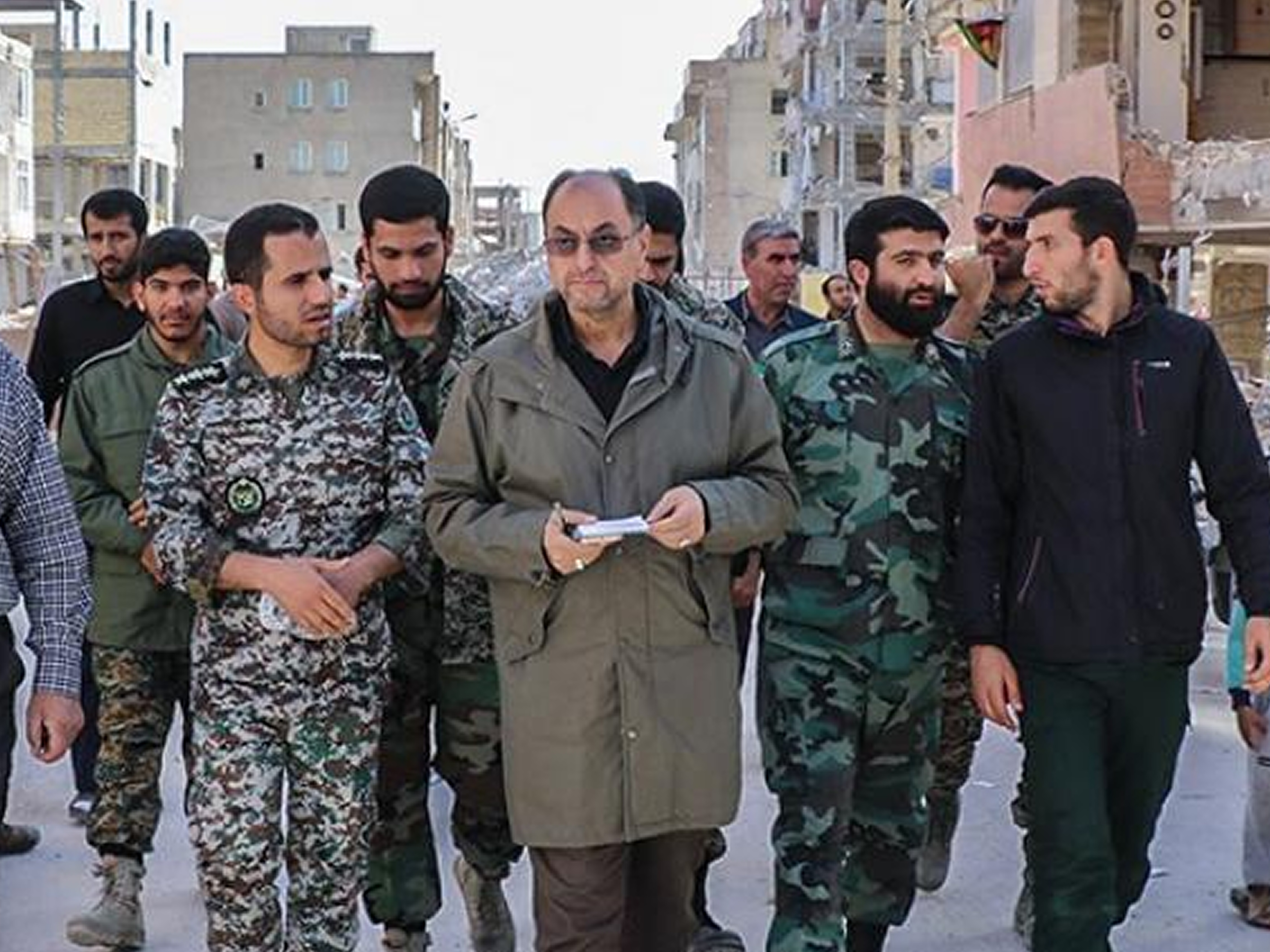
At the heart of the Islamic Republic's power structure sits a fortress of secrecy surrounding Ali Khamenei, Iran's Supreme Leader since 1989. Within this opaque apparatus, one figure emerged over three decades as the indispensable operative: Vahid Haghanian, a former Islamic Revolutionary Guard Corps commander known simply as "Sardar Vahid." Officially holding the title of Executive Deputy for Special Affairs in Khamenei's office, Haghanian functioned as the Supreme Leader's right hand, managing sensitive operations, suppressing dissent, and serving as the keeper of the regime's most closely guarded secrets.
His sudden disappearance from public view in recent years exposes not merely the fate of one official, but the deeper pathology of a system built on paranoia, internal purges, and the systematic consolidation of power in the hands of an aging autocrat and his sons. The circumstances surrounding Haghanian's fall illuminate three critical dimensions of the Islamic Republic's governance: the violent machinery used to crush opposition, the succession crisis brewing within Khamenei's family, and the precarious position of those who know too much.
This investigation reconstructs Haghanian's rise to power, his role in pivotal moments of repression including the brutal suppression of the 2009 Green Movement, the espionage scandal that may have triggered his downfall, and what his fate reveals about the fractured power dynamics at the apex of one of the Middle East's most secretive regimes.
Vahid Haghanian's path to the center of power followed a trajectory common among the Islamic Republic's second-tier elite: military service, revolutionary credentials, and proximity to the right patron at the right time. Born in 1963 in Tehran, Haghanian first entered the revolutionary ecosystem in the early 1980s as a driver for Abdullah Jasbi, a member of the Islamic Republican Party's central council. This humble position provided access to the clerical networks consolidating control after the 1979 revolution.
By the mid-1980s, Haghanian had transferred his services to Ali Khamenei, then serving as president before his elevation to Supreme Leader following Ayatollah Ruhollah Khomeini's death in 1989. The driver-patron relationship proved decisive. In the Islamic Republic's patronage system, such positions of trust often served as launching pads for ambitious operatives. Haghanian joined a cohort that included figures like Mohsen Rafighdoost, Khomeini's driver who rose to command the Mostazafan Foundation, and Mohammad Sharif Malekzadeh, Mahmoud Hashemi Shahroudi's driver who became a vice president under Mahmoud Ahmadinejad.
Haghanian's military career began in earnest in 1985 when he assumed command of the Sarollah patrol forces, the Islamic Revolutionary Guard Corps security units tasked with enforcing morality codes and suppressing dissent in Tehran. He deployed to the Iran-Iraq War front and sustained serious abdominal and leg injuries during the 1987 Battle of Beit-ol-Moqaddas III. These wounds, visible in his gait for the rest of his life, served as perpetual proof of revolutionary sacrifice, a credential that carried immense currency in a system venerating martyrdom.
After the war, Haghanian spent four years in the IRGC's Quds Force, the external operations wing responsible for exporting the revolution and building proxy networks across the Middle East. His focus on Eastern Bloc countries during this period coincided with the Islamic Republic's efforts to secure weapons and technology from former Soviet states. By 1992, Mohammad Mohammadi Golpayegani, Khamenei's newly appointed chief of staff, transferred Haghanian to the Supreme Leader's office to handle security responsibilities. This marked the beginning of his transformation from military operative to political enforcer.
To understand Haghanian's role requires mapping the labyrinthine structure surrounding Khamenei. The Office of the Supreme Leader, or Beit-e Rahbari, functions as the Islamic Republic's true nerve center, a parallel government that operates beyond constitutional constraints, parliamentary oversight, or public accountability. While Iran maintains elected institutions, including a president and parliament, real authority emanates from this secretive apparatus.
When Khamenei inherited supreme leadership in 1989, he lacked the religious credentials and revolutionary charisma of his predecessor. Khomeini ruled through personal authority; Khamenei would govern through bureaucratic control. He transformed the Supreme Leader's office into a sprawling network employing approximately 500 people drawn heavily from intelligence and security services. This expansion enabled Khamenei to micromanage every dimension of Iranian governance while insulating himself from direct accountability.
The inner circle divides roughly into two generations. The first consists of figures who served the revolution from its earliest days, individuals with intelligence backgrounds loyal primarily to institutional survival. This cohort includes Golpayegani, the chief of staff who helped found the Ministry of Intelligence in the 1980s; Ali Asghar Hejazi, deputy chief of staff for intelligence and security affairs; Ali Shirazi, the military liaison; and Haghanian himself, whose portfolio encompassed special affairs and coordination of both overt and covert operations.
The second generation revolves around Khamenei's sons, particularly Mojtaba Khamenei, the Supreme Leader's second son and presumed successor. Mojtaba operates from the shadows, wielding enormous influence without holding formal government positions. His brothers, Masoud and Meysam, manage propaganda operations including Khamenei's website, social media presence, and the hardline Khatt-e Hezbollah publication. Together, this second generation seeks to position themselves as their father's legitimate heirs and interpreters.
This dual structure breeds constant tension. The first generation jealously guards prerogatives accumulated over decades. The second generation pushes for control over messaging and succession planning. Haghanian navigated both worlds, serving simultaneously as Khamenei's personal enforcer and as a rival to those seeking to monopolize access to the aging leader. His mastery of this balancing act kept him indispensable for over two decades.
Beyond the office itself sits a vast economic empire that ensures the Supreme Leader's independence from elected government. Four major foundations, or bonyads, control an estimated 60 percent of Iran's national wealth. The Execution of Imam Khomeini's Order, known as Setad, manages assets worth approximately $95 billion built on systematically confiscated properties from religious minorities, political dissidents, and Iranians living abroad. Astan Quds Razavi, managing the Imam Reza shrine in Mashhad, operates a conglomerate with 351 subsidiary companies spanning construction, energy, agriculture, and finance. The Mostazafan Foundation and IRGC-controlled Khatam al-Anbiya complete this network of institutions that answer only to Khamenei, exempt from taxation and free from parliamentary scrutiny.
These foundations enable the Supreme Leader to reward loyalists, punish enemies, and fund operations without leaving paper trails through official government channels. Haghanian's role as coordinator of "special affairs" positioned him at the intersection of these financial flows and the political operations they funded. He knew which officials received kickbacks, which operations required covert funding, and which secrets could destroy careers. This knowledge made him invaluable and, ultimately, vulnerable.
Haghanian's emergence from relative obscurity into public consciousness occurred during Iran's 2009 presidential election crisis. The disputed reelection of Mahmoud Ahmadinejad triggered the largest protests the Islamic Republic had witnessed since the 1979 revolution. Millions took to the streets alleging systematic fraud. The regime's response exposed the full brutality of its security apparatus, and Haghanian played a central role in orchestrating the crackdown.
Evidence from multiple sources confirms Haghanian's coordination of suppression operations alongside Mojtaba Khamenei. The Sarollah and Mohammad Rasoul Allah forces, elite IRGC units reporting directly to the Supreme Leader's office, deployed throughout Tehran to crush demonstrations. Former IRGC Protection Guard member Mohammad Hossein Turkaman later testified that Haghanian and Mojtaba personally organized these units' response to protesters.
Abolfazl Fateh, an advisor to reformist candidate Mir-Hossein Mousavi, provided a firsthand account of Haghanian's gatekeeping function. When Mousavi composed a confidential letter to Khamenei detailing irregularities and demanding intervention, Fateh delivered it to Haghanian. The operative's response telegraphed the regime's position: "We advised the Interior Ministry on how to announce the vote count, but Ahmadinejad is the winner." This statement revealed that electoral outcomes had been predetermined, and protests would be treated as sedition rather than legitimate political expression.
The suppression followed a calculated pattern. Basij militia forces, augmented by plainclothes IRGC operatives, attacked protesters with clubs, electric prods, and firearms. Neda Agha-Soltan, a 26-year-old philosophy student, became the movement's symbol when a Basij member shot her in the chest on June 20, 2009. A bystander captured her final moments on video; the footage circulated globally within hours, transforming her into an icon of resistance. The regime responded by forcing her family to vacate their home and promoting conspiracy theories blaming Western intelligence services for her death.
Haghanian's most visible moment came during Ahmadinejad's August 2009 inauguration ceremony. In a break from protocol that shocked observers, he stood between Khamenei and Ahmadinejad on the parliamentary floor, physically delivering the validation certificate from the Supreme Leader. This role normally belonged to the head of the Expediency Council, Akbar Hashemi Rafsanjani, a former president and one of the revolution's founding figures. But Rafsanjani had refused to attend, signaling his opposition to the stolen election. Khamenei selected Haghanian to fill the void, a calculated insult to the political establishment and a message about where real power resided.
The seating arrangement during the parliamentary inauguration further underscored Haghanian's status. He occupied the front row among military commanders, positioned centrally ahead of figures like IRGC Chief Mohammad Ali Jafari and Armed Forces Chief of Staff Hassan Firouzabadi. For an operative without formal military rank, this placement suggested authority exceeding that of Iran's most senior generals.
The Green Movement's suppression exacted a terrible toll. At least 72 people died in street clashes; thousands were arrested, detained, and tortured. Opposition leaders Mousavi and Mehdi Karroubi were placed under house arrest in February 2011, a detention that would last 14 years. The crackdown succeeded in dispersing street protests by early 2010, but it fundamentally delegitimized the Islamic Republic in the eyes of millions of Iranians. More importantly for Haghanian, it cemented his reputation as Khamenei's indispensable enforcer, the operative who delivered results when the regime faced existential threat.
Following the Green Movement's suppression, Haghanian's public profile expanded. He began appearing at disaster sites and official ceremonies as Khamenei's personal representative, a role that signaled the Supreme Leader's attention while allowing Haghanian to monitor local officials and collect intelligence. In January 2017, he visited the collapsed Plasco building in Tehran, a 17-story structure that killed dozens when it caught fire and imploded. In May 2017, he traveled to the Azadshahr coal mine in Golestan province after a methane explosion killed 42 miners, the worst such disaster in Iranian history.
These appearances cultivated an image of Haghanian as Khamenei's eyes and ears, the official who ensured the Supreme Leader remained connected to events on the ground. But a November 2017 trip to Kermanshah province, where a devastating earthquake had destroyed government-built housing, exposed the tensions simmering beneath this public role.
Vice President Eshaq Jahangiri had criticized the shoddy construction of Mehr Housing, a massive project championed by Ahmadinejad's administration that collapsed easily during the earthquake. President Hassan Rouhani echoed these concerns, noting that privately built structures had survived while government housing crumbled. Haghanian, visiting Kermanshah as Khamenei's representative, launched into an expletive-laden tirade defending the project. "God damn Vice President Jahangiri!" he told a gathering, not realizing he was being recorded. "All this politicking and political games... This politicization started too early regarding the Mehr Housing."
The leaked video went viral. Haghanian issued a half-hearted apology claiming he meant no insult and that the gathering was private, but he defended both the housing project and his criticism. The incident revealed multiple fault lines. First, it demonstrated the Supreme Leader's office protecting Ahmadinejad-era programs despite their manifest failures. Second, it showed Haghanian willing to publicly attack elected officials, a sign of the contempt the unelected power structure held for constitutional government. Third, it exposed the broader conflict between Khamenei and Rouhani's administration over economic policy and political legitimacy.
More dangerous for Haghanian was the intensifying competition for the role of Khamenei's spokesperson. Hossein Shariatmadari, editor of the hardline Kayhan newspaper since 1993, had long functioned as an interpreter of the Supreme Leader's views. Appointed directly by Khamenei and known as the "sniper" for his attacks on reformists, Shariatmadari viewed himself as the authorized voice articulating positions too sensitive for Khamenei to state publicly. The emergence of Khatt-e Hezbollah, an online publication managed by Khamenei's sons and publishing analysis on sensitive issues like the 2015 nuclear deal, triggered a backlash from conservatives who accused the younger generation of usurping the Supreme Leader's authority.
Haghanian waded into these disputes by publishing his own commentary criticizing political figures. When Shariatmadari wrote that several conservative candidates should have withdrawn from the 2017 presidential election to consolidate support behind Ebrahim Raisi, Haghanian published a response calling the analysis "special thinking" aligned with enemy propaganda. This public rebuke of Shariatmadari, a Khamenei appointee, signaled either extraordinary confidence or dangerous overreach.
The escalating rivalry for spokesperson status reflected deeper anxieties about succession and control over Khamenei's legacy. Each faction positioning itself to interpret the Supreme Leader's will understood that this role would prove crucial when the 86-year-old leader died or became incapacitated. Haghanian's willingness to publicly claim this interpretive authority made enemies among both the clerical old guard and Khamenei's sons, who viewed monopolizing their father's message as essential to securing their political future.
The crisis that may have sealed Haghanian's fate emerged from the most sensitive possible source: a young operative he personally recruited into Khamenei's inner circle. Mohsen Saravani, a 24-year-old law student and Basij member from Zahedan, appeared to embody the regime's ideal: young, ideologically committed, and eager to serve. Haghanian brought Saravani into the Supreme Leader's office as an advisor, vouching for his loyalty and reliability. Photographs show the two together at official functions, Saravani's youth and energy contrasting with Haghanian's weathered appearance.
On April 17, 2022, IRGC intelligence arrested Saravani on charges of espionage for Israel's Mossad. Court documents obtained by human rights organizations detail the allegations: Saravani had allegedly collected classified information through government contacts and transmitted it to Mossad handlers. He was accused of intelligence collaboration with the "hostile Zionist regime," gathering confidential and secret materials through government agents, and providing this information both directly and indirectly to foreign services.
The case included two other defendants. Afshin Ghorbani, also accused of espionage, received a death sentence. Mandana Zanganeh Soroush, a former economic deputy in the governor's office, received a custodial sentence. But Saravani was the most damaging defendant because of his proximity to the Supreme Leader's office. His presence at high-level meetings meant he potentially had access to some of the regime's most sensitive intelligence.
Human rights investigators noted that Saravani's confession was extracted under torture, a routine practice in Iranian political cases. The judiciary moved with unusual speed, a signal that powerful forces wanted the case concluded quietly. On December 16, 2023, authorities executed Saravani in Zahedan Central Prison. State media announced the execution of an unnamed man convicted of espionage only after the fact, withholding Saravani's identity for several weeks.
For Haghanian, the Saravani case represented a catastrophic failure. He had vouched for an individual who allegedly betrayed the Supreme Leader's office to Iran's most dangerous enemy. Whether Saravani actually spied for Israel or was caught in a factional purge remains unclear, but the optics were devastating. Haghanian's judgment, his vetting procedures, and his trustworthiness all came under scrutiny. IRGC intelligence, which controls counterintelligence operations and has long competed with the Supreme Leader's office for dominance in the security sphere, possessed a powerful weapon to use against Haghanian and, by extension, against Khamenei's entire first-generation inner circle.
The executions of alleged Israeli spies intensified throughout 2024 and 2025 as tensions between Iran and Israel escalated following the October 7, 2023 Hamas attacks and Israel's subsequent campaign in Gaza. Iran executed multiple individuals accused of Mossad collaboration, often in secretive proceedings with minimal due process. The Saravani case fit this pattern but carried unique significance because of his connection to the Supreme Leader's office. That Haghanian's protégé could be executed for spying suggested either catastrophic incompetence or, more ominously, penetration of Khamenei's inner sanctum by hostile intelligence services.
Haghanian's visibility declined sharply after the Saravani execution became public. Reports circulated that he had been placed under house arrest or detained by IRGC intelligence. His last confirmed public appearance came on October 16, 2023, at the memorial service for his brother. The attendance of all of Khamenei's sons at this event suggested either a show of support or a message that despite his troubles, Haghanian retained some protection.
His final documented sighting occurred at a government meeting with Khamenei where he sat in the back rows, a dramatic demotion from his usual position at the Supreme Leader's side. Observers noted his diminished, almost defeated appearance, a striking contrast to the confident operative who had once stood center stage during Ahmadinejad's inauguration.
Several theories circulate about his current status. He may have fled Iran with assistance from individuals who benefited from his protection over the years. He may be under 24-hour IRGC surveillance, kept alive but neutralized. Or he may have negotiated a quiet retirement, permitted to fade from public life in exchange for silence about the regime's inner workings.
The likeliest scenario involves what might be called "insurance documentation," a practice common among regime insiders who accumulate compromising information as protection against purges. Such individuals typically arrange for sensitive materials to be released if they die or disappear under suspicious circumstances. This dead man's switch provides a degree of security in a system where liquidating inconvenient officials carries minimal risk. Haghanian, who spent three decades at the center of Khamenei's most sensitive operations, certainly possessed information that could damage or destroy numerous officials. His continued survival, despite the Saravani debacle, suggests this insurance may be functioning.
Parallels exist with other regime figures who fell from grace but avoided terminal consequences. Abbas Palizdar, who exposed corruption among senior clerics, faced arrest but not execution. Saeed Mortazavi, the notorious "butcher" prosecutor involved in torture and murder of dissidents, was eventually sidelined but not eliminated. The Islamic Republic's internal discipline system operates through a combination of co-optation, marginalization, and selective violence. Total elimination occurs primarily when an individual lacks sufficient connections or insurance.
Haghanian's fall illuminates the broader dysfunction within the Islamic Republic's power structure. A regime that cannot trust even its closest operatives suffers from terminal paranoia. The Supreme Leader's office, which theoretically represents the system's pinnacle of authority and loyalty, has been penetrated either by foreign intelligence or by factional rivals using espionage allegations as weapons in internal conflicts. Either scenario indicates profound institutional decay.
The succession crisis intensifies this instability. Khamenei, at 86, faces increasing health concerns even as regional tensions with Israel escalate. Speculation about succession has intensified since September 2024, when Israel killed Hezbollah leader Hassan Nasrallah, one of Khamenei's closest allies, and again in June 2025 when Israeli strikes killed multiple senior IRGC commanders. Reports emerged in late 2024 that a committee drawn from the Assembly of Experts had secretly designated Mojtaba Khamenei as successor, though no official confirmation followed.
The prospect of hereditary succession, with Khamenei's son inheriting supreme leadership, would transform the Islamic Republic into precisely the sort of dynastic monarchy the 1979 revolution claimed to abolish. This contradiction has generated significant resistance even among conservative factions who fear that too obvious a power grab might trigger the system's collapse. Haghanian's marginalization serves the succession project by removing a powerful figure from the first generation who might resist or complicate the transition.
Understanding Haghanian's role and fate requires examining the economic architecture that sustains Khamenei's position above factional politics. The four major bonyads, or foundations, that control approximately 60 percent of Iran's GDP operate as personal fiefdoms of the Supreme Leader, generating revenues that exceed Iran's annual oil income while remaining exempt from taxation and free from oversight.
Setad, the Execution of Imam Khomeini's Order, exemplifies this system. Founded in 1989 ostensibly to manage properties left ownerless after the revolution, Setad expanded into a business empire worth an estimated $95 billion by 2013, likely exceeding $200 billion today according to U.S. government assessments. The organization built this wealth through systematic confiscation of properties belonging to religious minorities, particularly Baha'is, political dissidents, and Iranians living abroad. An 82-year-old Baha'i woman described how Setad seized her apartment and those of her three children after years of harassment, part of thousands of similar seizures.
Setad now holds stakes in nearly every sector of Iranian industry: finance, oil, telecommunications, pharmaceuticals, and even ostrich farming. Its subsidiaries operate as front companies, shielding beneficial ownership and enabling sanctions evasion. The U.S. Treasury Department designated Setad in 2013 as "a massive network of front companies hiding assets on behalf of Iran's leadership," though sanctions relief under the 2015 nuclear deal lifted restrictions on approximately 40 Setad-owned entities.
Astan Quds Razavi, managing the Imam Reza shrine in Mashhad, controls a similarly vast empire. Through its subsidiary Razavi Economic Organization, AQR operates holdings in construction, agriculture, energy, telecommunications, and finance. The shrine itself generates enormous revenue from donations by the 34 million pilgrims who visit annually, funds that flow into AQR's investment portfolio. The foundation employs 19,000 people, owns most real estate in Mashhad, and operates businesses ranging from carpet manufacturing to automobile plants. When asked to identify Mashhad's most powerful person, residents name not the mayor but AQR's custodian, a position Khamenei controls through direct appointment.
The Mostazafan Foundation, ostensibly created to help the oppressed, has become the second-largest economic entity in Iran after the National Iranian Oil Company. With corporate assets estimated at $12 billion and annual revenue exceeding state tax collection, Mostazafan operates construction firms, agricultural businesses, banks, and industrial conglomerates. Like other bonyads, it pays no taxes and faces no independent audits. Its current director, Parviz Fattah, has himself acknowledged that senior officials misappropriate foundation properties for personal use, though his selective disclosures serve factional interests rather than transparency.
The IRGC's economic tentacles extend through its own bonyad, the Sepah Cooperative Foundation, and the Khatam al-Anbiya construction conglomerate. Estimates of IRGC economic control range from 25 to 80 percent of the Iranian economy, reflecting both the Guards' expansion into civilian sectors and the difficulty of tracing beneficial ownership through layers of subsidiaries and front companies.
This parallel economy ensures Khamenei's independence from elected government and parliamentary appropriations. While President Rouhani or his successors must negotiate budgets through the Majlis, Khamenei commands resources exceeding the national budget through foundations answerable only to his office. This financial autonomy enables him to fund security operations, reward loyalists, purchase political support, and pursue regional ambitions without leaving trails through official channels.
Haghanian's coordination of "special affairs" positioned him at the nexus of this system. He knew which foundation funded which operation, which officials received payoffs, which accounts held money for covert programs. This knowledge made him indispensable for maintaining the system's coherence but also made him dangerous to individual actors whose corruption he could expose. His fall may have been precipitated not by the Saravani case alone but by accumulated enemies among officials who viewed him as a threat.
The Haghanian case illustrates a broader pattern: the Islamic Republic's reliance on a shadow state that operates beyond law, accountability, or public scrutiny. This parallel structure encompasses the Supreme Leader's office, the IRGC and its intelligence apparatus, the judiciary's special courts, and the economic foundations. Together, these institutions form what scholars call Iran's "deep state," a network more powerful than elected government and designed to preserve revolutionary ideology and elite privilege.
This deep state maintains power through systematic repression. The 2009 Green Movement suppression, in which Haghanian played a central role, demonstrated the regime's willingness to deploy overwhelming violence against peaceful protesters. But repression extends far beyond crisis moments. Routine mechanisms include:
Arbitrary detention and torture of dissidents, journalists, and activists in facilities like Evin Prison and the infamous Kahrizak detention center, where Green Movement protesters were beaten, raped, and murdered in 2009. Parliamentary show trials forcing false confessions to foreign-backed "velvet revolution" plots. Execution of political prisoners on charges of "corruption on earth" or "enmity against God," vague categories that encompass virtually any opposition. Persecution of religious minorities, particularly Baha'is, including systematic property confiscation, denial of university education, and arbitrary imprisonment. Surveillance networks monitoring communications, social media, and private gatherings, with IRGC intelligence and Ministry of Intelligence competing to demonstrate vigilance. Targeted assassinations of dissidents abroad, from the 1990s campaign that killed dozens of opposition figures in Europe to recent operations targeting activists in exile.
This repressive architecture serves a dual function: suppressing threats to regime survival and enriching the security services that implement it. IRGC and intelligence officers gain wealth and influence through their positions, creating incentives to manufacture threats that justify their existence and expansion.
The Saravani case fits this pattern. Whether Saravani actually spied for Israel or was caught in a factional conflict, his execution served the interests of IRGC intelligence by demonstrating its vigilance while weakening the Supreme Leader's office. The nearly two-year delay between arrest and execution suggests extended interrogation designed to extract maximum information about Khamenei's office operations. The secrecy surrounding the case, with even Saravani's name withheld initially, indicates sensitivity about what was discovered or fabricated during his detention.
For ordinary Iranians, this system creates a climate of pervasive fear where anyone can be denounced, arrested, and disappeared with minimal pretext. The regime's paranoia about foreign infiltration, particularly by Israeli or Western intelligence, means that routine professional contacts with foreigners can be reframed as espionage. Dual nationals and Iranians with family abroad face particular vulnerability, frequently arrested as hostages to extract concessions from Western governments or as scapegoats when the regime requires demonstrations of vigilance.
Haghanian's marginalization occurs against the backdrop of the Islamic Republic's most severe succession crisis since 1989. Khamenei's age, health concerns, and the intensifying conflict with Israel have focused attention on who will inherit supreme leadership and whether the transition can occur without regime collapse.
The formal mechanism for succession involves the Assembly of Experts, an 88-member clerical body theoretically empowered to select and supervise the Supreme Leader. In practice, the Assembly has never meaningfully checked either Khomeini or Khamenei and conducts oversight through secret committees with no public accountability. Its members are vetted by the Guardian Council, which Khamenei controls, ensuring that only loyalists can serve. This circular structure means succession likely will be determined by backroom deals among elite factions rather than constitutional procedures.
Current speculation centers on two candidates. Mojtaba Khamenei, the Supreme Leader's second son, represents continuity. At 56, he has spent decades in his father's office accumulating power without holding formal positions. His wealth, estimated at over $3 billion held in accounts across the UAE, Syria, Venezuela, and African countries, positions him to reward supporters and buy loyalty. His close relationship with IRGC commanders, particularly through coordination during the Green Movement suppression, gives him influence within the security services essential to maintaining control.
But Mojtaba faces significant obstacles. He lacks religious credentials, holding only the mid-ranking title of Hujjat al-Islam rather than the senior rank of ayatollah. More damaging politically, his elevation would confirm that the Islamic Republic has become a hereditary monarchy, contradicting the revolution's founding ideology. Senior clerics, including reformist and even some conservative figures, have expressed opposition to dynastic succession. Mojtaba's reputation for brutality during 2009, including alleged personal involvement in ordering violence against protesters, makes him a polarizing figure who would struggle to claim the moral authority expected of supreme leadership.
The alternative candidate, Hassan Khomeini, grandson of the revolution's founder, emerged as a serious contender in recent succession discussions. At 51, Hassan lacks Mojtaba's institutional power but carries the Khomeini name's unparalleled legitimacy. He maintains better relationships with reformist and moderate factions, potentially making him a consensus candidate who could preserve stability during transition. His selection would represent continuity with revolutionary origins while avoiding the monarchy problem.
Yet Hassan's moderation, relative to regime standards, makes him suspect to hardliners who fear he might open political space that threatens their positions. His criticism of IRGC political interference, while mild, generated fierce attacks from military commanders and their media allies. Choosing Hassan would require the IRGC and Khamenei's sons to relinquish control they have spent years consolidating, an unlikely scenario unless forced by crisis.
The succession dilemma intensifies because of external pressures. Israeli strikes have killed multiple senior IRGC commanders, including Qassem Soleimani in 2020, Razi Mousavi in 2023, and numerous others in 2025. These losses hollow out the command structure that would enforce any succession decision. Regional setbacks, particularly the collapse of allied regimes in Syria and weakening of Hezbollah, undermine the axis of resistance that Iran has cultivated for decades. Economic sanctions, while periodically eased, have produced sustained degradation of Iran's economy and growing domestic discontent.
In this context, a contested succession could trigger regime collapse. If two factions each claim legitimacy through separate Supreme Leaders, the Islamic Republic could fragment along institutional lines with the IRGC backing one candidate and reformist-moderate political factions supporting another. Such a scenario might resemble the 1979 revolution's aftermath when competing visions fought for control, though this time conservative factions hold overwhelming military advantage.
Haghanian's removal from power serves the succession project by eliminating a first-generation figure who might resist Mojtaba's elevation or leak damaging information about the family's machinations. His intimate knowledge of three decades of secret operations makes him dangerous to anyone plotting a power grab. Better to marginalize him preemptively than risk his opposition or revelations during a vulnerable transition period.
The rise and fall of Vahid Haghanian exposes the pathological dynamics at the heart of the Islamic Republic's governance. A system built on revolutionary ideology has degenerated into a kleptocratic autocracy where personal loyalty trumps competence, paranoia substitutes for security, and the concentration of power in increasingly narrow circles produces instability rather than strength.
Haghanian's three decades of service encompassed some of the regime's darkest moments: the systematic suppression of the Green Movement, the consolidation of economic control through foundation-controlled monopolies, the expansion of regional influence through proxy forces, and the maintenance of internal discipline through surveillance and violence. His marginalization demonstrates that no service guarantees permanence in a system where today's indispensable operative becomes tomorrow's scapegoat when convenient.
The Saravani case, whether a genuine espionage scandal or factional weapon, reveals the fragility of elite trust. That a young operative personally vetted by Haghanian could be executed as an Israeli spy, whether truthfully or falsely, indicates either catastrophic penetration by hostile intelligence or willingness by internal factions to destroy rivals through fabricated charges. Neither scenario inspires confidence in the regime's coherence or longevity.
More broadly, Haghanian's story illuminates how absolute power concentrates until it becomes unsustainable. Khamenei's office, controlling parallel military forces, vast economic resources, intelligence networks, and propaganda apparatus, operates beyond constitutional constraints and public accountability. This concentration enables decisive action during crises but also produces corruption, incompetence, and internal conflict as factions compete for proximity to the leader and control over succession.
The economic dimensions particularly matter. When a Supreme Leader personally controls foundations worth more than $200 billion operating outside any oversight, when senior officials accumulate wealth measured in billions while imposing austerity on ordinary citizens, when systematic property confiscation finances political operations, the resulting system more closely resembles a mafia state than a government. The revolutionary ideology becomes window dressing for a predatory elite extracting wealth and maintaining power through violence.
For ordinary Iranians, this system imposes extraordinary costs. Systematic mismanagement of the economy produces inflation, unemployment, and declining living standards despite the country's oil wealth and educated population. Political repression forecloses avenues for peaceful reform, forcing dissent underground or into exile. Corruption pervades every interaction with government, from securing business licenses to accessing education to avoiding arbitrary arrest. The regime's regional adventures and nuclear program trigger international sanctions that further degrade economic conditions while enriching the elite who profit from sanctions evasion.
The disappearance of Vahid Haghanian will likely never be fully explained. He may live out remaining years under house arrest or surveillance, may have fled abroad with carefully hoarded assets, or may have negotiated quiet retirement in exchange for silence. But his fate matters less than what it reveals: a regime eating itself, a gerontocracy planning dynastic succession while facing mounting domestic and external pressures, an autocracy so paranoid that even the Supreme Leader's closest operatives cannot trust their positions or safety.
When succession occurs, whether through Khamenei's death or incapacitation, the Islamic Republic will face its most severe test since 1979. The concentration of power in the Supreme Leader's office means his removal creates a vacuum that may prove impossible to fill without conflict. The economic foundations will become prizes in factional warfare. The IRGC will weigh whether to back a weak Supreme Leader or seize power directly. Regional adversaries will exploit the transition's vulnerability. And ordinary Iranians, after 46 years of theocratic rule, may see an opportunity to reclaim their political future.
Vahid Haghanian rose from driver to the pinnacle of hidden power by mastering the rules of authoritarian survival: loyalty to the leader, ruthlessness toward opponents, and careful accumulation of leverage through secrets and connections. His fall demonstrates that in systems built on paranoia and repression, no position guarantees permanence. The operative who enforced the regime's will for three decades discovered what countless others have learned: the Islamic Republic's only consistent principle is the preservation of power, and anyone who knows too much eventually becomes a liability rather than an asset.
The regime Haghanian served sacrificed revolutionary idealism for elite enrichment, constitutional governance for autocratic control, and national development for regional ambition. It survives through violence and fear rather than legitimacy or popular consent. Such systems can endure for decades, but they ultimately face a choice: reform fundamentally or collapse entirely. The Islamic Republic has consistently chosen repression over reform. History suggests this choice, while postponing crisis, makes ultimate collapse more severe when it arrives.
For now, the shadow hand that once delivered the Supreme Leader's orders from behind the scenes has vanished into the same darkness that swallowed countless others who challenged, threatened, or simply knew too much about the machinery of power. His disappearance marks not an anomaly but the logical conclusion of serving a system where secrets, paranoia, and the concentration of absolute authority produce not security but an endless cycle of purges, each generation consuming the one before to preserve a regime that grows more brittle even as it tightens its grip.