



The Ghalibaf Files: Inside the Rise of Iran's Most Protected Warlord
An investigation reveals decades of violence, corruption, and impunity in Islamic Republic politics.
|
Pars Barghandan
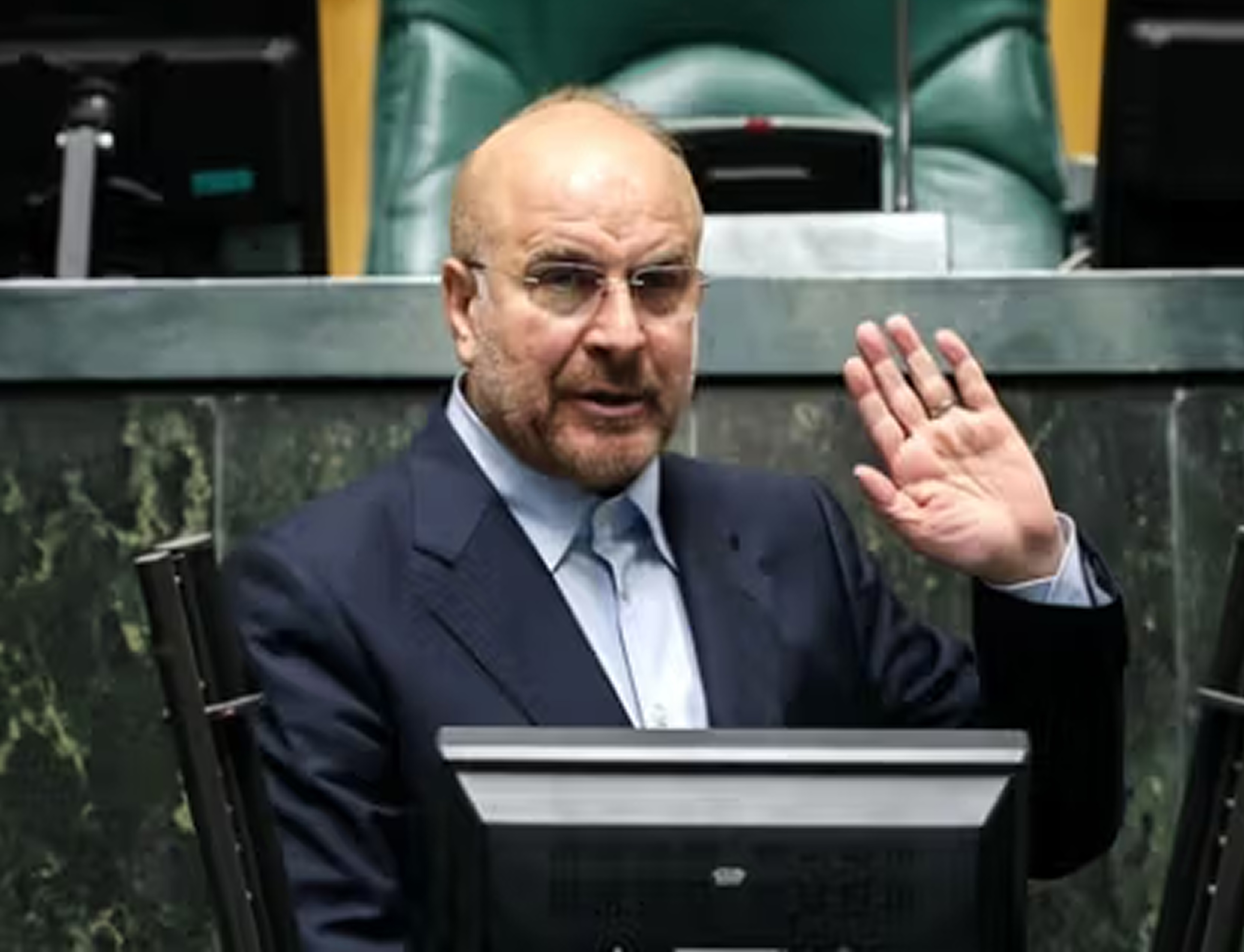
Mohammad Bagher Ghalibaf embodies the concentrated pathology of power in the Islamic Republic. Over four decades, this former Revolutionary Guard commander has systematically ascended through every lever of state authority, from battlefield to police headquarters, from city hall to the speaker's chair in parliament, leaving a trail of bloodshed, embezzlement, and unanswered questions. What distinguishes his career is not merely the scale of alleged crimes, but the architectural precision with which Iran's power structure has shielded him from accountability at every turn.
Evidence gathered from leaked audio recordings, judicial documents, and eyewitness accounts reveals a pattern that extends from the violent suppression of student protests to multibillion-dollar municipal corruption schemes involving the Islamic Revolutionary Guard Corps. While subordinates have been sentenced to decades in prison, while whistleblowers have been jailed for exposing his dealings, Ghalibaf himself has faced neither prosecution nor meaningful scrutiny. His trajectory illuminates how the Islamic Republic operates: not as a theocracy bound by divine law, but as a patronage machine where loyalty to the supreme leader purchases immunity from earthly justice.
Now serving his second term as speaker of parliament after four failed presidential campaigns, Ghalibaf stands positioned within reach of even greater power, his past neither forgotten nor forgiven by ordinary Iranians, but rendered institutionally irrelevant by a system designed to protect its own.
Mohammad Bagher Ghalibaf was born on September 1, 1961, in Torqabeh, a small town in Khorasan province in northeastern Iran. The son of a Kurdish father and Persian mother, he came of age as the revolutionary fervor of 1979 swept through Iranian society. While still a teenager, and before completing high school, he joined the Basij militia, the Islamic Republic's volunteer paramilitary force. His early revolutionary credentials were sealed not in the streets of Tehran but in the mountains of Kurdistan, where the new regime was brutally suppressing ethnic minority opposition.
The timing proved fortuitous. When Iraq invaded Iran in September 1980, launching an eight-year war that would claim over one million lives, Ghalibaf joined the Revolutionary Guards and quickly distinguished himself in the regime's eyes. His brother and father were both killed in the conflict, bestowing upon him the invaluable status of a martyr's family member, a designation that would open doors throughout his career. By 1982, at just 21 years old, he commanded the Imam Reza Brigade. Before the war's end, he had risen to lead the Nasr Division of Khorasan and then the 25th Karbala Division, responsibilities that placed him in charge of intelligence operations and, according to critics, of sending waves of poorly equipped young conscripts, many of them children, into minefields and enemy fire.
Personal advancement accompanied professional ambition. In 1982, Ayatollah Ruhollah Khomeini himself officiated a temporary marriage contract between Ghalibaf and Zahra Sadat Moshir-Estekhareh, a union that would later produce considerable wealth and its own corruption scandals. The marriage, and his family's sacrifices, cemented his position within the revolutionary elite.
After the war ended in 1988, Ghalibaf's career trajectory shifted from the battlefield to the business of reconstruction and political maneuvering. He briefly commanded the IRGC's Najaf garrison before being appointed deputy commander of the Basij in 1994. During this period, evidence suggests he established mechanisms for what critics describe as a "morality police" network, precursors to the forces that would later enforce hijab laws and suppress women's rights demonstrations.
But it was his 1994 appointment as commander of Khatam al-Anbia Construction Headquarters, the IRGC's sprawling economic arm, that marked his entry into the nexus of military and financial power. Nominally created to rebuild Iran after the war, Khatam al-Anbia evolved into one of the country's largest contractors, controlling over 800 subsidiary companies with a workforce exceeding 135,000. During Ghalibaf's tenure, the organization undertook railway projects linking Mashhad to Sarakhs, gas pipeline construction across multiple provinces, and maritime infrastructure in the Persian Gulf. Investigations later suggested financial irregularities in these contracts, though no formal charges were ever filed.
In 1997, Supreme Leader Ali Khamenei directly appointed Ghalibaf commander of the IRGC Air Force, a three-year tenure that would feature one of the most notorious incidents of his military career.
On a day in 1997 that military veterans still speak of with bitterness, Mohammad Bagher Ghalibaf led Revolutionary Guard forces in an armed assault on Iran's regular army. The confrontation took place at the 7th Fighter Base in Shiraz, where the IRGC Air Force under Ghalibaf's command sought to seize land belonging to the army's airborne division, territory that the supreme leader's office had explicitly ordered should remain under military control.
Retired Army General Shahram Rostami, who served as deputy chief of the joint armed forces staff at the time, provided a rare public account of the incident years later. According to Rostami, IRGC forces under Ghalibaf's command arrived with armored vehicles mounted with heavy machine guns. When army personnel resisted the illegal seizure, IRGC troops opened fire. A young army conscript was killed by direct fire. Witnesses say the order came from Ghalibaf. The invasion constituted a direct violation of the supreme leader's directive and an unprecedented breach between two branches of Iran's armed forces.
The aftermath revealed the protection mechanisms that would define Ghalibaf's entire career. Rather than face prosecution for the soldier's death, rather than answer to military justice for insubordination, Ghalibaf was neither arrested nor formally questioned. Instead, the judiciary and military command turned their attention to the army officers who had defended their base in accordance with regulations. General Rostami and other senior army commanders were subjected to investigation, temporarily suspended from service, and fined. The soldier who died protecting army property was buried quietly; his family received no justice. The perpetrators of the attack faced no consequences.
Ghalibaf's behavior during the investigation was telling. In Rostami's account, the IRGC commander was summoned for questioning but the session lasted barely an hour before being terminated, not because of cooperation, but because of intervention from above. Khamenei's office had decided that pursuing the case would embarrass the Revolutionary Guards, and the file was closed. The incident established a precedent: Ghalibaf could spill blood, violate direct orders, and undermine military discipline, yet the regime would shield him from accountability.
This pattern of impunity would repeat itself, with far greater casualties, in the years ahead.
The summer of 1999 marked a turning point in the Islamic Republic's relationship with its own youth. On July 8, peaceful student demonstrations erupted in Tehran following the government's closure of the reformist newspaper Salam. The next evening, plainclothes paramilitaries, identified as Ansar-e Hezbollah and Basij forces, stormed a Tehran University dormitory, smashing through halls with batons and chains, setting fire to rooms, and beating students indiscriminately. At least one student was killed in the initial raid; more than 200 were injured. The assault sparked six days of the most widespread unrest Iran had witnessed since the early years of the revolution.
Ghalibaf was not officially responsible for the raid. He served as IRGC Air Force commander, not a law enforcement role. But eyewitnesses placed him in the streets during those violent days, and years later, he would proudly confirm it. In a speech before Basij members captured on audio, Ghalibaf boasted of his personal involvement: "The lists that were written, I prepared them. When protesters were moving on the ground toward the Leader's residence, I was the commander of the Air Force. There's a photo of me now on a motorcycle with a club. I stood on the ground with Hossein Khaleghi to clear the streets. Wherever necessary, we came to the streets and beat people with clubs. I'm among the club-wielders, and I'm proud of it."
The remark was not bravado but confession. Ghalibaf admitted to operating outside his chain of command, descending into street-level violence with makeshift weapons, personally administering beatings to civilians exercising their constitutional right to protest. His description, chain in hand, eyes closed, striking anyone in his path, painted a picture of indiscriminate brutality.
But the 1999 protests had another consequence: they crystallized the IRGC's determination to assert political dominance over the reformist presidency of Mohammad Khatami. On July 11, as the demonstrations continued, 24 senior Revolutionary Guard commanders, including Ghalibaf, signed an extraordinary open letter to President Khatami. The language was barely coded threat: "Our patience is at an end," they wrote, warning that if the elected government could not suppress the protests, the IRGC would intervene directly. The letter represented an unprecedented public declaration that Iran's military would override civilian authority if its interests were threatened.
Khatami, recognizing the coup threat, capitulated. The protests were crushed. Student leaders were arrested by the hundreds. And the IRGC commanders who had threatened to overthrow the government faced no discipline. Instead, Ghalibaf was promoted.
In 2000, Ayatollah Khamenei personally appointed Ghalibaf as commander of Iran's Law Enforcement Forces, the national police, replacing General Hedayat Lotfian, who had been dismissed amid the 1999 protests despite being cleared of direct responsibility for the dormitory raid. The promotion handed Ghalibaf control over the very institution that would be tasked with suppressing future dissent.
As police chief, Ghalibaf modernized the force's repressive capabilities. He expanded special units, founded the "110 Police" rapid-response force, and implemented what he termed a "moral security" campaign, a systematic effort to enforce hijab requirements and arrest journalists, bloggers, and reformist activists. Dozens of intellectuals, newspaper editors, and website managers were detained, interrogated in a special facility Ghalibaf established in Tehran's Javan Square, and held without charge.
But his most significant act as police commander came in 2003, during the anniversary protests of the 1999 demonstrations. Students again took to the streets on July 9, demanding reform and accountability. Ghalibaf was determined to prevent a repeat of the previous unrest, and he sought explicit authorization to use lethal force.
A leaked audio recording, released years later during the 2013 presidential campaign, captured Ghalibaf describing the critical meeting in his own words. Speaking to a gathering of Basij members, he recounted the scene: "I sat in that meeting at the Ministry of Interior and said, tonight anyone who wants to come into the student dormitory and do these things, I, Ghalibaf, as the commander of NAJA [Law Enforcement Forces], will crush them, I'll deal with them, I'll round them up."
He continued: "I stood up in that meeting. With the confrontation I carried out, I received authorization for military presence and shooting for NAJA in the university dormitory from the Security Council. Mr. Lari, Mr. Moein, they signed it and gave it to me."
The recording confirms that Ghalibaf not only demanded but received written permission from the Supreme National Security Council, signed by senior officials including Interior Minister Abdollah Nouri and other cabinet members, to deploy armed forces inside university grounds and to open fire on students. This authorization represented a fundamental shift: universities, traditionally spaces of relative autonomy, were now declared legitimate targets for armed suppression.
The policy had immediate and deadly consequences. During the 2003 protests, security forces used live ammunition against demonstrators. Ghalibaf's forces arrested hundreds and subjected them to interrogation and abuse. Yet when confronted with these facts during televised presidential debates in 2013, he initially denied everything, claiming he had refused to authorize violence and had in fact protected students. It was only after the audio leaked, with his own voice admitting the opposite, that the lie became untenable.
Hassan Rouhani, who served on the Supreme National Security Council during that period, publicly confirmed Ghalibaf's account during the 2017 presidential debates. "You were the one who said let the students come so we can crush them," Rouhani stated. "We said the solution isn't to give authorization and then crush them. The solution is to say there's no permit, or if there is a permit, let them come and demonstrate peacefully." Rouhani revealed that Ghalibaf had advocated for overwhelming force, using language that suggested extreme suppression.
The 2003 suppression succeeded in silencing that wave of student activism. But it established the precedent that would shape the regime's response to all future protests: meet dissent with violence, secure legal cover from pliant officials, and rely on the supreme leader's protection against consequences.
When massive protests erupted following the disputed 2009 presidential election, protests that would become known as the Green Movement, Ghalibaf no longer held a security portfolio. He had been mayor of Tehran since 2005. Yet on the night of June 25, 2009, he appeared again at the gates of a university dormitory, this time at the head of a large force of plainclothes agents and riot police.
The circumstances mirrored 1999: students and protesters had gathered at the University of Tehran to challenge the announced victory of Mahmoud Ahmadinejad over reform candidate Mir-Hossein Mousavi. Many questioned the legitimacy of results that showed Ahmadinejad winning in a landslide despite pre-election polls suggesting a close race. The government declared the protests illegal; protesters insisted on their constitutional rights.
According to multiple accounts and witness testimony, Ghalibaf personally led the raid on the university. His forces beat students with batons, made mass arrests, and killed at least five people that night. Many more were detained and subjected to torture in the weeks that followed. The Green Movement, which had represented the largest challenge to the regime since the revolution, was brutally suppressed over the following months.
Ghalibaf's involvement, a sitting mayor commanding paramilitary operations outside his jurisdiction, illustrated the fluid, overlapping nature of repression in the Islamic Republic. Official titles matter less than revolutionary credentials and personal loyalty to the supreme leader. Ghalibaf possessed both, and thus could move freely across institutional boundaries when regime survival demanded it.
The 2009 suppression also revealed the international dimension of the IRGC command network's power. Many of the commanders who crushed the Green Movement, including Ghalibaf's longtime associates Qassem Soleimani and Mohammad Ali Jafari, were simultaneously managing Iran's regional operations in Iraq, Syria, Lebanon, and Yemen. The same organizational capacity that enabled external projection of force proved equally effective at domestic subjugation.
In 2005, Ghalibaf had narrowly missed becoming president, finishing fourth in an election ultimately won by Mahmoud Ahmadinejad in a runoff. Supreme Leader Khamenei, seeking to placate the disappointed commander and maintain IRGC influence in the capital, personally intervened to install Ghalibaf as Tehran's mayor. According to Ghalibaf's own account, captured on audio years later, Ahmadinejad had wanted to appoint one of his own allies to the position, but Khamenei overruled him. Mohammad Golpayegani, the supreme leader's chief of staff, personally accompanied Ghalibaf to the Tehran City Council meeting to ensure the appointment went through.
What followed was twelve years of systematic corruption on a scale that dwarfed ordinary graft. Tehran's municipal government controls vast real estate holdings, major construction contracts, and revenue streams that make it one of the most lucrative positions in Iran outside the oil sector. Ghalibaf transformed this institutional power into personal enrichment and IRGC patronage.
In August 2016, the architecture and urban development website Memari News published documents revealing that Tehran municipality under Ghalibaf had sold over 1.1 million square meters of public property, prime real estate in northern Tehran's affluent neighborhoods, to municipal managers, city council members, judiciary officials, and Revolutionary Guard officers. The sales were made at 50 percent discounts from market value, with artificially low appraisals compounding the giveaway. Investigators estimated the total loss to public coffers exceeded 2,200 billion tomans, approximately 700 million dollars at the time.
The scandal's details were damning. Properties worth 1,700 billion rials were sold for 10,000 billion rials to politically connected buyers through intermediary firms. Land parcels measuring 70,000, 7,000, and 3,000 square meters were transferred to a charity organization run by Ghalibaf's wife, Zahra Moshir-Estekhareh, along with direct cash payments totaling 600 billion tomans.
Yashar Soltani, the editor who published the exposé, was arrested within days. Tehran's mayor filed a criminal complaint; the website was blocked by government order. Soltani was held in detention, unable to post the 2 billion rial bail, roughly 63,700 dollars. In an open letter, Ghalibaf demanded not an investigation into the accuracy of the reports, but severe punishment for publishing them.
Soltani was eventually sentenced to five years in prison and banned from journalism. Multiple appeals and retrials followed, but the fundamental fact remained: the person who had exposed corruption was imprisoned, while the perpetrators of the corruption faced no investigation. The property transfers were never reversed, the buyers never prosecuted, the municipal officials never questioned.
Parliament did briefly consider launching a formal investigation. In 2017, a motion for "inquiry and accountability" was tabled, requiring municipal records to be audited and officials to answer questions under oath. But after intensive lobbying, including, according to leaked accounts, the payment of 65 billion tomans in bribes to a key parliamentary committee chairman, the motion was defeated 132 votes to a minority in favor.
If the property scandal represented old-fashioned graft, the Yas Holding case exposed the structural integration of municipal corruption with Revolutionary Guard financial networks. Yas Holding was a subsidiary of the IRGC's Cooperatives Foundation, ostensibly a commercial entity providing services and construction contracts. Between 2013 and 2018, Tehran municipality under Ghalibaf transferred approximately 129,000 billion rials, over 3 billion dollars at the prevailing exchange rate, to Yas Holding for infrastructure projects. Of that sum, only 32,000 billion rials was actually spent on municipal work. The rest, nearly 80,000 billion rials, vanished into IRGC-controlled accounts.
The scheme operated through a web of overpriced contracts and phantom expenditures. Municipal properties would be purchased by Yas Holding at wildly inflated prices, with the difference flowing back to insiders. Construction projects were billed at multiples of their actual cost. Money designated for Tehran's infrastructure was diverted to fund Revolutionary Guard operations, including the Quds Force's activities in Iraq, Syria, and Lebanon.
The full scope of the conspiracy emerged in February 2022 when an audio recording was leaked to the press. The recording captured a conversation between Mohammad Ali Jafari, former commander of the entire IRGC, and Sadeq Zolqadrnia, the IRGC's deputy for construction and economic affairs. In the audio, Zolqadrnia directly implicated Ghalibaf, along with Qassem Soleimani, Hossein Taeb, and Jamaloddin Aberoumand in actively covering up the embezzlement.
According to Zolqadrnia, the discovery of the missing funds created panic among IRGC leadership. "Mohammad Bagher Ghalibaf was very upset about the corruption issue related to the municipality and the IRGC cooperative," he stated in the recording. The conspirators worked to conceal the shortfall, pressuring auditors and manipulating financial records. Zolqadrnia described a meeting in which Ghalibaf asked him to sign a memorandum of understanding for 8,000 billion tomans, essentially a document creating the appearance that the missing money had been properly accounted for.
The revelations triggered calls for prosecution. Tehran City Council members, including reformist councilor Masoumeh Ebtekar, demanded accountability. But once again, the judiciary moved to protect Ghalibaf. Yas Holding was officially dissolved in 2018, erasing the corporate entity and with it much of the documentary evidence. Four individuals were charged, including Isa Sharifi, Ghalibaf's deputy mayor. Sharifi was sentenced to 20 years in prison and ordered to repay a portion of the embezzled funds. Three other mid-level officials received similar sentences.
Ghalibaf himself was never questioned, never charged, never called to testify. Supreme Leader Khamenei, informed of the case, ordered that it be "handled appropriately," which in practice meant burying it while sacrificing subordinates. Qassem Soleimani, one of the key figures in the cover-up according to the leaked audio, was killed in a U.S. drone strike in Iraq in January 2020, taking whatever firsthand knowledge he possessed to the grave.
Auditors who briefly gained access to municipal records before Ghalibaf's departure revealed additional irregularities. Tehran municipality maintained 47 undisclosed bank accounts during his tenure, shadow ledgers that allowed funds to be moved without oversight or public knowledge. The judiciary was owed 229.7 billion tomans by the municipality, a debt that was concealed from official balance sheets.
In the opposite direction, the IRGC's Ta'avon (Cooperatives) Foundation owed 497 billion tomans to the municipality for services and contracts, debts that were never seriously pursued. The relationship between the municipality and IRGC economic entities functioned less as arm's-length transactions than as a circular flow of money within a closed system, with Ghalibaf positioned at a critical node.
When his reformist successor, Mohammad Ali Najafi, took office in August 2017 after a reformist sweep of Tehran's city council elections, he immediately commissioned investigations into the previous administration. Within 100 days, Najafi reported to the council that irregularities exceeding tens of billions of dollars had been identified. He revealed that more than 670 properties had been transferred from municipal ownership to "individuals and institutions" without proper authorization. He spoke of "widespread illegal actions" and a "corrupt system" that needed fundamental reform.
Najafi's tenure lasted seven months. In March 2018, facing what he described as "threats and insults" from judiciary officials and pressure from Revolutionary Guard intelligence, he resigned. The judiciary had publicly warned him to "resign and you won't be prosecuted," an extraordinary threat that implied fabricated charges would be filed if he continued investigating his predecessor's corruption. Multiple council members confirmed that IRGC intelligence had directly pressured Najafi to step down.
The final chapter of Najafi's story illustrates the depths to which the system will go to protect its own. In 2019, Najafi was arrested and charged with murdering his second wife, Mitra Ostad. Some analysts, including former government spokesman Abdollah Ramezanzadeh, alleged that Ostad had been an intelligence operative placed in Najafi's life specifically to create kompromat. Whether by design or coincidence, the murder case and subsequent trial consumed all media attention, burying the corruption investigations beneath a sensational personal scandal. Najafi was convicted and sentenced to prison. The Yas Holding case, the property transfers, the 52 trillion tomans in unaccounted municipal debt, all faded from public discourse.
Not all consequences of Ghalibaf's mismanagement manifested as financial theft. Some appeared as bodies pulled from rubble.
On the morning of January 19, 2017, the Plasco Building, a 17-story Tehran landmark that had been the capital's tallest structure when it was completed in 1962, caught fire. The building, which housed a shopping center and numerous clothing workshops, had been inadequately maintained and lacked basic fire safety equipment. Tehran's fire department had repeatedly warned building managers of violations, but no enforcement action had been taken. When the blaze erupted on the ninth floor shortly before 8 a.m., ten fire brigades responded.
They fought the fire for hours. Then, without warning, the building's north wall collapsed, triggering a complete structural failure. The entire building came down in seconds, burying firefighters under thousands of tons of concrete and steel. The final death toll reached at least 20 firefighters and several civilians, with more than 70 people injured.
Mayor Ghalibaf arrived at the scene and announced there were no civilian casualties, a claim witnesses immediately disputed, saying they had seen people inside the building before it collapsed. In the days that followed, investigators confirmed that the building had received only a single official safety warning from the municipality, that fire extinguishers had not been installed despite requirements, and that the fire department had been chronically underfunded during Ghalibaf's tenure.
The collapse dredged up painful memories of other infrastructure failures and highlighted the consequences of a governance model that prioritized kickback-generating megaprojects over basic public safety. Ghalibaf had spent billions on highways and luxury developments in northern Tehran, projects that often involved IRGC contractors and generated substantial commissions. Meanwhile, the fire department lacked modern equipment, building inspections were cursory, and enforcement of safety codes was negligible.
Public anger erupted. Protesters gathered at the site demanding accountability. Social media filled with accusations of criminal negligence. Parliament announced it would investigate whether Ghalibaf should be charged with dereliction of duty. For a brief moment, it seemed the mayor might finally face consequences.
But the judiciary declined to press charges. Parliament's inquiry was quietly shelved. Ghalibaf expressed condolences, praised the fallen firefighters as martyrs, and returned to business as usual. Within months, the incident had been bureaucratically normalized as a tragic accident rather than prosecuted as criminal negligence.
Five years later, in May 2022, an even deadlier building collapse occurred in Abadan, in the southwestern province of Khuzestan. The ten-story Metropol building, an unfinished residential and commercial tower, collapsed suddenly on May 23, killing at least 41 people and injuring dozens more. Investigations revealed that the building had been illegally constructed with ten stories instead of the six permitted, that the owner had bribed local officials to overlook violations, and that corruption and shoddy construction practices were endemic in the region's reconstruction efforts following the Iran-Iraq War.
While Ghalibaf was not directly responsible for the Abadan collapse, he had left the Tehran mayorship five years earlier, the disaster sparked renewed scrutiny of his record. Critics noted that the same patterns of corruption, regulatory capture, and impunity that characterized his administration had spread throughout Iran's governance system. Ghalibaf, by then serving his second term as parliament speaker, faced calls for resignation over his broader failure of leadership.
Supreme Leader Khamenei declined to comment on the Abadan disaster and reaffirmed his confidence in Ghalibaf as parliament speaker shortly thereafter. The official investigation into Metropol resulted in the arrest of the building owner, the mayor of Abadan, and two former mayors. No senior regime officials were implicated. The systemic corruption that enabled the disaster remained unaddressed.
As Ghalibaf accumulated power, his immediate family accumulated wealth. His wife, Zahra Sadat Moshir-Estekhareh, held the position of director of Women's Affairs at Tehran municipality, officially an unpaid advisory role, but one that provided access and influence. She simultaneously ran the Imam Reza charity organization, which received hundreds of billions of tomans in municipal funding and prime real estate parcels during her husband's tenure.
The couple's three sons and one daughter enjoyed lifestyles far exceeding what official salaries could support. The most public scandal involved the family's April 2022 trip to Turkey. Social media activist Vahid Ashtari published photographs showing Ghalibaf's wife, daughter, and son-in-law returning from Istanbul with approximately 20 large pieces of luxury luggage, including a high-end baby carriage. The images triggered widespread outrage, the trip occurred amid Iran's worst economic crisis in decades, with ordinary citizens struggling to afford basic necessities while inflation spiraled.
Further investigation revealed that during the Turkey visit, Zahra Moshir had purchased two luxury apartments in Istanbul's Sky Land high-rise complex for approximately 1.6 million dollars. The real estate acquisition, the ostentatious shopping, and the tone-deaf display of wealth crystallized public anger about elite corruption and hypocrisy.
Ghalibaf initially dismissed the reports as fabrications by political enemies. His daughter appeared on state television to claim the reports were "lies" designed to harm her father's reputation, insisting the family trip was ordinary and that no extravagant shopping had occurred. But the evidence, photographs, flight records, real estate documents, was irrefutable.
The response from the judiciary was swift, but not against the Ghalibaf family. Vahid Ashtari, the whistleblower who published the photographs, was sentenced to two years in prison and banned from all media activity. He was also ordered to shut down all social media accounts. In a statement, Ashtari said the case was filed the same day as the indictment, that no defense was permitted, and that the verdict was predetermined. He was arrested in June 2024, shortly after releasing additional evidence showing that Ghalibaf's daughter had lied in her television interview about the Turkey trip.
The "Layette-gate" scandal also ensnared other journalists. Saba Azarpeik, another media activist who covered the story, was arrested to serve a prison sentence. Yashar Soltani, already convicted for exposing the property scandal, faced additional charges related to his coverage of the family's wealth. The message was unambiguous: exposing the corruption of powerful officials carried a higher penalty than the corruption itself.
The case of Es'hagh Ghalibaf, the speaker's son, provided additional insight into the family's finances. In 2018, Es'hagh applied for permanent residency in Canada, submitting detailed financial disclosure documents as required by Canadian immigration law. Those documents, obtained years later through access-to-information requests and published by Iran International, revealed that Es'hagh held 12,394,806,106 rials, equivalent to 295,114 dollars, in a single bank account at Iran's Pasargad Bank, money he could access immediately. The disclosure directly contradicted his father's televised statement during the 2017 presidential campaign, when Ghalibaf claimed that his son's bank account held approximately one million tomans, roughly 200 dollars.
The Canadian documents further showed that Es'hagh, whose father was covering his living expenses, had increased his personal savings approximately 600-fold in about one year. During the same period, he purchased and rented out two apartment units in Melbourne, Australia. The source of this sudden wealth was never explained, but the timing coincided with his father's final years as Tehran mayor.
After the documents were leaked and published in February 2024, Canadian Immigration Minister Marc Miller announced that Es'hagh's permanent residency application had been rejected. "The Iranian regime has engaged in acts of terrorism and systemic human rights violations," Miller stated. "We stand with the people of Iran."
The family's third son, Elias Ghalibaf, served as media advisor to Tehran municipality during his father's tenure, a position that provided both salary and access. In 2014, Iranian media reported that Elias had been arrested in connection with financial misconduct at the Shams al-Shamus educational institute, where he served on the board of directors. The organization had been established with initial capital of 100,000 tomans but had grown to be worth more than 20 billion tomans. Elias was held for 24 hours before being released, and reports of the arrest were scrubbed from official news websites.
In December 2023, approximately 7 kilograms of gold, valued at roughly 420,000 dollars, was stolen from Elias's residence in Tehran's upscale Farmanieh district. The robbery received brief media coverage before authorities imposed a blackout on reporting. The incident contradicted years of Ghalibaf's public rhetoric about living modestly and eschewing material wealth.
Despite his power in other arenas, the presidency eluded Ghalibaf across four attempts spanning nearly two decades. Each campaign revealed something about both the man and the system he represented.
In 2005, running as a technocratic moderate, he finished fourth with approximately 4 million votes, behind Akbar Hashemi Rafsanjani, Mahmoud Ahmadinejad, and Mehdi Karroubi. His campaign featured posters showing him in pilot gear, emphasizing his military credentials and managerial competence. He believed he was the supreme leader's preferred candidate, but Khamenei ultimately shifted support to Ahmadinejad in the final days, a betrayal Ghalibaf would reference bitterly in private.
The 2013 campaign saw him adopt a different persona: the sophisticated urbanite in tailored suits, promising economic reform and engagement with the West. He finished second with roughly 6 million votes but lost decisively to Hassan Rouhani, who captured the reformist and moderate vote. Ghalibaf's candidacy was undermined by his record in Tehran, even then, corruption allegations and the Plasco disaster had begun eroding his credibility.
By 2017, with the property scandals fully exposed and Rouhani using televised debates to catalog his abuses, Ghalibaf adopted yet another image: the humble, pious manager in simple clothes, eschewing ostentation and promising to serve the people selflessly. The transformation fooled no one. University students confronted him during campaign appearances, demanding answers about the IRGC cooperatives debt and the Turkey shopping trips. Rather than finish a distant third, Ghalibaf withdrew from the race days before the vote and endorsed Ebrahim Raisi, the hardline judiciary chief.
His final attempt came in June 2024, following Raisi's death in a helicopter crash. Despite his name reportedly appearing on a sample ballot photographed in Khamenei's hand, a signal of supreme leader preference, Ghalibaf finished third in the first round with only 3,383,340 votes (14.41 percent). He trailed both reformist candidate Masoud Pezeshkian and hardline rival Saeed Jalili. The election saw the lowest turnout in Islamic Republic history, with only 39.93 percent of eligible voters participating, rising slightly to 49.68 percent in the runoff between Pezeshkian and Jalili.
The repeated failures exposed a fundamental contradiction: while Ghalibaf enjoyed unconditional protection from the supreme leader and dominated institutional power structures, ordinary Iranians viscerally rejected him. His name had become synonymous with corruption, violence, and hypocrisy. Even in an authoritarian system with limited democratic legitimacy, even with extensive fraud and vote manipulation, the popular revulsion was too great to overcome.
The most significant question about Mohammad Bagher Ghalibaf is not what he has done, the evidence of violence and corruption is voluminous, but why he has never faced justice. The answer lies in the interlocking systems of power that define the Islamic Republic, and in Ghalibaf's position at the nexus of those systems.
First, there is his relationship with Ali Khamenei. From the supreme leader's direct appointment of Ghalibaf as police chief in 2000, to the intervention securing his mayorship in 2005, to the repeated endorsements for parliament speaker, Khamenei has consistently protected him. This protection appears rooted in both personal loyalty, Ghalibaf has never wavered in his support for rule of the jurisprudent, and institutional calculation. Prosecuting Ghalibaf would expose the IRGC command network to scrutiny and potentially unravel the patronage systems that keep the regime stable.
Second, Ghalibaf remains embedded within the Revolutionary Guard structure despite holding civilian positions. His career was forged in the IRGC, his wealth accumulated through IRGC-connected contracts, and his closest associates, Qassem Soleimani, Mohammad Ali Jafari, Ahmad Vahidi, were all part of the same wartime command network. This cohort has effectively captured the Iranian state, occupying positions across the military, intelligence, judiciary, and parliament. They protect each other because their fates are intertwined.
Third, the judiciary itself operates as an arm of repression rather than a check on power. The prosecutors and judges who file charges and issue sentences answer ultimately to the supreme leader, not to law or constitution. When Ghalibaf's subordinates have been convicted, deputy mayor Isa Sharifi serving 20 years for the Yas Holding embezzlement, it serves not justice but the appearance of accountability while ensuring the principal actor escapes.
Fourth, those who threaten to expose the system face systematic retaliation. Yashar Soltani, Vahid Ashtari, Saba Azarpeik, all were imprisoned for journalism. Mohammad Ali Najafi was driven from office and subsequently convicted of murder under circumstances many find suspicious. The message to potential whistleblowers is clear and chilling.
Finally, there is the matter of official narrative control. State media presents Ghalibaf as a capable administrator and devoted public servant. Leaked audio recordings that contradict this image are dismissed as fabrications, even when authenticated. Documents proving corruption are declared forgeries or classified as state secrets. The regime's information apparatus, backed by internet censorship, propaganda, and the imprisonment of independent journalists, creates parallel realities in which Ghalibaf's crimes simply do not exist in official discourse.
The trajectory of his career illuminates what the Islamic Republic has become. It is not a theocracy where clerics govern according to religious law, if it were, corruption on this scale would be impossible to square with Islamic ethics, and murderers could not hold high office. Nor is it simply a military dictatorship, as civilian institutions retain some functionality and elections, however manipulated, still occur. Instead, it is a patronage machine dressed in revolutionary rhetoric, where loyalty to the supreme leader purchases immunity from law, where violence in defense of the system is rewarded with promotion, and where the accumulation of wealth by the elite proceeds alongside the immiseration of ordinary citizens.
Ghalibaf personally embodies this system's logic. The club-wielding young Basij volunteer became a wartime commander, then police chief, then mayor, then parliament speaker, not despite his violence and corruption but in significant part because of it. Each act of repression demonstrated his reliability; each corruption scandal implicated him more deeply in the web of mutual dependency that holds the regime together.
For the thousands of Iranians who have watched his rise with mounting fury, students beaten on university campuses, families of the dead firefighters, residents of Tehran robbed of public assets, journalists imprisoned for truth-telling, Ghalibaf represents the bankruptcy of any claim the Islamic Republic makes to justice, piety, or popular legitimacy. He is the man who boasted of beating protesters with chains, who authorized shooting students, who oversaw the theft of billions while the economy collapsed, whose family shops in Istanbul while ordinary Iranians cannot afford meat.
And he remains untouchable, protected by a system that cannot afford to hold him accountable without indicting itself. In this sense, the story of Mohammad Bagher Ghalibaf is the story of the Islamic Republic, its violence, its corruption, and its impunity laid bare. Whether that system can survive the contradictions it has created, whether the Iranian people will ultimately demand the justice their institutions refuse to provide, remains the central question of Iran's future. What is certain is that as long as figures like Ghalibaf wield power without consequence, that future will be built on the same foundation of blood and stolen money that has marked the past four decades.