



The Architect of Terror: Four Decades of State Violence Under Mostafa Pourmohammadi
How one cleric rose from provincial executioner to presidential candidate through systematic repression and mass killing.
|
Pars Barghandan
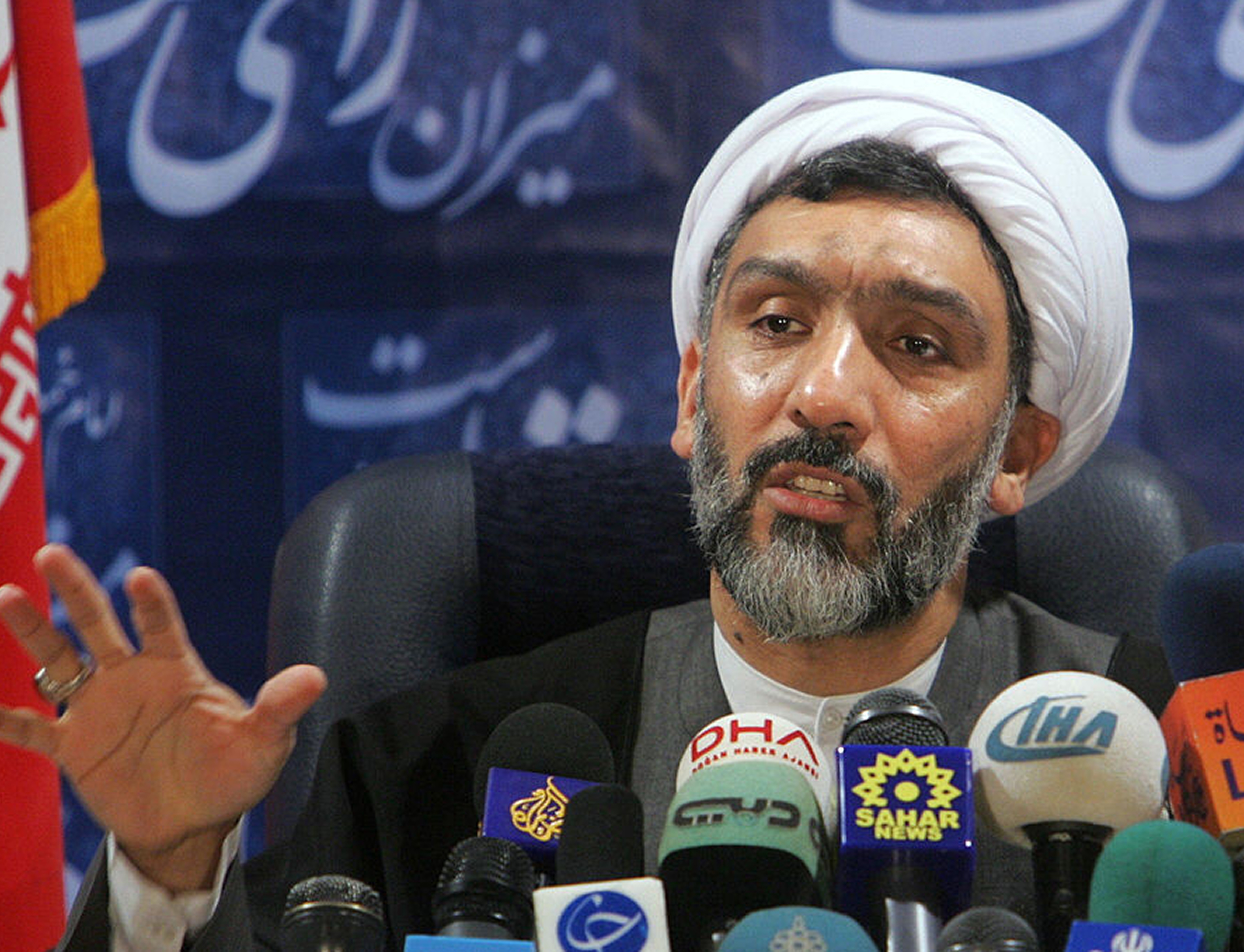
For more than four decades, Mostafa Pourmohammadi has occupied the darkest corridors of power in the Islamic Republic, his career trajectory marked not by administrative excellence or diplomatic skill, but by an unbroken record of orchestrating state violence on a scale that defies comprehension. Born in 1960 in Qom to a tailor who stitched clerical robes, Pourmohammadi transformed his family's modest connections into a license for mass killing that began when he was barely out of his teens and continues, in institutional form, to this day.
At twenty years old, Pourmohammadi was dispatched to Khuzestan province as a revolutionary prosecutor, the first appointment in what would become a forty-year chronicle of judicial murder, systematic torture, and transnational assassination. By twenty-two, he had sentenced more than three hundred prisoners to death in Bandar Abbas, including teenagers as young as sixteen. One documented case reveals the sadism that would characterize his tenure: after executing Mohammad Ezzat Shenas, a sixteen-year-old student, Pourmohammadi forced the boy's father, a prominent merchant, to publicly celebrate his son's death at Friday prayers, threatening to execute a second son still held in detention if he refused. In Hormozgan province alone, evidence indicates he issued execution orders for over 3,300 political prisoners, many of them minors, in judicial proceedings that lasted minutes and afforded no meaningful opportunity for defense.
The system was already in place. Revolutionary courts, established in the immediate aftermath of the 1979 revolution, operated under different rules than ordinary courts. Defendants had limited access to counsel. Trials were conducted in secret. Appeals were perfunctory. The judge, prosecutor, and jury could be the same individuals, or the roles could be collapsed entirely into a single official issuing judgment with little to no deliberation. Pourmohammadi, assigned to Khuzestan and then Hormozgan, became the principal instrument through which this system was operationalized in provincial Iran. His efficiency and zeal attracted notice. By 1981, he was transferred to Khorasan, in northeast Iran, where similar patterns of mass execution continued. By 1986, he had earned appointment to the Ministry of Intelligence, where his talents for systematic elimination would be refined and scaled.
What made Pourmohammadi useful to the regime was not intelligence or strategic vision but ruthlessness combined with a theological framework that rendered killing a sacred duty. His own later statements reveal the intellectual scaffolding that supported his actions. He did not view the execution of political prisoners as crimes but as a religious obligation and a wartime necessity. Prison, he argued, was not a place of rehabilitation or humane detention; it was a holding facility for enemies that could be emptied when the state deemed it necessary. Prisoners who refused to recant their political beliefs were not exercising conscience or principle; they were committing heresy against God and the Islamic state. That such prisoners should be executed was not a question; the only question was methodology and timing.
In the immediate post-revolutionary period, this ideology found widespread adoption among the clerical and military leadership. Ruhollah Khomeini, the revolutionary founder and first Supreme Leader, had established the conceptual framework: the Islamic Republic was in existential conflict with both external enemies (the United States, imperial powers) and internal enemies (nationalists, communists, Mojahedin). The revolution's survival required the elimination of these threats. By the early 1980s, as Iraq's invasion sparked an eight-year war and as the Mojahedin Organization escalated armed operations against the state, this logic took on the character of military doctrine. Pourmohammadi's job was to implement it, to translate the ideology into blood and bureaucracy.
He excelled at the task. His willingness to sentence the young, to execute those who had already served most of their sentences, to ignore procedural niceties, and to overcome any humanitarian qualms earned him promotions and trust from those above him. By the mid-1980s, he had become one of the most feared judicial officials in Iran, someone whose name struck terror into the families of the detained. But it was the summer of 1988 that would immortalize Pourmohammadi as an architect of one of the largest mass executions of the post-Cold War era.
On August 15, 1988, the Islamic Republic was in crisis. After eight years of brutal war with Iraq, the military had finally been defeated. The Mojahedin Organization had launched a series of operations inside Iranian territory, including an invasion of Azerbaijan province from Iraq. The revolution, which had promised to sweep away imperialism and create a just society, had instead created a military disaster and spawned a powerful armed opposition. Khomeini, now ninety-one years old and in failing health, faced the unpalatable choice of continuing a war Iran could not win or accepting a ceasefire that would be perceived as defeat.
On July 18, 1988, Khomeini made the decision. In a statement that conflated his acceptance of the ceasefire with drinking poison, he authorized an end to the war. But he also authorized something else. In a separate directive issued in early August 1988, Khomeini ordered the formation of a special commission to "re-examine the cases" of political prisoners, many of whom had been in detention since the early years of the revolution. The majority of these prisoners had already been tried, convicted, and sentenced to prison terms. They posed no active military threat; their "crime" was political opposition to the regime years or even a decade earlier. But Khomeini's fatwa made clear that those who remained "steadfast in their positions of hypocrite belief" should be executed.
The Death Commission, as it became known, consisted of four individuals: Hossein Ali Nayyeri, a judge; Morteza Eshraqi, a prosecutor; Ebrahim Raisi, a deputy prosecutor; and Mostafa Pourmohammadi, representing the Ministry of Intelligence. The physical layout of their operations was described by one prisoner who appeared before them: the four men sat behind a large table, with Nayyeri in the center, Raisi on one side, Eshraqi on the other, and Pourmohammadi to the left. The prisoner stood before them in what amounted to a mock trial.
The questions were formulaic and the purpose was predetermined. Interrogators would ask: Are you a Muslim? Do you believe in God? Will you pray? Will you renounce the Mojahedin or the leftist organization you belonged to? The responses, regardless of content, were filtered through a binary political calculus. Prisoners who expressed any ideological commitment to their former organizations, or who refused to adopt the regime's narrative, were marked for death. The entire proceeding, from interrogation to judgment to removal, took minutes.
The scale of the operation was staggering. In the span of approximately two months, between mid-July and late September 1988, an estimated five thousand to thirty thousand prisoners were executed. The actual number remains contested because the regime has refused to release records, but survivor testimony and family accounts suggest the higher estimates are credible. The killings occurred primarily at Gohardasht Prison near Karaj and at other detention facilities around Tehran. Bodies were disposed of in mass graves, sometimes dug by bulldozers. Some families were notified; many were not. Relatives who inquired about loved ones were told nothing, or given false information, or threatened with arrest.
The Death Commission was not an aberration or a spontaneous response to crisis; it was a deliberate state operation authorized at the highest level and conducted with bureaucratic precision. Decisions were documented. Execution orders were signed and filed. The organizational structure was clear: those who made the decisions, those who carried them out, and those who provided oversight. Pourmohammadi, as the Intelligence Ministry's representative, bore responsibility both for participating in the killings and for furnishing information that influenced decisions. According to witness testimony compiled by international human rights organizations, Pourmohammadi was instrumental in this process, personally interrogating prisoners and making recommendations regarding their fate.
What would eventually set this massacre apart from the regime's other killings was the intervention of Grand Ayatollah Hossein-Ali Montazeri. Montazeri, who had been designated by Khomeini as the successor to the position of Supreme Leader, was apparently not involved in the Death Commission's direct operations but received reports of the scale of the killings. In late August 1988, Montazeri summoned members of the Death Commission, including Pourmohammadi, to his residence. In that meeting, which was recorded, Montazeri delivered a moral denunciation of the massacre that, while it did not stop the killings, created a critical documentary record.
"History will condemn you as murderers," Montazeri told the commission. "The greatest crime that has been committed during the Islamic Republic, for which this nation will never forgive you, has been perpetrated by you." He continued, addressing the justifications the officials offered for their actions: "I have come to believe that you are a bunch of murderers. I cannot and will not accept responsibility for this. As an old man on the verge of death, I cannot and will not remain silent about this injustice. You are going to hell."
Pourmohammadi and the others defended themselves, arguing that they were following Khomeini's orders, that prisoners had been offered the opportunity to recant, and that those executed had posed a threat to the state. Montazeri was unmoved. He noted that the prisoners being killed had not been caught carrying arms; they were prisoners who had already served years in detention for their beliefs. The executions were extrajudicial killings of captives, fundamentally different from punishment of individuals apprehended while committing crimes or bearing weapons.
When Montazeri suggested that the officials at least feel shame before God and before the coming arrival of the twelfth imam (the messianic figure of Shia belief), Pourmohammadi responded coldly: "God is witness that we have tried to prevent excessive cruelty, but these are necessities of the time." The "necessities" Pourmohammadi invoked were not immediate threats but ideological ones: the danger that these prisoners represented to the Islamic Republic's monopoly on political authority.
The audio recording of this meeting vanished into the files of Montazeri's office. For twenty-eight years, it remained private. In 2016, following Montazeri's death, his family released the recording. The effect was immediate and profound. For the first time, the highest-ranking cleric to question the massacre's legitimacy could be heard, in his own voice, delivering a theological and moral condemnation. And the perpetrators, including Pourmohammadi, could be heard defending themselves with the same cold logic they had employed throughout: wartime necessity, obedience to authority, the threat posed by ideological enemies.
The 1988 massacre did not end with August and September killings. As documented by survivor accounts and family testimony, executions continued into the fall. But Montazeri's intervention had consequences. Within weeks of his remonstrations to the Death Commission, Khomeini removed Montazeri as his designated successor, a move that signaled to the regime's clerical and security establishments that concern about mass executions would not be tolerated. Montazeri was placed under house arrest, a status he would endure until his death in 2009. The message was clear: loyalty to the state required not merely participation in killings but willingness to defend them publicly and reject any moral objections from within the system.
Pourmohammadi received this message. Rather than being sidelined or disgraced by Montazeri's accusations, he was promoted. Throughout the remainder of 1988 and into 1989, as questions about the massacre began to circulate within Iran and internationally, Pourmohammadi remained employed by the Intelligence Ministry and ascended within its ranks. His willingness to defend the killings, his lack of remorse, and his ability to articulate a theological rationale for mass execution made him increasingly valuable to a regime desperate to consolidate control after the war's end.
By the late 1980s, the Islamic Republic had established a parallel security apparatus designed to conduct operations beyond Iran's borders. The Revolutionary Guards, originally militia units during the revolution, had evolved into a military force with significant autonomy and an extensive intelligence network. The Ministry of Intelligence, nominally subordinate to civilian authority, had developed its own foreign operations apparatus. And a shadowy network of operatives, some official employees and some contract agents, carried out assassinations, bombings, and other operations targeting Iranian exiles and hostile regimes across Europe, the Middle East, and beyond.
The scope of these operations was vast. Between 1979 and the late 1990s, human rights organizations and government investigators documented as many as 360 targeted assassinations and attempted assassinations carried out by Iranian agents. The targets were overwhelmingly exiled opposition figures: political leaders, intellectuals, journalists, business people, and military officers who had fled Iran and posed propaganda or operational threats to the regime. But the operations extended beyond political targets. In 1994, Iranian agents bombed the AMIA Jewish community center in Buenos Aires, killing eighty-five people in one of the deadliest terrorist attacks of the 1990s.
Mostafa Pourmohammadi, as deputy minister of intelligence and later as head of the ministry's foreign operations directorate, occupied a position of significant responsibility within this apparatus. The specific operations under his command are difficult to attribute with certainty, as Iranian intelligence deliberately obscures lines of authority and operational history. But documentary evidence, court proceedings in multiple countries, and testimony from defected agents point to his involvement in planning and authorizing a series of high-profile assassinations in the late 1980s and early 1990s.
The first major operation attributed to this period was the June 1989 assassination of Abdorrahman Ghassemlou in Vienna. Ghassemlou was the secretary-general of the Kurdistan Democratic Party of Iran, a nationalist organization based in Iraqi Kurdistan. He had been engaged in negotiations with Iranian officials, facilitated by Austrian mediators, regarding a potential ceasefire in Kurdistan. But on June 13, 1989, as Ghassemlou met with his colleagues in a Vienna apartment, three men entered and began shooting. Ghassemlou and two companions were killed. The operation appeared to be either a hit disguised as a robbery or a deliberate assassination carried out during negotiations, a tactic the regime would employ repeatedly to eliminate opponents while maintaining a veneer of diplomatic engagement.
In April 1991, Shapour Bakhtiar, Iran's last prime minister before the revolution, was assassinated in his Paris apartment. Bakhtiar had become an increasingly vocal opponent of the Islamic Republic and had developed ties with French intelligence. In his home, he was stabbed to death in an operation that bore the hallmarks of targeted assassination: carefully planned, executed with ruthlessness, and constructed to appear as a robbery or a crime of passion. The French investigation eventually identified Iranian agents as responsible, but the political decision to prosecute was not made until years later.
In June 1992, Fereydoun Farrokhzad, a celebrated singer, entertainer, and dissident voice, was found murdered in his Bonn apartment. Farrokhzad had been a beloved cultural figure in Iran before the revolution and had become prominent in exile circles as a symbol of the secular, cosmopolitan Iran that the Islamic Republic had suppressed. His murder, carried out by stabbing, was similarly attributed to Iranian intelligence operations. Like Bakhtiar, Farrokhzad posed little operational threat to the regime; his value to the opposition was symbolic and propagandistic. Yet the regime had decided his existence outside Iran was unacceptable.
The same year saw the Mykonos assassination in Berlin, in which Kurdish opposition figures were killed in a restaurant. A German investigation eventually concluded that Iranian intelligence was responsible, and in 1997, a Berlin court issued indictments against five Iranian officials, including Intelligence Minister Ali Fallahian. The indictment was significant because it explicitly found that the assassinations were not the work of rogue agents but were authorized at the highest levels of the Iranian government, as part of a state policy to eliminate opposition figures.
These operations continued through the 1990s, with assassinations carried out in Switzerland, Turkey, Pakistan, and elsewhere. The targets included Kurdish leaders, Mojahedin operatives, exiled academics and journalists, and political figures of various persuasions. The common thread was not any particular threat they posed operationally but their existence as voices of opposition, symbols of alternative political visions, and reminders to Iranians that dissent had not been entirely suppressed.
Pourmohammadi's specific role in authorizing or planning these operations remains partially obscured by the secrecy of intelligence operations. But his position as deputy minister during the period when many of these operations were planned, and his subsequent advancement within the intelligence hierarchy, suggests substantial responsibility. Former defectors and intelligence officials have indicated that major operations were conducted by a small circle of senior officials, with approval required from the deputy minister and, in some cases, the minister himself. The fact that Pourmohammadi was not only retained but promoted following the period of most intense assassination activity suggests he was viewed as reliable, efficient, and ideologically committed to the regime's security objectives.
What distinguished these extraterritorial operations from conventional terrorism was their scale, sophistication, and direct state sponsorship. Unlike operations by terrorist organizations, which often claim responsibility or seek to make statements through their attacks, Iranian operations were typically attributed to criminal networks, opportunistic robbers, or rival opposition groups. Iranian officials publicly denied involvement, framing the assassinations as regrettable tragedies. This created a situation in which the regime could simultaneously conduct systematic eliminations of opponents while maintaining diplomatic relations with the countries in which the operations occurred.
The European nations in which many of these operations took place were limited in their response options. Germany issued the arrest warrant for officials involved in Mykonos, but prosecution proved difficult. France had political and economic interests in maintaining relations with Iran. Austria similarly balanced its concerns about sovereignty with broader foreign policy considerations. No country was willing to make Iranian intelligence operations a defining element of bilateral relations or to impose costs severe enough to deter future operations.
While the regime was conducting assassinations across Europe, a parallel campaign of killings was unfolding within Iran itself. Beginning in the late 1980s and accelerating through the 1990s, a series of murders targeted Iranian intellectuals, writers, journalists, and political figures. These were not executions conducted through the formal judicial system, though that system remained in operation. They were assassinations, conducted by what appeared to be rogue elements but which investigation would later suggest were coordinated by elements within the intelligence apparatus.
The pattern began with the killings of lesser-known intellectuals and journalists. By the mid-1990s, prominent figures began to fall. The murder of Mohammad Mokhtari, a writer and the secretary of the Iranian Writers Association, in January 1998 shocked the intellectual community. Weeks later, Mohammad-Ja'far Pouyandeh, another prominent writer and intellectual, was killed. The deaths came at a moment when Mohammad Khatami had assumed the presidency in 1997, promising a more moderate and reformist approach than his predecessors. The murders appeared designed to demonstrate that even under a reformist president, dissent would be suppressed and voices of criticism would be eliminated.
The most shocking murders occurred in the winter of 1998. On November 21, Dariush Forouhar, a nationalist politician and intellectual who had been a deputy prime minister before the revolution, was stabbed to death in his Tehran home. Hours later, his wife, Parvaneh Forouhar, was also killed. The Forouhar murders were brazen: they took place in the family home, in the capital city, and targeted a figure who had been reasonably prominent and whose disappearance would not go unnoticed. The message appeared to be directed at the broader intellectual and political community: no figure was too prominent, no setting too visible, to prevent assassination if the regime deemed it necessary.
The murders generated enormous public outcry, even within Iran's controlled press. The intellectual community mobilized. Khatami's government, apparently embarrassed by the murders and facing pressure, launched an investigation. In January 1999, the Ministry of Intelligence issued an extraordinary statement: it admitted that its agents had committed murders and that responsibility lay with "rogue elements" within the ministry who had acted without authorization from senior leadership.
The ministry identified one individual as the mastermind: Saeed Emami, a deputy minister of intelligence with access to operational assets and the authority to deploy agents. According to the official narrative, Emami had decided to conduct these assassinations on his own initiative, without approval from the minister or higher authorities, motivated by what Emami allegedly believed was a need to prevent a "soft coup" by reformists who were allegedly infiltrating the state. Within weeks of this admission, authorities announced that Emami had committed suicide in prison, drinking hair removal cream in an apparently coordinated effort to leave no investigation to be conducted.
This narrative was, on its face, implausible. Senior intelligence officials do not conduct systematic assassinations without some form of authorization, particularly not in a state as centralized as the Islamic Republic. The existence of a "rogue element" capable of deploying assets, conducting surveillance, and executing high-profile murders without detection suggested either extraordinary incompetence on the part of senior leadership or a deliberate decision to provide cover for authorized operations. The apparent suicide of Emami, accomplished through a method requiring access to substances and a window of unobserved time in secure detention, strained credibility further.
Pourmohammadi was not charged with direct involvement in the chain murders. But his subsequent statements on the subject illuminate the question of responsibility. In interviews and public statements, Pourmohammadi has asserted that the chain murders were not the work of rogue operatives but represented "an organizational decision" and "part of the system." This admission, while not explicitly acknowledging his role, suggests that murders attributed to Emami were in fact part of a broader institutional operation.
The targets of the chain murders shared common characteristics. They were secular nationalists or leftists, not Islamists. They were intellectuals and cultural figures, not operational threats. They had been tolerated or minimally persecuted during periods when hardliners had absolute control but were targeted during a moment when a reformist president had assumed office. The pattern suggests that the murders were designed to constrain the reformist agenda by demonstrating to the intellectual community that even under a president promising liberalization, dissent would result in death.
The regime's response to the chain murders further illuminated the system's structure. Rather than pursuing a genuine investigation into the murders, the government accepted the scapegoating of Emami, Pourmohammadi's contemporary in the intelligence ministry who represented a slightly different political current. Rather than holding senior intelligence officials accountable, the ministry as an institution was allowed to admit "mistakes" while senior figures remained in place or were promoted. Rather than acknowledging that the murders reflected state policy, officials insisted they were aberrations.
This pattern of limited admission followed by impunity became standard. In 2005, an official report on the chain murders attributed them to Saeed Emami and a small number of associates, deliberately framing the killings as rogue operations not sanctioned by leadership. But the report's logic contained an obvious flaw: if Emami had been able to conduct systematic assassinations using intelligence ministry assets without authorization or detection, then the ministry's security and oversight systems had completely failed. If the systems had not failed, then Emami had acted with authorization or at minimum with knowledge of superiors. The regime chose to accept the first explanation rather than the second, an admission of institutional incompetence being preferable to an admission of state criminality.
For victims' families, for survivors of the violence, and for the intellectual community that had been targeted, the chain murders represented something more significant than a scandal to be managed. They represented the regime's determination to suppress dissent by any means, and its willingness to sacrifice minor functionaries to maintain the fiction that assassinations were not official policy. For Pourmohammadi and others within the intelligence apparatus, the chain murders represented a successful operation: the targeted figures had been eliminated, the opposition had been demoralized, and no significant consequences had followed.
The trajectory of Pourmohammadi's career following the 1988 massacre and the chain murders illustrates the mechanism of impunity that sustains the Islamic Republic's system of repression. At each point where accountability might have been pursued, institutional protection intervened. When the 1988 massacres became a matter of international concern, Pourmohammadi was promoted. When the chain murders generated domestic outrage, he was reassigned but remained employed. When he was eventually appointed to high-profile cabinet positions that drew human rights condemnation, these positions came with the backing of the Supreme Leader and significant factions of the regime's clerical and security establishments.
Understanding this mechanism requires understanding the Islamic Republic's political structure. The system is formally a theocracy, with a Supreme Leader whose authority is derived from divine delegation and whose power is theoretically absolute. All other centers of authority, from the president to the parliament to the military, derive their legitimacy from the Supreme Leader and operate within boundaries he sets. The judiciary is directly controlled by the Supreme Leader, as is the intelligence and security apparatus. Real power is concentrated in the Supreme Leader's office, with the Guardian Council serving as a vetting mechanism to ensure that elected officials maintain loyalty to the system and the Supreme Leader.
This centralized structure of authority means that impunity is not an accident of failed prosecution but a deliberate choice made by the system's apex. When Ruhollah Khomeini authorized the 1988 massacre, he was not merely suggesting an action that subordinates might take; he was issuing an order that would be obeyed. When the Death Commission members carried out the executions, they were not acting in contravention of their superiors' wishes; they were following orders. When Khomeini subsequently removed Montazeri as his successor in apparent response to Montazeri's moral objections to the killings, the message was unmistakable: loyalty to the state meant accepting the logic of mass execution.
The regime's subsequent protection of Pourmohammadi follows the same logic. He was promoted not despite his record as an executioner but because of it. His demonstrated willingness to kill on command, his ability to overcome any humanitarian qualms, and his capacity to articulate a theological justification for mass murder made him precisely the sort of official the system required. As the regime sought to consolidate power after the revolutionary period and as it faced ongoing challenges to its authority from internal and external opponents, it needed operatives who had proven their mettle through acts of extreme violence.
The role of the Supreme Leader is central to this structure. Ali Khamenei, who assumed the position of Supreme Leader in 1989 and has held it ever since, has exercised his authority to protect officials implicated in atrocities. When doubts arose about the 1988 massacre's justification, Khamenei insisted it had been necessary to preserve the revolution. When the chain murders generated questions, Khamenei backed the intelligence ministry and accepted the scapegoating of Emami. When European courts issued arrest warrants for Iranian officials involved in assassinations, Khamenei ensured those officials remained in power.
The Guardian Council, nominally an independent institution designed to interpret the constitution and vet candidates for elected office, functions as an instrument of the Supreme Leader's will. In 2013, when Hassan Rouhani nominated Pourmohammadi as minister of justice, the Guardian Council initially raised objections, reflecting concern about international reaction and domestic opposition. But after Khamenei signaled his support for the appointment, the council approved Pourmohammadi. In 2024, when Pourmohammadi was nominated to run for president following Ebrahim Raisi's death, the Guardian Council initially disqualified him, then reversed that decision following intervention by Khamenei. The council's ostensible independence, enshrined in the constitution, was revealed as procedural theater.
This arrangement creates a situation in which accountability is structurally impossible. The mechanisms that would ordinarily check executive power and hold officials responsible for abuses are controlled by the same individuals who authorize the abuses. The judiciary cannot prosecute those with Supreme Leader protection because the judiciary answers to the Supreme Leader. The parliament cannot impose consequences because it lacks the constitutional authority to do so, and even if it had such authority, reformist members are outnumbered by conservatives aligned with the security apparatus. Civil society, independent media, and independent courts are virtually nonexistent.
International pressure, which might provide an external check on impunity, has proven ineffective. Germany issued an arrest warrant for Ali Fallahian, the intelligence minister under whom many of the assassinations occurred, but Fallahian has remained in Iran and under Khamenei's protection. Argentina sought an Interpol red notice for officials allegedly involved in the 1994 AMIA bombing, but these officials similarly remain beyond extradition's reach. The United States has imposed targeted sanctions on officials involved in human rights violations, but these sanctions have not altered the regime's behavior and are viewed by the regime as external pressure to be resisted rather than evidence for which change is necessary.
This imperviousness to international pressure is enabled by a strategic choice on the part of Western governments to treat Iran as a potential partner despite its human rights record. The 2015 nuclear agreement, negotiated between Iran and six world powers (the United States, United Kingdom, France, Russia, China, and Germany), provided sanctions relief to Iran in exchange for constraints on its nuclear program. The agreement was negotiated without conditioning the lifting of sanctions on improvements in Iran's domestic human rights practices. The result was that Iran obtained the economic benefits of sanctions relief while continuing unabated its executions, imprisonments, and systematic repression.
This dynamic played out directly in Pourmohammadi's career. When he was appointed justice minister in 2013 under Rouhani, a president who was pursuing the diplomatic negotiations that would culminate in the nuclear agreement, the international community protested but took no concrete action beyond statements. Western governments conducted trade negotiations with Iran, signed deals, and pursued relations with a state whose senior justice official was implicated in mass atrocities. The implicit message to the Iranian regime was that Western concerns about human rights were subordinate to geopolitical and economic interests.
For Pourmohammadi personally, the result was that his career remained uninterrupted. He held the position of justice minister for four years, a position that gave him direct control over the judiciary and significant authority over law enforcement and prison administration. During his tenure, executions in Iran averaged over 500 per year, among the highest rates globally. In 2013 alone, there were over 600 executions, a rate that would spike in subsequent years. That Pourmohammadi was appointed to oversee this system while the international community continued normal relations with Iran reflects a calculated decision to subordinate human rights concerns to other policy goals.
By 2024, when Pourmohammadi was cleared to run for president, the architecture of impunity had become so normalized that his candidacy provoked international concern but little practical response. The Guardian Council's initial disqualification, which would normally be final, was reversed by Khamenei's intervention, a move that was remarkable for its brazenness. A Supreme Leader dictating the reversal of a vetting decision revealed the fiction of Guardian Council independence and made explicit what had previously been left implicit: that the system's leadership would not tolerate any constraint on whom it deemed qualified to hold office.
What Mostafa Pourmohammadi represents is not an individual anomaly within the Islamic Republic but a crystallization of the system's core logic. He did not invent the mechanisms of repression; he inherited them from the revolutionary period and operationalized them across four decades of service. He did not create the doctrine of absolute leadership under which loyalty is demonstrated through willingness to kill; he adopted and internalized it. And he was not protected from consequences by an accident or oversight; he was deliberately sheltered by a system that views officials capable of extreme violence as assets to be preserved.
The implications of this understanding extend beyond Iran. The Islamic Republic's ability to commit crimes against humanity with complete impunity, and to advance perpetrators to higher office, demonstrates a fundamental failure of international accountability mechanisms. If an individual can be credibly documented as responsible for the deaths of thousands, can defend those killings in public statements, can supervise subsequent assassinations and repression, and can ascend to the position of presidential candidate without facing prosecution, then universal jurisdiction has failed. If major powers can negotiate agreements with a state whose senior officials bear responsibility for crimes against humanity without conditioning those agreements on accountability, then the principles of international humanitarian law have been subordinated to realpolitik.
The 2025 release of additional audio recordings of the Death Commission's operations, by Montazeri's family and subsequently by investigative journalists, provided further documentation of Pourmohammadi's direct involvement in the 1988 massacre. In one recording, Pourmohammadi can be heard questioning prisoners and making recommendations regarding their execution. His tone is calm and bureaucratic, as if conducting routine administrative tasks. The dispassion is perhaps more chilling than overt sadism would be; it demonstrates how completely the killing has been normalized, how thoroughly ideology has overwritten conscience.
Yet these revelations have not altered Pourmohammadi's position within the state or derailed his political ambitions. The Islamic Republic's narrative regarding the 1988 massacre has evolved slightly to acknowledge that the events occurred, but the regime continues to justify them as necessary to preserve the revolution. Pourmohammadi's role is similarly rationalized: he was following orders, carrying out the will of the Supreme Leader, doing what any loyal official would have done under the circumstances. The same logic is applied to the chain murders, the assassinations abroad, and the ongoing systematic repression.
Within Iran, the systematic elimination of opposition continues. In 2024, Iran executed more than 850 people, the highest number in years and a marked increase from previous years. Among those executed were political prisoners, activists convicted of crimes such as attending protests or criticizing the government on social media, and minors. The executions continue despite increasing international documentation of systematic torture, forced confessions, and the use of capital punishment as a tool of political repression. The mechanisms that Pourmohammadi helped establish and refine over decades operate with undiminished efficiency under new leadership, suggesting that the system has become institutional and self-perpetuating.
What remains to be seen is whether the accumulation of evidence and the persistence of documentation by human rights organizations and survivor networks will eventually produce consequences. The UN Human Rights Council's establishment of a fact-finding mission on Iran in 2022, and the mission's 2025 report calling for accountability mechanisms, represents a step toward systematic documentation. But the pathway from documentation to prosecution remains elusive. The International Criminal Court lacks jurisdiction over non-state parties to its statute, and Iran is not a member. Universal jurisdiction, which could theoretically allow states to prosecute foreign individuals for genocide, crimes against humanity, and war crimes, has been unevenly applied and faces legal and political obstacles.
Pourmohammadi's continued prominence, despite the documentation of his role in mass atrocities, thus serves as both a symptom and a symbol. It reflects a system in which loyalty to the state is more important than accountability for crimes. It demonstrates that the Islamic Republic has calculated that the international community will accept rhetorical condemnation and symbolic gestures rather than impose consequences severe enough to alter behavior. And it suggests that until the structures enabling impunity are directly challenged, from within Iran or from the international community, the perpetrators will remain not merely unpunished but rewarded.
The families of the 1988 massacre's victims, the survivors of torture in Evin and Gohardasht prisons, the journalists imprisoned for reporting truth, and the activists killed in the streets have waited thirty-seven years for acknowledgment and justice. Each year that passes without accountability is an additional failure of the international community and an additional message to perpetrators that atrocities can be committed with impunity. Mostafa Pourmohammadi's career, from provincial executioner to justice minister to presidential candidate, is the fullest expression of that failure.