The Final Hours
On the evening of January 8, 2017, Akbar Hashemi Rafsanjani, 82, entered the swimming pool at the Saadabad complex in northern Tehran, a facility reserved for senior officials of the Expediency Discernment Council he chaired. The former president, who had spent the afternoon in meetings at the council headquarters, chose to swim alone. Security cameras were switched off at his request, according to official accounts. His medical team, which normally accompanied him everywhere in a dedicated ambulance, was absent that day despite standard protocol.
At approximately 6:20 PM, bodyguards discovered Rafsanjani unconscious in the water. They pulled him from the pool and attempted resuscitation. He was rushed to Tajrish Hospital in north Tehran, where doctors worked for more than an hour to revive him. At 7:30 PM, he was pronounced dead. The official cause: cardiac arrest.
Within hours, state television interrupted regular programming to announce the death of one of the Islamic Republic's founding fathers. But the swift announcement concealed a mounting mystery that would fracture Iran's political elite and expose the lethal consequences of dissent at the highest levels of the theocratic system.
What followed was not an investigation, but a cover-up. Rafsanjani's body was never sent for autopsy despite family requests. No forensic examination was conducted. The death certificate, issued at the hospital rather than by legal authorities, cited only "cardiac arrest," a term forensic experts note is medically meaningless as a cause of death. Within days, he was buried beside Ayatollah Ruhollah Khomeini, the revolution's founder, in a state funeral attended by millions.
But photographs of the body, leaked by family members, told a different story. They showed a broken nose, severe bruising across the forehead and around the eyes, and a blood-soaked towel wrapped around his head. For a man who allegedly drowned peacefully from heart failure, the injuries suggested violence. More disturbing still was a detail that would emerge later: the towel was contaminated with radioactive material. Tests on Rafsanjani's body revealed radiation levels ten times higher than normal.
The Speech That Came Before
The timing of Rafsanjani's death cannot be separated from an event that occurred just hours earlier. On the morning of January 8, Supreme Leader Ali Khamenei delivered a speech in the holy city of Qom to a gathering of Basij militia members and residents. His words, broadcast on state television, contained a thinly veiled attack that those familiar with the internal politics of the Islamic Republic immediately recognized as directed at Rafsanjani.
"We cannot blame everything on outsiders," Khamenei declared. "If we act badly, if we do not act on time, if we are lazy, if we mistake the enemy, if our greater Satan turns out to be a reprobate and misguided brother instead of the real greater Satan, we will be struck."
The phrase "reprobate brother" who represents the "greater Satan" was unmistakable. For decades, the Islamic Republic had branded the United States as the "Great Satan" and Israel as the "Little Satan." Now, Khamenei was suggesting that an internal enemy, a supposed brother within the revolution, posed an even more dangerous threat. The message was clear to insiders: Rafsanjani, who had openly advocated for rapprochement with the West and criticized Khamenei's leadership in leaked videos, had become that internal Satan. That same evening, the "reprobate brother" was found dead in a swimming pool.
A Friendship That Built and Broke a Republic
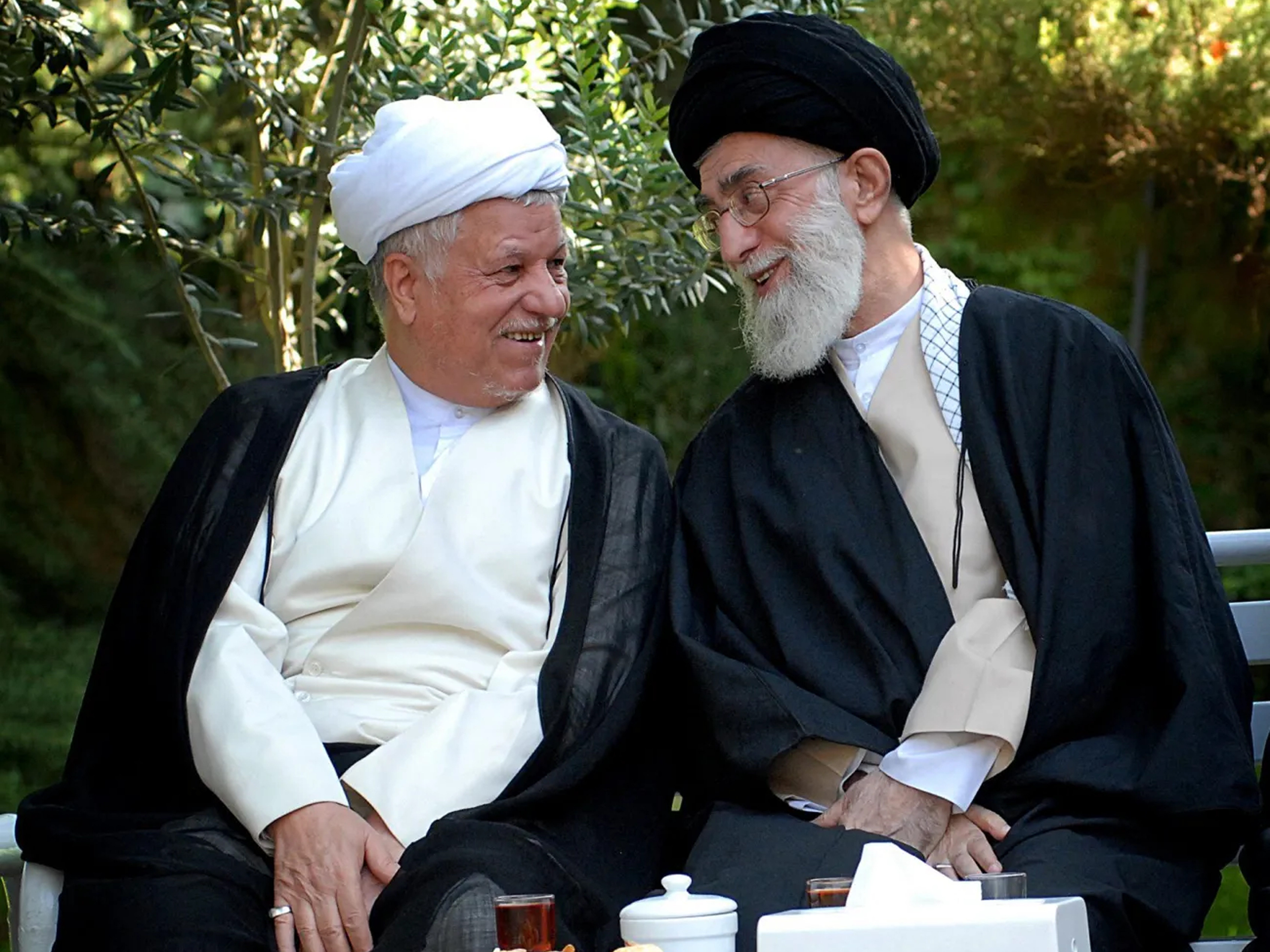
To understand how two men who had been friends for more than fifty years came to this point requires tracing the arc of the Islamic Republic itself. Rafsanjani and Khamenei met as young seminary students in Qom in the 1950s. Both became disciples of Ayatollah Khomeini and joined his movement against Shah Mohammad Reza Pahlavi. They were imprisoned together during the 1960s and 1970s. When the revolution succeeded in 1979, they stood side by side as founders of the new theocratic order.
Rafsanjani was the more powerful of the two. While Khamenei served as president from 1981 to 1989, real authority resided with Speaker of Parliament Rafsanjani, who controlled the purse strings, directed military strategy during the Iran-Iraq War, and acted as Khomeini's chief political operator. Iranians called Rafsanjani "the Shark" for his political cunning and his smooth, nearly beardless face, unusual among the clerical establishment.
When Khomeini died in June 1989, the succession crisis that followed revealed Rafsanjani's miscalculation. The constitution required that the next Supreme Leader be a "source of emulation," a senior religious authority. Khamenei, a mid-ranking cleric, did not qualify. Rafsanjani orchestrated a solution: he convinced the Assembly of Experts to elect Khamenei anyway, arguing that political acumen mattered more than religious credentials. The constitution was amended retroactively to accommodate the choice.
Rafsanjani believed he had installed a figurehead. As president, which he became immediately after engineering Khamenei's elevation, Rafsanjani thought he would continue to wield real power while Khamenei provided religious legitimacy. "Rafsanjani was not Khamenei's president," scholar Mehdi Khalaji later observed. "Khamenei was Rafsanjani's supreme leader."
But Khamenei refused to play the role assigned to him. Quietly and systematically, he began building parallel power structures. He cultivated the Revolutionary Guards, expanded the intelligence services, and took control of state media. He established an office that would eventually employ thousands and manage an economic empire worth an estimated $95 billion. By the time Rafsanjani's presidency ended in 1997, the balance of power had shifted irrevocably.
Rafsanjani had made two fatal errors. First, he allowed the Revolutionary Guards, at Khamenei's request, to enter the economy as contractors and managers, transforming them into a wealthy military-industrial complex loyal to the Supreme Leader. Second, he ceded control of the intelligence apparatus. Khamenei used both to consolidate power, sideline rivals, and eliminate threats.
The Crimes They Shared
Both men bore responsibility for some of the Islamic Republic's darkest chapters. In the summer of 1988, as the Iran-Iraq War drew to a close, Khomeini issued a secret fatwa ordering the massacre of political prisoners, particularly members of the Mujahedin-e-Khalq opposition group. Death commissions were established in prisons across the country. Prisoners were asked a few questions about their beliefs. Those who failed to renounce their politics were hanged, often within hours.
Estimates suggest between 4,000 and 5,000 prisoners were executed over several months. The exact number remains unknown; families were not informed, and many bodies were buried in unmarked mass graves. Rafsanjani and Khamenei, as speaker of parliament and president respectively, were part of the hierarchy that implemented Khomeini's orders. They ensured compliance and suppressed dissent.
Ayatollah Hossein-Ali Montazeri, Khomeini's designated successor, opposed the massacres. In an audio recording leaked decades later, Montazeri told members of the death commission: "The greatest crime in the history of the Islamic Republic, for which history will condemn us, has been committed by you." Khomeini stripped Montazeri of his position as heir apparent. Rafsanjani and Khamenei remained silent.
Four years later, on September 17, 1992, assassins burst into the Mykonos restaurant in Berlin and murdered four leaders of Iranian Kurdish opposition groups. After a four-year trial, a German court found that the assassinations had been ordered at the highest levels of the Iranian government. The judge named three men as responsible: Supreme Leader Khamenei, President Rafsanjani, and Foreign Minister Ali Akbar Velayati. The verdict established that Iran operated a systematic program of transnational assassinations targeting dissidents abroad.
Rafsanjani never faced justice for these crimes. But unlike Montazeri, who spent his final years in open opposition to the regime and published damaging memoirs, Rafsanjani chose a different path. He remained within the system, never publishing the most explosive entries from his detailed diaries, never fully breaking with Khamenei. This loyalty to the institution, even as he criticized its direction, would define the rest of his career.
The Reconstruction President and the Accumulation of Wealth
Rafsanjani's presidency from 1989 to 1997, known as the Reconstruction Period, focused on rebuilding Iran after eight years of devastating war with Iraq. He pursued economic liberalization, privatization of state industries, and rapprochement with the West. He expanded the Islamic Azad University system, which now educates more than half of Iran's college students. Infrastructure improved, literacy rates climbed, and the country gradually reconnected with the global economy.
But reconstruction also meant opportunity for those with political connections. The Rafsanjani family amassed enormous wealth during this period. They acquired Iran's largest copper mine and came to dominate the pistachio export industry. Rafsanjani was born in Rafsanjan, a city in Kerman province famous for pistachio cultivation, and his family's agricultural holdings expanded dramatically. They established an oil engineering firm and invested in automobile manufacturing. Relatives were appointed to key positions: provincial governorships, oil ministry posts, and leadership of state television.
The most controversial allegations centered on Rafsanjani's son Mehdi, who acted as a fixer for foreign companies seeking contracts in Iran. Norwegian oil giant Statoil paid $15 million to a consulting firm linked to Mehdi for access to Iran's natural gas fields. French oil company Total allegedly paid $78.6 million. In 2015, Mehdi was sentenced to 15 years in prison on corruption charges, though the sentence was later reduced and he was released in 2023.
Critics pointed to the hypocrisy of a revolutionary elite that had overthrown the Shah in the name of justice for the downtrodden, only to become a new class of oligarchs. But Rafsanjani was hardly alone. Khamenei's own sons accumulated vast fortunes. Massoud Khamenei reportedly controlled over $500 million in banks in France, England, and Tehran, and held monopoly rights to sell French Renault cars in Iran. Hassan Khamenei, the Supreme Leader's nephew, was the exclusive agent for Sony in Iran, earning an estimated $42 million annually.
When Rafsanjani began publicly discussing the wealth of Khamenei's family, the Supreme Leader retaliated by targeting Rafsanjani's children. The battle was no longer just political; it was personal.
The Presidency That Never Was
The 2005 presidential election marked the beginning of Rafsanjani's decline. Running for a third term, he won the first round but faced a runoff against Mahmoud Ahmadinejad, a populist hardliner backed by the Revolutionary Guards. Despite Rafsanjani's resources and name recognition, Ahmadinejad won by more than seven million votes.
Rafsanjani and other centrist politicians alleged massive fraud. They accused the Revolutionary Guards and intelligence services of systematically rigging the vote. But Khamenei endorsed the result, and Ahmadinejad became president. For the next eight years, Ahmadinejad and his allies waged a campaign against Rafsanjani, attacking his record, his family, and his wealth. The former president was stripped of his position as Tehran's Friday prayer leader, a crucial platform for shaping public opinion.
The breaking point came in 2009. Rafsanjani supported Mir Hossein Mousavi, a reformist candidate challenging Ahmadinejad's reelection. When officials declared Ahmadinejad the winner in what was widely seen as a fraudulent election, millions took to the streets in the largest protests since the revolution. The Green Movement was born.
On July 17, 2009, Rafsanjani delivered a sermon at Friday prayers that electrified the reform movement. Speaking to a crowd that overflowed Tehran University, he called for transparency, the release of political prisoners, and an investigation into electoral fraud. "If we have doubt, and for building trust this doubt must be removed," he said. "The people's trust must be restored."
Khamenei's response was swift. Four days later, in his own Friday sermon, the Supreme Leader declared that his views were "closer" to Ahmadinejad's than to Rafsanjani's on foreign policy, social justice, and cultural matters. It was a public humiliation. Rafsanjani would never deliver Friday prayers in Tehran again.
The final insult came at the inauguration ceremony for Ahmadinejad's second term. Traditionally, the head of the Expediency Council presents the Supreme Leader with the signed decree to give to the incoming president. Khamenei privately asked Rafsanjani to perform this duty. Rafsanjani refused. "I do not accept his election," he told Khamenei. "I do not consider him president." In the end, a low-level aide from Khamenei's office carried the decree. It was an unprecedented breach of protocol and a public declaration of the rupture between the two men.
Disqualification and the End Game
In 2013, Rafsanjani announced his candidacy for president at the last possible moment, hoping to avoid sabotage. He was 78 years old but still commanded a loyal base among centrists and reformists. His candidacy offered hope to millions who had watched the Green Movement crushed and its leaders, Mousavi and Mehdi Karroubi, placed under house arrest.
The Guardian Council, which vets all candidates, disqualified him. No official explanation was provided, though the council's spokesman suggested he was too old to handle the demands of the presidency. Years later, Heydar Moslehi, who had served as intelligence minister under Ahmadinejad, publicly admitted that he had engineered Rafsanjani's disqualification. The revelation confirmed what reformists had long suspected: the security services controlled the electoral process.
But Rafsanjani refused to quit. He threw his support behind Hassan Rouhani, a centrist cleric and longtime ally who had served as chief nuclear negotiator. Rouhani campaigned on a platform of moderation and rapprochement with the West. He won decisively, defeating hardline candidates. Rafsanjani had once again played kingmaker.
Rouhani's presidency, and the nuclear agreement with world powers that followed in 2015, represented Rafsanjani's vision vindicated. For decades, Rafsanjani had argued that Iran's isolation was unsustainable and that engagement with the West served the country's interests. Now, sanctions were being lifted, and Iran was rejoining the international community.
But hardliners, with Khamenei's tacit support, sabotaged Rouhani at every turn. The Revolutionary Guards undermined the nuclear deal. Security forces arrested dual nationals and imprisoned reformist activists. The promised opening never fully materialized. And Rafsanjani, now in his eighties, grew increasingly bold in his criticism.
The Videos That Sealed His Fate
In late 2016, a series of videos began circulating showing Rafsanjani making extraordinarily frank criticisms of Khamenei. The clips, filmed at private gatherings, represented a level of public dissent from a senior official that was almost unheard of in the Islamic Republic.
In one video, Rafsanjani described telling Khamenei that both men would have to answer to God on Judgment Day for their decisions regarding relations with the United States. Rafsanjani recounted: "I said, 'In the end, on the Day of Resurrection, God will ask both of us about this.' He said, 'I will give God's answer.'" The implication was clear: Khamenei had assumed a divine authority that Rafsanjani considered illegitimate.
In another video, recorded at an unknown date but released shortly before his death, Rafsanjani launched an even more direct attack. Speaking to a small audience, he accused Khamenei of being dangerously uninformed about the country's dire economic and social situation. "I am very sorry and upset that the country's work has reached this point," he said. "I think the Leader and many of these friends do not have sufficient information from within these sectors. They have limited the flow of information. They have made it difficult. They have created such a security atmosphere that if, for example, the gentleman who spoke two months ago... after the meeting he would have to go to the Intelligence Ministry to explain, they would interrogate him, they would hand him over."
He continued with a devastating critique of the surveillance state Khamenei had constructed: "This kind of security atmosphere that has been created in the country, this atmosphere of insecurity, makes people afraid. This is the worst thing. They say this is security, but this is graveyard security. In a graveyard there is no problem, but for a living and vibrant society, security means that everyone can choose their own path, say their own words. These are rights that Islam and the constitution have established for us."
The speech was an open challenge to Khamenei's authority. And it came from a man who had helped create the system and knew its darkest secrets.
The Final Warning Signs
Rafsanjani was aware of the danger. In 2014, he told journalist Masih Mohajeri of a plot to kill him, though he provided no details. His family later reported multiple suspicious incidents. In 2012 or 2013, an intruder entered the Expediency Council building at night, reached the secretaries' offices, and set a fire. Despite extensive security systems, the person was never identified or apprehended. One camera captured footage of the intruder, but authorities from the Intelligence Ministry refused to provide information about the investigation, despite orders to do so.
Rafsanjani's son Mohsen later revealed that before his father's death, there had been attempts to replace his bodyguards. The family resisted, but on the day of his death, Rafsanjani swam without his usual medical team present. The health minister at the time claimed this was at Rafsanjani's request. The family disputed this, noting that the medical team had always accompanied him as standard protocol.
In the days before January 8, Rafsanjani appeared to be in good health. His memoirs, meticulously kept for decades, show no indication of illness. His wife's diary entry for that morning noted that he ate breakfast normally and left for his meetings in good spirits. He spent the afternoon at the Expediency Council, where colleagues described him as engaged and energetic.
Then came Khamenei's speech. And then came the swimming pool.
A Death Without Answers
The official investigation, led by Ali Shamkhani, secretary of the Supreme National Security Council, concluded within weeks that Rafsanjani's death was "completely natural, without any ambiguity." President Rouhani rejected the report and ordered a reinvestigation, but no new findings were made public. Family members were denied access to CCTV footage from both the swimming pool and Rafsanjani's office, despite repeated requests. They were told the cameras had been turned off.
The forensic evidence, such as it was, raised more questions than it answered. Dr. Maziar Ashrafian, a forensic medicine expert, noted in published analysis that cardiac arrest is not a medical cause of death but rather a description of what happens when the heart stops. The actual cause could be anything from electrocution to poisoning to drowning to heart disease. Without an autopsy, determining the cause is impossible.
Ashrafian also noted that the injuries visible in photographs of the body, particularly the severe bruising and broken nose, were inconsistent with a simple case of drowning or heart attack. The injuries suggested either a struggle or, possibly, aggressive resuscitation attempts. But the presence of water in the lungs typically indicates drowning. According to Rafsanjani's son Mohsen, doctors told the family there was no water in the lungs, meaning he did not drown.
The radioactive contamination remains unexplained. Rafsanjani's daughter Fatemeh revealed in 2018 that tests showed radiation levels ten times higher than normal in her father's body and that the towel wrapped around his head was contaminated with radioactive material. Iranian authorities never addressed these findings publicly.
Journalists and activists outside Iran assembled their own theories. Rouhollah Zam, an opposition journalist based in France, claimed that Rafsanjani had been "choked underwater" by an assassination team. Reza Malek, a source close to the family, provided a detailed account: a trained diver equipped with breathing apparatus entered the pool while Rafsanjani was swimming, grabbed his legs, and held him underwater until he stopped struggling. The operative then exited through a pre-arranged route, slipping on the pool deck and injuring his teeth in his haste. According to this account, the area was searched only by security personnel loyal to the plotters, ensuring evidence was removed before any independent investigation could begin.
These remain unverified allegations. But they gain credibility from the pattern of suspicious deaths that has characterized the Islamic Republic's history. Opponents have been poisoned, pushed from windows, shot in apparent robberies, and killed in staged traffic accidents. The German court verdict in the Mykonos case established that assassination was official policy, ordered from the top. Rafsanjani himself had been part of that system.
The Message in the Funeral
Rafsanjani was buried on January 10, 2017, in a funeral attended by an estimated two million people. The massive turnout reflected not universal love for the man but desperation among Iran's beleaguered reformists and moderates. Rafsanjani, for all his flaws, had represented the possibility of change within the system. His death closed that door.
The funeral became a site of political struggle. Reformist leaders Mousavi and Karroubi, still under house arrest, were barred from attending. Former President Mohammad Khatami, who had been banned from appearing in media for years, was permitted to attend but his presence was not shown on state television. When his image appeared in crowd shots, broadcasters blurred his face.
Khamenei delivered a eulogy that managed to be both conciliatory and condescending. He praised Rafsanjani as a "companion of struggle" and acknowledged their decades of friendship, but he emphasized their "differences of opinion" on major issues. The message was clear: Rafsanjani had been wrong, and Khamenei had been vindicated.
Rafsanjani's daughter Faezeh gave a powerful graveside speech in which she barely concealed her belief that her father had been murdered. "They did not even let us see the security cameras," she said. "This shows that there is something they do not want us to see." Her voice broke. "Father, your blood was not shed in vain."
Five years later, in 2022, Khamenei's office released a video of a private meeting between the two men in which they had argued about relations with the United States. It was an extraordinary breach of protocol—publishing footage of a confidential discussion with a man who had been dead for five years. The video showed Khamenei dismissive and imperious, Rafsanjani attempting to argue his case but ultimately deferring to the Supreme Leader's authority.
Faezeh responded furiously. She accused Khamenei of "ungentlemanly" conduct born of "fear and lack of self-confidence." She noted that her father had been dead for five years and could not defend himself. "Perhaps the goal is to reach power and more dictatorship," she wrote on social media. "But this betrayal can have another reason: lack of self-confidence. That is, despite having complete power, they themselves do not believe in themselves."
The comment struck at the heart of the matter. Khamenei had won. He had outlasted and outlived his rivals. He controlled every lever of power in Iran. Yet he still felt threatened enough by a dead man to try to humiliate him posthumously.
What Was Buried With the Shark
Rafsanjani's death marked the end of an era in Iranian politics. He was the last surviving member of the original revolutionary generation with both the legitimacy and the will to challenge Khamenei's authority. His removal left Rouhani isolated and weakened. When Rouhani's term ended in 2021, he was replaced by Ebrahim Raisi, a hardline cleric who had served on the death commission during the 1988 prison massacres. Raisi's elevation was widely seen as a clear signal: there would be no more accommodation with reformists, no more tolerance for dissent.
The consequences have been profound. The Islamic Republic has grown increasingly repressive, paranoid, and isolated. Economic mismanagement and corruption have devastated living standards. In 2022, the death of Mahsa Amini in police custody sparked the largest protests since the revolution, with demonstrators openly calling for the overthrow of the Islamic Republic. The regime responded with mass arrests, torture, and executions.
What died with Rafsanjani was not just a man but a possibility: the hope that the system could reform itself from within, that pragmatic figures could steer Iran toward moderation and openness. Rafsanjani had believed, or claimed to believe, that the Islamic Republic could evolve, that it could balance religious authority with popular sovereignty, that it could engage with the world without abandoning its identity.
Whether that belief was genuine idealism or cynical calculation is impossible to say. Rafsanjani was, after all, the Shark—a man who had survived and thrived for nearly four decades in one of the world's most ruthless political systems. He had blood on his hands: the blood of executed prisoners, of assassinated dissidents, of protesters shot in the streets. He had enriched himself and his family at the public expense. He had enabled the very authoritarianism he eventually opposed.
Yet in his final years, he chose to speak. He challenged Khamenei openly, knowing the risks. He supported the Green Movement. He championed the nuclear deal. He called for political prisoners to be freed and for the government to respect its own constitution. Whether from conviction or calculation, he placed himself in opposition to the direction Khamenei was taking the country.
And then, hours after Khamenei warned of the danger posed by a "reprobate brother" who was the real "greater Satan," Rafsanjani was found dead in a swimming pool.
The Impunity That Persists
No one has been held accountable for Rafsanjani's death, just as no one has been held accountable for the 1988 massacres, the Mykonos assassinations, or countless other crimes committed by the Islamic Republic. The culture of impunity that Rafsanjani helped create ultimately consumed him. The system he built to suppress others turned on him when he became inconvenient.
His family continues to face harassment. His children are periodically arrested on dubious charges, subjected to travel bans, and prevented from speaking publicly. His grandson has been imprisoned. The persecution serves a dual purpose: it punishes the family for their patriarch's late-life apostasy, and it sends a message to anyone else who might consider following his example.
In this, Rafsanjani's death reveals the essential truth about authoritarian systems: they tolerate no rivals, forgive no disloyalty, and recognize no limits. It does not matter if you helped found the regime, if you were once the Supreme Leader's closest friend, if you have given your entire life to the revolution. The moment you become a threat, you become disposable.
The swimming pool in the Saadabad complex, where Rafsanjani spent his final moments, remains in use. The cameras that were supposedly turned off on January 8, 2017, presumably work now. The medical team that was inexplicably absent that day has been replaced. Life in the Islamic Republic goes on, as it always does, with the machinery of repression functioning smoothly and efficiently.
But for those who knew what Rafsanjani knew, who saw what he saw, the message is clear. The revolution devours its children. The shark, who had navigated treacherous waters for so long, finally encountered a predator he could not outwit. And the truth about his death, like so many truths in the Islamic Republic, has been buried beneath layers of lies, locked away behind sealed files, and consigned to a history that will be written by those who rule through fear.
On a cold January evening, a man who had shaped his country's destiny for four decades entered a pool alone and did not emerge alive. Whether he was murdered or died of natural causes obscured by incompetence and cover-up, the result is the same: a system that cannot tolerate truth, cannot accept accountability, and cannot escape the logic of violence it has always employed. That is the real legacy of Akbar Hashemi Rafsanjani's death—not the mystery of how he died, but the certainty of why his death had to remain a mystery.