

Plasco: How a Tehran Landmark Became a Deadly Security and Corruption Trap
An investigation into Tehran's Plasco disaster, linking negligence, security priorities and contested property interests.
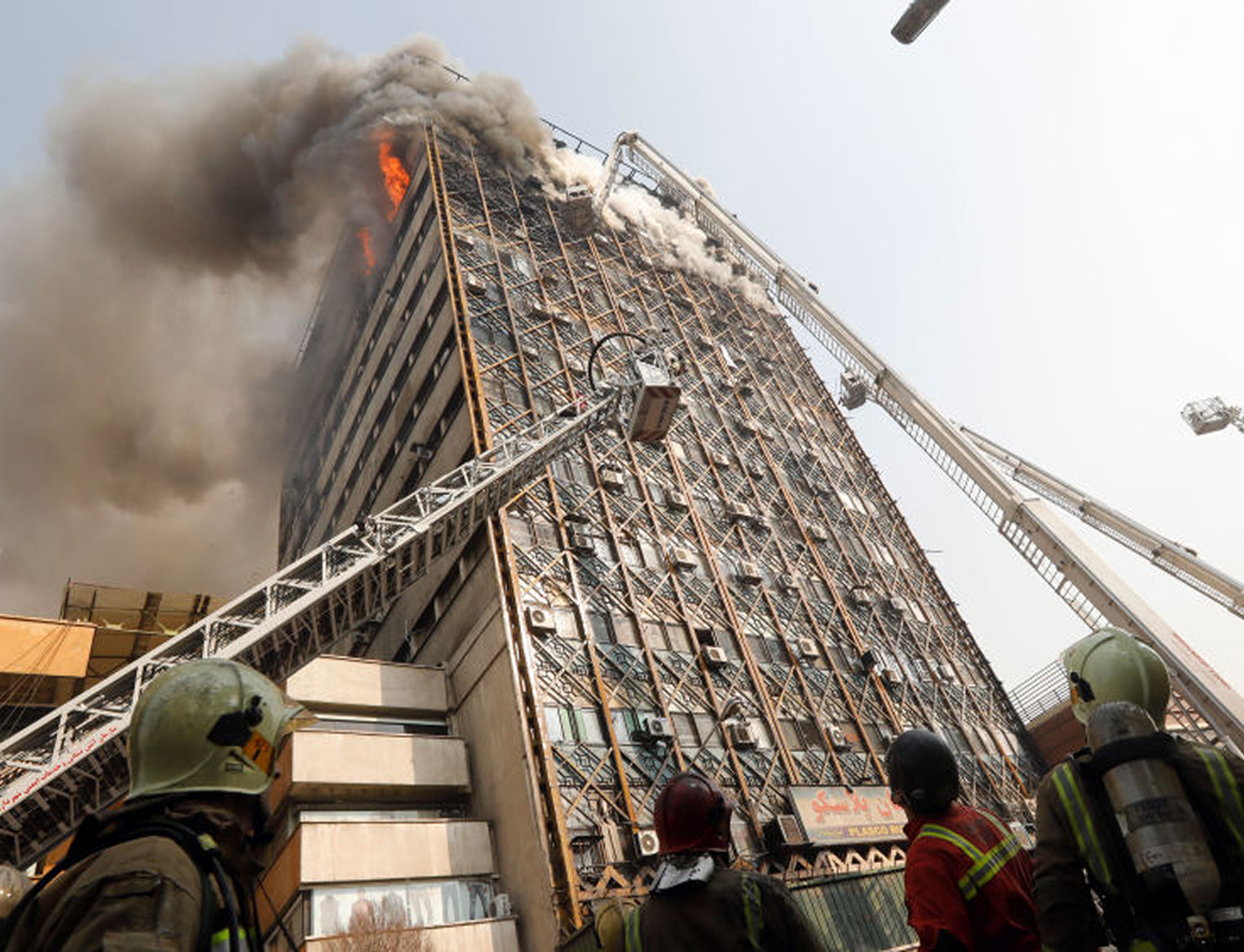
When Tehran’s Plasco building caught fire and collapsed in January 2017, images of firefighters buried under steel and concrete produced an instant national trauma. Officially, the disaster was portrayed as a tragic accident caused by an electrical fault in an aging commercial tower. Yet taken as a whole, eyewitness accounts, technical reports and subsequent decisions by powerful institutions point to something more disturbing: a convergence of decades of confiscation, regulatory neglect, security priorities and opaque profit making.
This investigation reconstructs Plasco’s trajectory from a showcase of mid twentieth century modernity to a firetrap situated inside the most tightly controlled air defense perimeter of the capital. It examines what happened on the day of the fire, why multiple explosions were heard and recorded, how air defense arrangements around the leadership compound shaped the rescue response, and who ultimately benefited from the rubble.
The core findings can be summarized as follows:
Plasco’s transformation from a modern high rise into an overcrowded, poorly regulated garment hub was driven by confiscation and rent seeking by state-linked foundations, while safety enforcement was systematically weakened.
The official explanation for the fire and collapse - an electrical fault and burning fuel - conflicts with the absence of piped gas, video evidence of multiple explosions and testimony about the building’s unusual vertical collapse pattern.
Plasco was not merely a commercial tower but also a node in the air defense ring protecting the leadership compound. Anti aircraft guns and a radar had been positioned on its roof, and recent engagements against small drones had taken place from there.
Flight bans and control by a Revolutionary Guard security headquarters delayed or restricted aerial firefighting and rescue options, even as firefighters lacked modern equipment and reliable communications.
In the aftermath, the foundation that controlled Plasco consolidated ownership, sidelined many previous tenants and built a larger, more lucrative complex whose key beneficiaries reportedly include members of the security establishment and regime loyalists.
Far from an isolated accident, the Plasco disaster exposes a system in which public safety, transparency and the rights of ordinary citizens are repeatedly sacrificed to the priorities of security organs, quasi state conglomerates and politically connected networks.
When Plasco opened in the early 1960s, it was a symbol of an ambitious, outward looking Tehran. The 17 story steel framed tower, built at Istanbul intersection in the city center, was among the tallest and most modern buildings in the Middle East at the time. Its steel skeleton and cladding were designed for an estimated useful life of roughly two centuries.
The man behind it, Habib Elghanian, was a prominent Jewish industrialist and head of the Jewish community’s official association. His family ran extensive businesses in Iran, the United States and Europe. They introduced plastic manufacturing under the Plasco brand and launched the country’s first aluminum profile factory. At opening, Plasco and the nearby Aluminum building dominated Tehran’s skyline. With a footprint of about 29,000 square meters and larger lower floors, the building quickly became a hub for offices, film production companies and fashionable retailers.
That trajectory ended abruptly with the 1979 revolution. As the new Islamic Republic targeted pre revolution industrialists and religious minorities, Elghanian was arrested, tried in a revolutionary court and executed after what contemporaries describe as a 20 minute proceeding. The next day he was shot in Tehran’s Qasr prison, alongside several others.
Plasco and the Aluminum building were among the assets seized. These properties were transferred to the Foundation of the Oppressed, a powerful conglomerate that grew into one of the largest economic actors in the country. Attempts by Elghanian’s heirs to reclaim their property failed.
There is a second, contested narrative of ownership embedded in the historical record. According to the memoirs of former officials and businessmen, a Baha’i entrepreneur named Jabbar Yazdani had purchased Plasco and the Aluminum building from Elghanian several years before the revolution, paying 220 million tomans in 1974. This transaction, if accurate, suggests the foundation appropriated not only Elghanian’s assets but also property that had already legally changed hands. What is uncontested is that the foundation emerged from the revolutionary upheaval as the effective owner and landlord, with the power to decide the building’s future.
In the decades that followed, Plasco evolved from a mixed use commercial building into a dense manufacturing and wholesale hub for garments. The foundation, seeking revenue rather than safety, rented several middle floors to small workshops and production units, without adequately considering ventilation, fire load or evacuation routes.
By the time of the fire, the building housed around 560 units, including workshops, warehouses and retail shops. The lower floors catered mostly to retail customers, while upper floors became crowded with production and wholesale operations. There was no piped gas in the building, yet it was full of flammable materials: textiles, packaging, synthetic fibers and cardboard. To keep warm in winter, many workers relied on electric heaters or unofficial, unsafe heating devices.
For years, rumors circulated that Plasco would be demolished for “renovation” or replaced with a more profitable complex. Tenants and shop owners, often holding expensive “key money” rights rather than full ownership, resisted any plan that did not include clear guarantees and compensation. They complained that state authorities would not support them if the building was emptied for redevelopment. As a result, Plasco remained in a limbo: structurally robust on paper, but functionally degraded, packed far beyond its original design and operating with minimal compliance with modern fire codes.
Safety warnings did surface. Fire officials and inspectors flagged the building as non compliant. A shop owner on nearby Jomhouri Avenue later blamed the district municipality, arguing that officials knew Plasco had no gas network, many units lacked fire extinguishers and basic safety equipment, yet chose not to seal it because bribes and under the table payments kept inspections at bay.
In this telling, the foundation extracted substantial upfront payments and high key money from tenants, the municipality tolerated hazards in exchange for rent seeking, and no one in authority assumed responsibility for making the building safe.
On a Thursday morning in late January 2017, residents of Tehran woke up to reports that Plasco was on fire. Initial expectations were that it would be a difficult but manageable incident. Fire engines and crews from multiple stations converged on the building, deploying ladders and high pressure hoses to attack the blaze rising from the upper floors, where garment workshops were densely packed.
The fire started around 8 a.m., quickly involving floors from the ninth upward. Videos show flames erupting through windows and thick smoke billowing over the capital. Firefighters battled the blaze for several hours. At one point, officials suggested the fire had been brought under control. Then the situation changed. Parts of the building’s upper floors appeared to weaken. Some slabs reportedly failed, sending debris crashing onto lower levels.
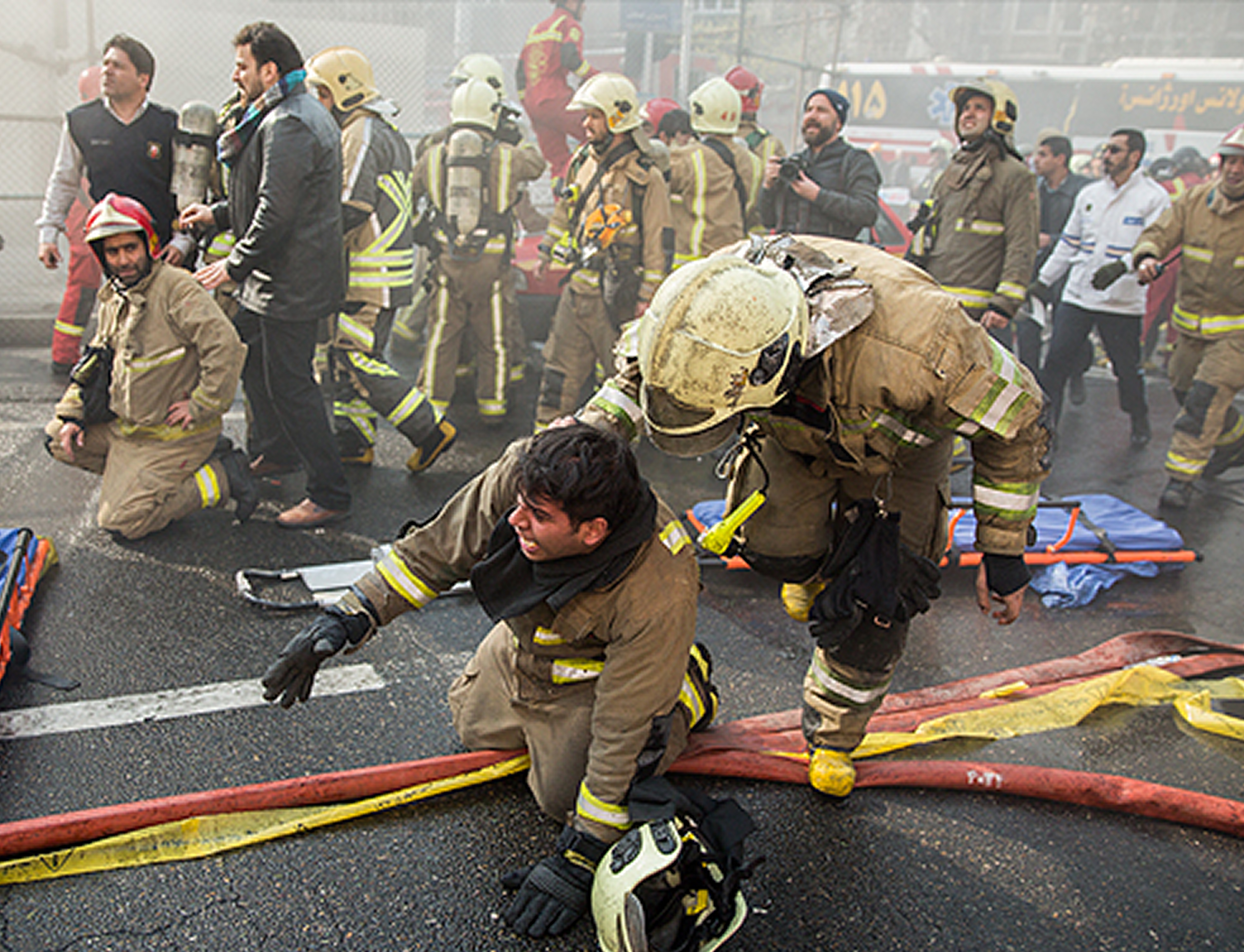
Around three and a half hours after the first reports, Plasco suddenly gave way. Live footage captured the moment the tower seemed to sink into itself, collapsing almost vertically into its own footprint. Bystanders screamed as a dust cloud engulfed the intersection. Many firefighters were still inside, trying to extinguish the remaining flames.
In the immediate aftermath, information was scarce and contradictory. Preliminary counts suggested dozens of firefighters had been trapped. Reporters on the scene spoke of at least 25 injured firefighters being rushed to hospitals even before the final collapse. The eventual official figures, released slowly over several days, put the number of injured at 235, with one firefighter dying in hospital. The bodies of 15 firefighters and 6 civilians were recovered from the rubble, for a total of 22 confirmed dead.
Yet even these numbers do not tell the full story. According to officials, at least ten non firefighter workers were initially listed as missing. Only five bodies were formally identified. Some of the missing were undocumented Afghan workers employed in the garment workshops. Working and living in the building without legal status, their identities were never properly recorded. Their families had limited ability to demand answers. The true human cost remains uncertain.
Debris removal took roughly nine days. Around 1,900 truckloads transported an estimated 20,000 tons of rubble, steel and ash from the site. The speed at which the pile was cleared fueled suspicions among those who believed key evidence was being destroyed before independent experts could fully examine it.
Faced with public anger, the president at the time ordered a special fact finding committee. In April 2017, the committee’s head, Mohammad Taqi Ahmadi, presented its findings. The report described Plasco’s collapse as a symbol of accumulated negligence by multiple state bodies over decades. Failures in inspection, enforcement, emergency planning and building management had compounded to create a high risk environment.
The technical committee on structural behavior concluded that the building’s failure happened in three stages. After about three hours of fire, a section of the 11th floor slab, above the 10th floor, reportedly failed in the northwest corner where the fire was most intense. Around ten minutes later, sections of the 12th and 13th floor slabs collapsed onto the 10th floor, and this cascading failure of floors continued downward. Despite this internal collapse sequence, the external frame held for several more hours before the final, global failure initiated from the eastern and southern sides, bringing the structure down.
This timeline raises a critical question that the report did not satisfactorily answer: why were firefighters not evacuated after the first internal collapses? Experts estimate there were 30 to 40 minutes between the initial localized slab failures and the terminal collapse. In principle, that should have been enough time to clear the building if commanders had fully understood the structural danger.
One possible explanation is the breakdown of communications. There are indications that firefighters inside did not receive timely orders to withdraw, whether due to faulty radios, chaotic command structures or lack of trained structural observers capable of reading warning signs. The special committee itself criticized the absence of a dedicated safety team within the incident command structure. But it did not systematically explore how much the institutional culture of the municipality and emergency services discouraged a conservative, life protecting withdrawal in favor of continuing an already doomed fight against the flames.
The cause of the initial fire and the explosions heard during the incident are equally contested. Various officials publicly suggested electrical faults, possibly combined with leaking gas cylinders, as the source of ignition and the later blasts. Yet the national gas company stated clearly that Plasco was not connected to the gas network, ruling out a large gas main leak.
Video clips recorded by bystanders show several distinct explosions in the middle floors during the fire, well before the final collapse. Some viewers linked this to pressurized cylinders used in workshops. Others believed they resembled the sudden flare and shock associated with fuel or ammunition.
Mehdi Chamran, then head of the Tehran City Council, claimed that an explosion of a diesel storage tank on the upper floors was responsible for some of the blast effects. However, the building’s own trustees countered that the main diesel fuel for generators was stored in the basement and motor room, not on higher levels, and that the observed explosions appeared to originate from elsewhere.
The special presidential committee ultimately attributed the fire to an electrical short circuit, possibly combined with leakage from small gas cylinders, and declared that the main cause of the collapse was the prolonged fire itself. It explicitly rejected any hypothesis of explosives or large explosive materials within the building. Critics pointed out that the report made only cursory reference to citizen videos and eyewitness accounts that described multiple explosions, and that it did not offer a detailed reconciliation of these observations with its official scenario.
Additional questions arise from the way Plasco fell. Structural engineers note that steel framed buildings subjected to intense fire often deform and lean, causing partial collapse toward the direction of greatest weakness rather than a near vertical, footprint collapse. Evacuation zones around burning high rises are designed with this behavior in mind. In Plasco’s case, the tower’s main vertical segment appeared to come down largely straight, with the horizontal, lower wing of the L shaped plan suffering comparatively less damage. A number of experts suggested this pattern looked “engineered” to reduce lateral damage, though others argue that the building’s specific geometry and load paths could produce such an outcome without deliberate intervention.
Even some supporters of the official conclusion concede that public skepticism was fueled less by conspiracy theories than by the authorities’ own track record: opaque investigations, tightly controlled media access, and a long history of unexplained incidents involving state owned assets.
The Plasco building was not just a commercial and industrial hub. It sat inside one of the most sensitive security zones in Tehran: the air defense ring protecting the leadership compound, presidential institutions and other strategic sites in the city center. Within this “diamond shaped” no fly zone, even civilian helicopters require special permission to enter the airspace.
According to residents and video evidence, a 23 millimeter anti aircraft gun had been installed on Plasco’s roof, with a similar gun on the neighboring Aluminum building. Together with at least one Shilka four barrel anti aircraft system on the roof of the University of Tehran’s central library and other sites, these guns formed a low altitude defensive network against small aircraft or drones approaching the leadership compound. A radar believed to coordinate these systems was reportedly placed on Plasco itself.
In early January 2017, Tehran residents witnessed two unusual air defense incidents. On 3 Dey 1395, a mid sized quadcopter was seen flying above the central city, including near Jomhouri Avenue. It was tracked by the rooftop radar and shot down by the gun on the Aluminum building, known locally as “Samaavat”. Later, it was claimed that the drone belonged to state television and had been filming Friday prayers, a claim that was quickly denied given that prayers that day were held at the city’s main prayer hall rather than the university campus.
On 27 Dey 1395, just three days before the Plasco fire, the guns fired again. Residents recorded the sound of sustained anti aircraft fire stretching from the vicinity of the Har garrison to the area around Plasco and the university. Witness videos show the first salvos coming from the roof of Plasco itself, with tracers arcing into the sky. Officials later confirmed that air defense units had engaged a small “heli shot” - a lightweight, unmanned aerial device that had entered the forbidden airspace. The target reportedly left the area after the first bursts, and the guns ceased firing to avoid endangering residential neighborhoods. No further details were provided about the drone’s origin or mission.
These episodes did more than reveal the existence of the air defense posture. They marked Plasco as a front line node in the protection of the leadership compound. Yet when the building burned days later, neither military authorities nor security commanders offered any explanation of what happened to the anti aircraft gun, its ammunition or the associated radar.
This silence matters because many observers link one of the major explosions during the fire to the detonation of stored ammunition on the roof or upper floors. According to this hypothesis, the blaze initially started as an industrial fire. Firefighters managed to contain parts of it. But at some point, heat reached the munition stockpile serving the rooftop gun. The resulting explosion dramatically widened the fire and compromised structural elements, hastening the eventual collapse.
Official reports do not mention any live ammunition or weapon systems inside Plasco. They focus exclusively on civilian hazards such as fuel, textiles and gas cylinders. Without transparent disclosure and independent inspection of military remnants, this line of inquiry remains speculative. However, the coincidence of recent anti aircraft engagements originating from the roof, the continued presence of guns within that no fly zone and the unexplained explosion pattern in citizen videos sustain public suspicion.
Security considerations also shaped the rescue response. An employee in a nearby government office later described how the “security atmosphere” of Tehran complicated firefighting efforts. He recalled that even hours into the fire, permissions for helicopter flights were tightly controlled by Sarallah, the Revolutionary Guard headquarters responsible for defending the capital. Despite the usefulness of aerial water drops or rooftop rescues for upper floors, he said, clearance for a rescue helicopter to operate in the no fly zone was not granted until around early afternoon, long after the most critical window had passed.
In his account, the upper stories could have been reached and the fire significantly contained using a helicopter equipped for firefighting, had such an aircraft been available and authorized. Instead, firefighters relied mainly on aging ladder trucks, some of which did not reach the necessary height. There were widespread reports that only four aerial ladders in the city were in operational condition, and that even these were outdated and unsafe.
The airspace restrictions were not the only security driven constraint. The city and national authorities repeatedly emphasize the need to keep the area around the leadership compound “safe” from aerial threats. Critics argue that in practice this has meant prioritizing the protection of buildings housing the ruling elite over the lives of ordinary citizens who live and work beneath the anti aircraft guns. As one commentator put it, in a city of 12 million where a small drone triggers automatic barrages of heavy fire over dense neighborhoods, no real consideration is given to acquiring specialized firefighting helicopters, yet immense resources are poured into air defense hardware.
This critique was voiced most sharply by political activist Mehdi Khazali in a student meeting shortly after the disaster. He argued that the firefighters and civilians who died in Plasco had, in effect, sacrificed their lives to protect the leadership compound, since the security architecture that placed anti aircraft guns on the roof and restricted rescue flights had made their deaths more likely. He contrasted the small budget obtained by the fire department with the hundreds of billions of tomans reportedly channeled to a charity controlled by the mayor’s wife, and called for the mayor’s resignation. Days later, Khazali was arrested by the Revolutionary Guard’s intelligence branch.
In early 2024, years after the disaster, air defense authorities reportedly shifted the central radar unit that had been on Plasco’s roof to another building, the Amir Kabir publishing house near a different downtown intersection. A military helicopter was seen lowering a radar onto that rooftop at night. Officially, these moves are never discussed, underscoring how little transparency exists around the security infrastructure embedded in civilian urban spaces.
The Plasco tragedy did not end with funerals and commemorations. It opened a new chapter of conflict over property rights, compensation and the use of one of central Tehran’s most valuable plots.
In the immediate aftermath, the controlling foundation promised shopkeepers and workshop owners that a new Plasco would rise within two years and that their key money rights would be honored. Early statements spoke of handing over units in spring 2020. Yet as time passed, the promised timetable slipped. One reason cited was bureaucratic: city authorities did not issue a building permit matching the foundation’s desired height and specifications.
When a new president of the foundation, Parviz Fattah, a former Revolutionary Guard commander, took office, the approach changed. According to multiple accounts, Fattah showed little interest in waiting for full permits. Construction began on a larger complex, reportedly 20 stories high and built without approved parking provisions. Five extra floors were added beyond the original structure.
More troubling for former tenants, many of them were simply sidelined. Despite earlier assurances, previous key money holders and long time tenants were not systematically reinstated. Instead, a large portion of the roughly 11,600 stalls and units in the new complex were reportedly allocated to members of the Revolutionary Guard, families of fighters killed in Syria and Iraq, and members of the Basij militia. What had been a diverse, messy commercial ecosystem dominated by garment producers and small traders was reshaped into a more tightly controlled, politically filtered space.
From a business standpoint, the foundation appears to have achieved several objectives. It shed hundreds of older tenant relationships and key money obligations that constrained its revenue. It replaced a relatively low rise L shaped structure with a taller, denser complex on prime land, maximizing future rental income. And it could present the project as a gesture toward “martyrs’ families” and security forces, insulating itself from criticism.
Those who lost the most were the shopkeepers, workshops and workers who had no leverage in this new distribution. Entire lines of business vanished. Insurance payouts, where they existed, rarely covered the full value of destroyed stock and key money. Some victims struggled for years with litigation and bureaucracy. Others, particularly undocumented workers, had no recognized claim at all.
Responsibility for the disaster was similarly deflected. The special committee’s report identified multiple institutions that had failed in their duties: the foundation as owner, the municipality and fire department as regulators, the labor ministry as overseer of workplace safety, and national bodies responsible for crisis management. But concrete accountability was minimal. No senior official resigned. No major criminal case against top managers of the foundation or the municipality resulted in significant punishment.
Instead, blame was dispersed. The interior minister emphasized electrical faults and careless workshops. City officials highlighted the age of the building and non compliant tenants. The foundation pointed to the municipality’s lax enforcement and the fire department’s limited equipment. In public debates, citizens saw a familiar pattern: institutions capable of mobilizing immense resources for elite projects were suddenly helpless when it came to compensating ordinary victims or reforming their own opaque governance.
One revealing comparison emerged repeatedly: in the two years before Plasco, a fire on the same Jomhouri Avenue had forced two women to jump from upper floors and die because no aerial ladder could reach them. Witnesses recall that at the time, too, officials promised to update firefighting equipment. Yet when Plasco burned, the city still lacked reliable high reach ladders and any dedicated firefighting helicopter. By contrast, air defense guns and radars had been upgraded and relocated with speed and precision.
The broader urban risk remains alarming. Crisis management officials acknowledged that in a major disaster in Tehran, only a fraction of the city’s needs could be met. One senior figure suggested that perhaps 20 percent of the city could be effectively “covered” in a serious incident, with the rest left to fend for themselves. Even this coverage, critics argue, would likely be concentrated near strategic sites and elite neighborhoods, not in the dense, aging districts where most ordinary residents live.
Taken together, the history, fire, collapse and aftermath of Plasco reveal much more than a tragic episode of misfortune in a single building. They illuminate core characteristics of the system that produced and managed the disaster.
First, Plasco illustrates how confiscation and quasi state ownership, without transparency or independent oversight, can erode both safety and rights. What began as the property of a private industrialist was transferred to a politically connected foundation. Over time, the imperative to generate rents and maintain control outweighed any responsibility to invest in safety or respect the legitimate interests of tenants. Competing narratives of ownership underscore how loosely such foundations treat legal titles once an asset has entered their domain.
Second, the case exposes a deep asymmetry between investments in security and investments in public safety. Anti aircraft guns, radars and command structures around the leadership compound operated with little regard for the risks their presence posed to the densely populated neighborhoods below. Flight bans designed to protect elite sites constrained life saving options for firefighters, even as basic equipment such as modern ladders and helicopters remained underfunded.
Third, Plasco highlights a pattern of investigations that determine “systemic failures” yet protect individuals at the top. Reports acknowledge decades of negligence, bureaucratic overlap and enforcement gaps, but stop short of naming and sanctioning senior officials who made or ignored key decisions. Civil activists who articulate sharper critiques, tying the disaster directly to specific political and military leaders, are prosecuted rather than heard.
Fourth, the reconstruction of Plasco reflects how disasters can be turned into opportunities for asset reconfiguration. By erasing physical structures and previous tenancies, a catastrophe can clear the way for more lucrative, more controlled developments that favor those closest to power. Former tenants and workers, who bore much of the risk, are left with little more than memories of a vanished livelihood.
Finally, the human dimension remains central. Firefighters entering the burning building did so with courage, but also with inadequate tools and incomplete information. Workers trapped in the motor room sent desperate messages that became another unresolved mystery when authorities claimed they could not locate the sender, even though four bodies were later found nearby. Families of undocumented migrants have no graves to visit and no official recognition of their loss.
For many residents of Tehran, the collapse of Plasco was not only the physical destruction of a familiar landmark. It symbolized the implosion of a promise: that the state and its powerful institutions would protect the lives and property of ordinary citizens in return for their obedience and taxes. Instead, the disaster suggested that when security priorities, institutional interests and profit converge, that promise is fragile at best.
In a capital marked by aging buildings, dense populations and simmering seismic risk, Plasco stands as a warning. Unless transparency, independent oversight and a genuine commitment to human safety take precedence over narrow security doctrines and opaque economic networks, the next disaster may be deadlier still.