Summary
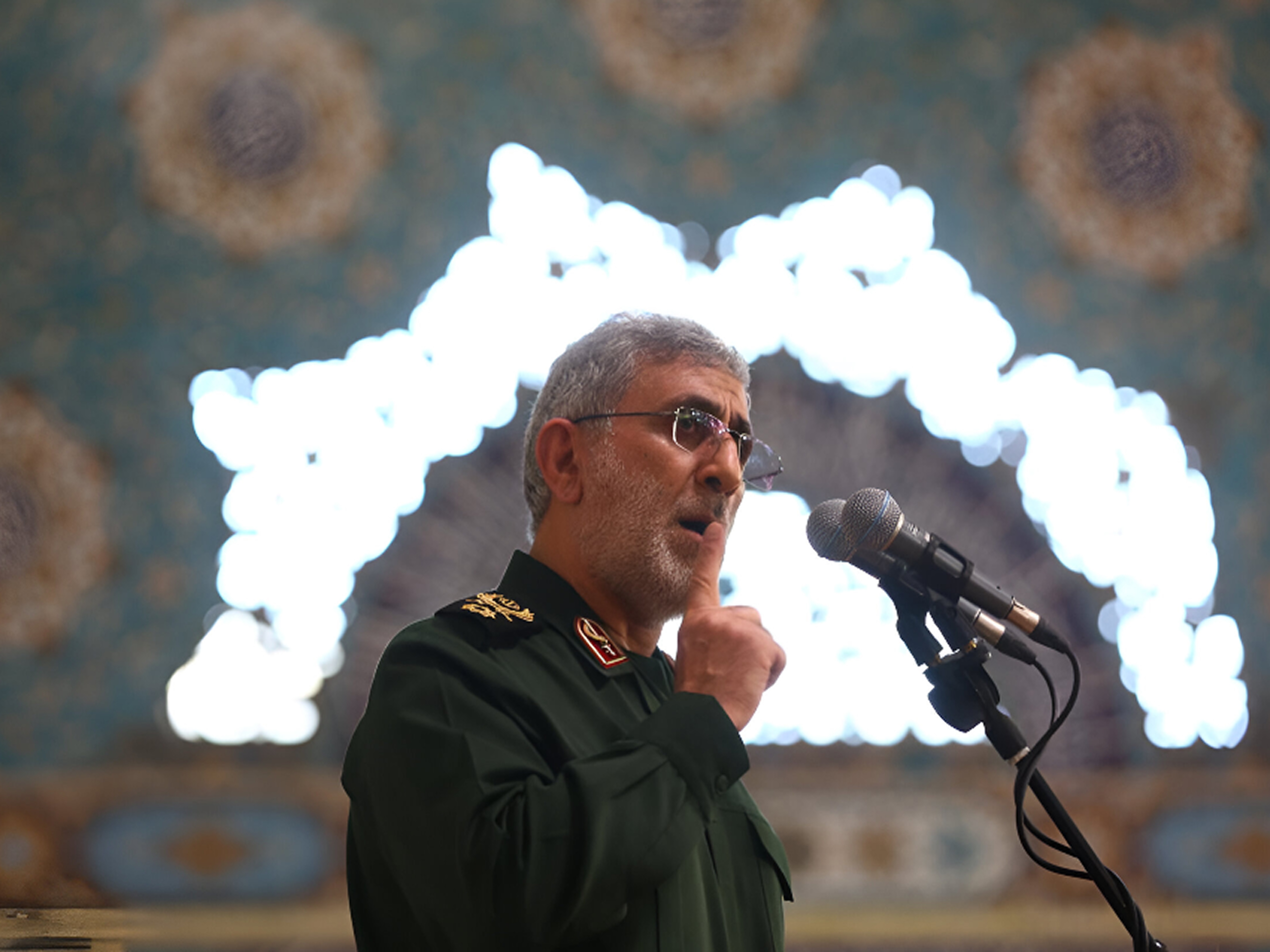
In the aftermath of Israel's assassination of Hezbollah Secretary-General Hassan Nasrallah in September 2024, one of the Islamic Republic's most senior military commanders vanished for 18 days, triggering speculation that ranged from his death in Israeli airstrikes to arrest on espionage charges. Esmail Qaani, commander of the Quds Force of the Islamic Revolutionary Guard Corps, had been in Beirut coordinating with Hezbollah leadership when Israeli strikes killed Nasrallah and other senior commanders. When Qaani disappeared from public view without explanation, regional media outlets reported that he was under interrogation by the IRGC's counterintelligence division on suspicion that Israeli intelligence had penetrated his inner circle. According to multiple reports from Middle East Eye and Sky News Arabia, Qaani's office director was suspected of providing information to Mossad that led to Nasrallah's assassination. When Qaani finally reappeared at a funeral ceremony in Tehran nearly three weeks later, he was accompanied by a masked security official who remained directly behind him at all times, an unusual arrangement that suggested he remained under close surveillance.
This investigation examines the rise of Esmail Qaani from a mid-level IRGC officer to commander of one of Iran's most powerful military organizations, the mounting evidence of Israeli infiltration into the Quds Force command structure, and what these breaches reveal about the vulnerabilities of the Islamic Republic's external operations apparatus. Based on leaked transcripts, intelligence reports, and media documentation, the evidence suggests that Qaani's tenure as Quds Force commander has been marked by operational failures, intelligence compromises, and a dramatic decline in the organization's effectiveness compared to the era of his predecessor, Qassem Soleimani.
From Obscurity to Command
Esmail Qaani Akbarnejad was born on August 8, 1957, in Mashhad, Iran's second-largest city and a center of religious conservatism. Unlike many revolutionary figures who emerged from the underground opposition to the Shah's regime, Qaani had no significant political or militant background before the 1979 revolution. He joined the newly formed Islamic Revolutionary Guard Corps in 1980, shortly after its establishment, and was sent to Tehran for basic military training at the Sa'dabad Barracks, later renamed Imam Ali Barracks. After completing training, he returned to Mashhad as one of the first trained cadres of the local IRGC chapter.
Qaani's early career trajectory changed with the Kurdish uprising in Iran's western provinces. He was deployed to Kurdistan to suppress separatist movements, an assignment that provided his first significant combat experience and accelerated his advancement within the IRGC ranks. When the Iran-Iraq War began in 1980, Qaani was transferred to Khuzestan province, where he would remain for the war's duration. It took two years before he received his first major command position. In 1983, he was appointed commander of the 21st Imam Reza Brigade, a position he held for four years. In 1987, he was promoted to commander of the 5th Nasr Division, which he led until the war's end in 1988.
The war provided Qaani with a military resume, but it also established patterns that would later prove controversial. He was known for utilizing Afghan fighters and, according to some accounts, child soldiers in military operations. This practice would be institutionalized decades later when the Quds Force recruited thousands of Afghan refugees living in Iran to fight in Syria under the Fatemiyoun Brigade banner. Human Rights Watch reported that the Islamic Republic sent Afghan refugee minors as young as 14 to fight in Syria, an action constituting a war crime under international law. The Washington Post documented this recruitment program in detail. Qaani not only failed to deny these allegations but later praised the effectiveness of the Fatemiyoun forces.
After the war ended in 1988, Qaani returned to Mashhad with an appointment from then-IRGC Commander Mohsen Rezaei as deputy commander of the 8th Ground Forces Operations Unit. His rise through the IRGC hierarchy was gradual but steady. In 2006, he was appointed deputy head of intelligence for the IRGC's Joint Staff, a position that appeared to be preparation for his next assignment. In 2007, Qaani achieved his most significant promotion when he was appointed deputy commander of the Quds Force under Qassem Soleimani, a position he would hold for 12 years until Soleimani's assassination in January 2020.
The appointment of Qaani as Soleimani's successor sparked immediate controversy. Many veteran IRGC officers and military analysts questioned whether he had the stature and capabilities to fill Soleimani's role. The regime's propaganda apparatus launched an intensive campaign with the slogan "Qaani is another Soleimani" to justify Ali Khamenei's choice, similar to the "Khamenei is another Khomeini" campaign after Ayatollah Khomeini's death in 1989. But time would demonstrate that Qaani could never replicate Soleimani's impact. IRGC-affiliated media attempted to create a distinctive image for him with titles like "the thinking brain of the IRGC," "the Syrian commander," or "the architect of Quds Force intelligence," but none of these epithets gained traction. The project to create a second Soleimani effectively failed.
The Shadow of Soleimani
Qaani faced three fundamental problems in establishing himself as Quds Force commander. First, Soleimani's profile had become so prominent during the previous decade through regional military activities and cross-border operations that his deputy, Qaani, never had the opportunity to demonstrate his own capabilities. He was known primarily as a shadow commander with no significant role in decision-making. Second, Qaani never achieved parity with Hassan Nasrallah, the Hezbollah secretary-general. In all media and propaganda presentations, Soleimani had been portrayed as Nasrallah's equal, genuinely sharing power in regional decision-making. Qaani never attained such standing. Nasrallah himself acknowledged this when, in a somewhat controversial statement after Qaani's appointment, he said Qaani "needs time" and expectations should not be excessive. Third, Qaani lacked Soleimani's character for propaganda imagery. He did not photograph well and was not an effective public speaker. He could not even replicate Soleimani's master-disciple dynamic with Khamenei that kept him in the media spotlight.
The inadequacy became evident in Qaani's international engagements. A few months after assuming command, he traveled to Iraq to coordinate the selection of a prime minister but was denied a meeting with Grand Ayatollah Ali al-Sistani, Iraq's most influential Shia cleric. The rejection was widely reported in international media. The Associated Press wrote extensively about the incident, noting that while Soleimani communicated directly in Arabic with Iran-affiliated groups, Qaani operated through interpreters and primarily through coordination with Iraj Masjedi, Iran's ambassador in Baghdad, and had less familiarity with militia leaders. The report noted that unlike Soleimani, who traveled freely in Iraq, Qaani had to obtain a visa like ordinary citizens.
Qaani attempted to compensate for his lack of stature with aggressive rhetoric. Like other second-generation IRGC commanders such as Hossein Salami and Amir Ali Hajizadeh, he directed verbal threats toward the United States and Israel to at least present an attractive appearance to the Islamic Republic and Khamenei personally. He declared: "I say explicitly, the more America exerts pressure, the more the Zionist regime exerts pressure, undoubtedly double pressure will be placed on them, God willing." But these threats from the Quds Force commander not only proved ineffective but prompted a swift and direct American response. Brian Hook, head of the Iran Action Group at the U.S. State Department, gave a detailed interview to Al-Sharq Al-Awsat newspaper and explicitly threatened that if Qaani followed Soleimani's policies and killed Americans, he would meet a similar fate.
This serious threat from Hook was not without effect on Qaani's aggressive rhetoric. He reduced his threats toward America but redirected his verbal artillery inward, with his threatening speeches during the nationwide protests following Mahsa Amini's death in 2022 becoming notably more frequent. One of his most controversial statements came on December 20, 2022, when he addressed unveiled women: "This is uptown Tehran. Go through all of Vali-e Asr Street, you won't see one honorable woman who is unveiled. Not one honorable woman. Damn you all, you don't understand. You are the most dishonorable people."
Disappearance and Suspicion
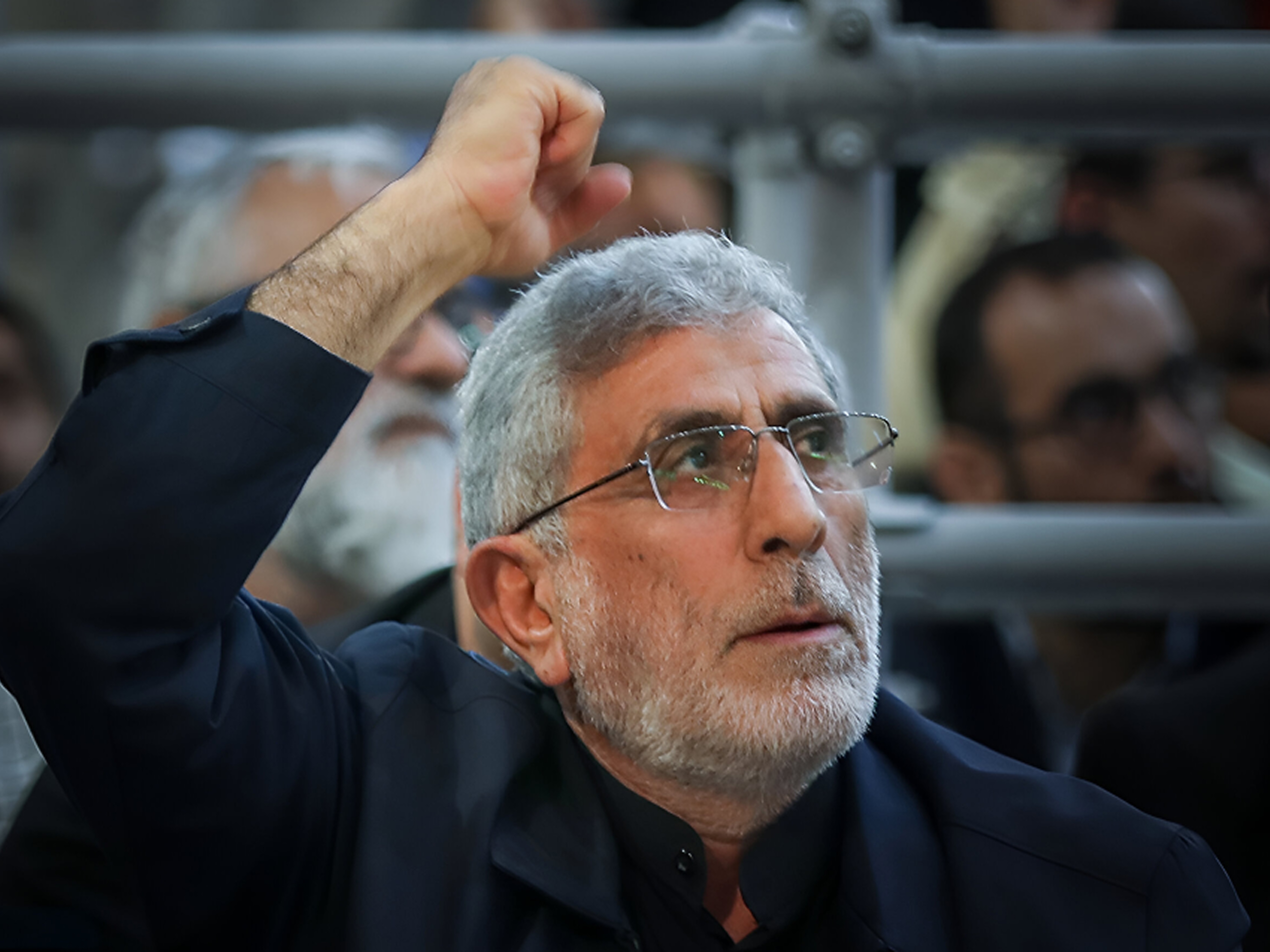
But these were not Qaani's only controversial moments. In October 2024, his name became entangled in the assassination of Hassan Nasrallah. Following Israel's missile attack on Hezbollah headquarters that killed the organization's secretary-general, initial reports emerged claiming that Qaani had also been killed in the strikes. IRGC-affiliated media later reported that Qaani was in perfect health and unharmed. Then suddenly, strange news spread on social networks claiming that Qaani had suffered a heart attack and was hospitalized. The news, rumors, and speculation surrounding the Quds Force commander reached the highest possible level when Middle East Eye, a credible media source for Middle East news, published an exclusive report claiming that Qaani had been arrested on espionage charges for Israel and involvement in Nasrallah's assassination and was under interrogation. Shortly after that report, Sky News Arabia wrote that Qaani had suffered a severe heart attack during interrogation, which explained his hospitalization.
Although pro-regime media denied these reports, the complete absence of any trace of Qaani left everyone genuinely uncertain whether he had been killed or was being held on espionage charges for Israel. Finally, on October 15, 2024, footage of Qaani's presence at the ceremony for the return of Abbas Nilforoushan's body from Lebanon was broadcast on television, somewhat ending part of the speculation. Naturally, with the broadcast of Qaani's footage, speculation about his death ended, but rumors of his possible cooperation with Mossad remained strong. Sky News Arabia wrote in another report: "Esmail Qaani, commander of the Quds Force of the Revolutionary Guards, was not harmed in Israel's attack on Lebanon, but was interrogated due to significant security breaches. Esmail Qaani was interrogated about the penetration of his special communication devices, and his chief of staff is suspected of espionage for Israel."
Lebanese sources also reported that Qaani was under house arrest in Lebanon and was interrogated by individuals under the direct control of Iran's leader, Ali Khamenei. Following these reports published one after another, placing Qaani and the entire Quds Force in an increasingly weak position, a semi-official IRGC figure finally responded to the affair, praising Qaani's performance and announcing that the Quds Force commander was to receive the Fath Medal. Ibrahim Jabbari, advisor to the IRGC Commander-in-Chief, said in late October 2024 at a media session: "God willing, in the coming days, commanders will receive the Fath Medal from His Excellency." However, this promise never materialized.
Then, following Israeli missile attacks on Iran on June 13, 2025, Qaani made headlines again, and speculation and rumors surrounding him intensified. In the initial hours after the attack, news spread on social media that Qaani had been killed along with other IRGC commanders, but the news of Qaani's death was quickly denied and the rumors took a different shape. The nature of the attack and the targeting of main IRGC commanders at the same time in different locations reinforced suspicions of cooperation by a high-ranking IRGC official with Israel, and this time Qaani was again placed under suspicion of espionage. But this time he was not alone, and individuals such as Ali Shamkhani and Saeed Mohammad were equally suspected of espionage, accusations that remain in a gray area of ambiguity, neither confirmed nor denied.
The Security Breach
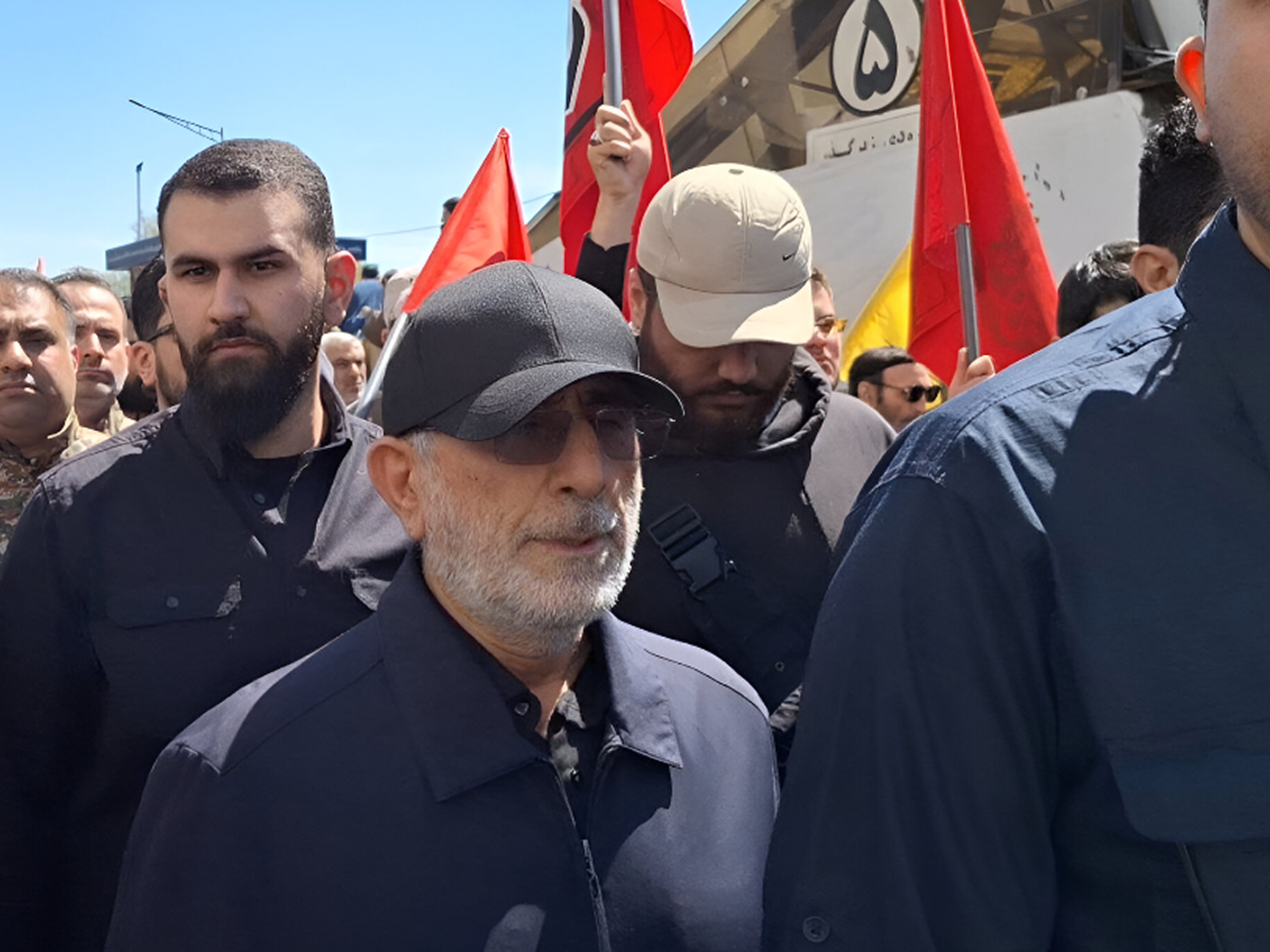
The most telling detail of Qaani's reappearance after 18 days was not widely noted: a security officer wearing a hat and mask positioned directly behind him throughout the funeral ceremony, never leaving his side. In all footage and photographs released, this officer remained precisely behind Qaani, not taking his eyes off him for a moment. Normally, Islamic Republic officials' bodyguards never conceal their faces in this manner. The footage emphasized that Qaani's main bodyguard was absent from his side for the first time, a matter that could strengthen the possibility that this bodyguard was a spy. In the video released by the Sima news agency, the presence of this bodyguard and his adherence to Qaani was extremely palpable.
The fundamental question is why he, as one of the hardline and revolutionary commanders loyal to the Leader, disappeared in this manner, and why Islamic Republic officials refused for several days even to announce that he was alive and remained silent about his fate. Furthermore, how did Qaani, who had disappeared in Beirut, return to Iran, and after a period of silence and no information about his condition, why was his sudden appearance at Nilforoushan's ceremony deliberately emphasized in the media, while after the serial assassination of Hezbollah commanders and IRGC commanders by Israel, security concerns about Islamic Republic officials and commanders are greater than ever?
Hamed Mohammadi, a journalist and analyst of political and security issues, told Voice of America in this regard that the Islamic Republic's delay in providing information about the Quds Force commander was suspicious. Although Ibrahim Jabbari, advisor to the IRGC Commander-in-Chief, announced to end speculation that Qaani would receive the Fath Medal from Ali Khamenei in the coming days, and finally the release of his footage at Nilforoushan's funeral drew a line through the possibility of his death, two new ambiguities emerged: the ceremony scheduled for Qaani to receive the Fath Medal from Khamenei was canceled, and the funeral prayer for Nilforoushan, which was scheduled to be performed by Khamenei in the courtyard of the Leader's house, was not held. This time, Ayatollah Alamolhoda, the representative of Khorasan, performed the funeral prayer.
The meaningful and prolonged silence of government news media and regime officials about Qaani being alive was a confirmation that important events had occurred behind the scenes of the IRGC and government intelligence agencies. While it is said this silence was for security reasons and to keep him safe from assassination by Israel as part of the operation to secretly transfer him from Beirut to Iran, perhaps the origin of this silence was a power struggle to decide between the option of eliminating Qaani in Iran by intelligence agencies and announcing the false news of his martyrdom in Beirut, or the option of announcing that he was alive and his return after disclosure by the leadership office behind the scenes. Because the leak of information from his office, which apparently was effective in Hassan Nasrallah's death, was not something that the IRGC's intelligence protection would easily overlook. Therefore, due to the complexity of this issue, this investigation examines the circumstances of the disappearance, the operation of his return, and the behind-the-scenes of the suspicious absence of Esmail Qaani, the Quds Force commander.
A Pattern of Infiltration
The disappearance was not the first indication of intelligence vulnerabilities in Qaani's command. His tenure had been marked by a series of security failures that contrasted sharply with the Soleimani era. The successful Israeli assassination campaign against Hezbollah and IRGC commanders throughout 2024 suggested systematic intelligence penetration at the highest levels. The precision of Israeli strikes, the timing of attacks, and the apparent foreknowledge of secure meeting locations all pointed to a compromised communications network.
Le Parisien reported that an Iranian source provided the Israeli military with the location and timing of the commanders' meeting with Nasrallah in Beirut's southern suburbs. This report was subsequently republished with greater detail by Israeli media, and several Arab media outlets reported, citing their sources, that the Mossad infiltrator was an individual named Ehsan, the director of Esmail Qaani's office. It was also said that Qaani was scheduled to attend the secret meeting but suddenly changed plans an hour beforehand and sent Abbas Nilforoushan to the meeting in his place, who was consequently killed in the Israeli attack.
Reuters, citing two sources in the Iranian government, also reported that Qaani was in Beirut at that time to rebuild Hezbollah's military capacity and that there had been no sign of him since the bombing of Hashem Safieddine's residence in Beirut's Dahieh neighborhood. The IRGC and high-ranking military commanders had remained silent, with only certain individuals such as Abbas Golrou, a member of the Majles National Security Commission, denying news of Qaani's death, injury, or disappearance. Various options were proposed following Qaani's disappearance and the Islamic Republic officials' hesitation to make a definitive statement about his fate. Some raised the possibility of his death, but some observers said he had been detained by the IRGC Intelligence Organization due to Mossad's infiltration of the IRGC's high security levels. Some even claimed that Qaani had fled to Israel.
According to some political analysts, the Islamic Republic concealed Qaani to create an atmosphere and buy time, thereby creating psychological warfare. Hamed Mohammadi, a journalist and analyst of security issues, said in an interview with Voice of America on October 9: "This is the Islamic Republic's psychological warfare tool. Perhaps in another day or two they will unveil him, give him a medal of conquest, and unveil him as a brave commander." On the other hand, because of the regime's previous lies about the deaths of its commanders, perhaps this time they were also buying time to announce his death. According to this journalist, if Qaani had been killed, announcing his death would have been fuel under the pot of regime supporters and would have forced the Islamic Republic into another military response, precisely at a time when Islamic Republic regime officials were trying through various lobbies to limit Israel's military operations.
Mohammadi also emphasized that the Islamic Republic's propaganda apparatus was active, stating it was said that Qaani was in some corner of Syria or Lebanon to plan. According to this analyst, it was unusual for the Islamic Republic to lose contact with one of its commanders at the height of war and conflict in the region. On the other hand, reviewing the regime's history in such situations showed that before it was possible they might bring Qaani out from behind the scenes and highlight him, it was possible they might announce his death, because such a thing had happened in similar cases.
Systemic Vulnerabilities and the Question of Impunity
The Qaani affair exposes fundamental vulnerabilities in the Islamic Republic's external operations apparatus that extend beyond one commander. The Quds Force, established to conduct covert operations, support proxy militias, and project Iranian power throughout the region, appears to have been systematically compromised by Israeli intelligence. The recruitment of Afghan nationals, including minors, for foreign wars created security risks that materialize when former fighters become potential intelligence assets. The reliance on foreign proxies and extensive communication networks across multiple countries created numerous points of vulnerability for electronic surveillance and human intelligence operations.
The Islamic Republic's response to these breaches has been characterized by opacity and denial rather than accountability. When intelligence failures led to the assassinations of nuclear scientists, military commanders, and proxy leaders, the regime typically blamed external actors while avoiding internal investigation or reform. The brief detention and interrogation of Qaani, if reports are accurate, represents an unusual deviation from this pattern, but even this took place entirely in secret, with no public acknowledgment or explanation.
The regime's protection of its commanders and operatives serves multiple purposes. Admitting intelligence breaches would undermine domestic and regional perceptions of the IRGC's capabilities. Publicly investigating senior commanders would expose internal divisions and power struggles. And holding officials accountable for operational failures would contradict the Islamic Republic's narrative of divinely guided inevitable victory. Therefore, even when commanders like Qaani face suspicion of catastrophic intelligence failures, the regime's priority remains maintaining the appearance of strength and unity rather than addressing systemic vulnerabilities.
This culture of impunity has practical consequences. Without genuine accountability for security failures, the same vulnerabilities that enabled Israel to assassinate Soleimani, Nasrallah, Nilforoushan, and numerous other commanders remain unaddressed. The presence of a masked security officer constantly monitoring Qaani suggests that even the regime recognizes he represents a security risk, but rather than replacing him or conducting a transparent investigation, the Islamic Republic has chosen to maintain him in position under close surveillance.
Conclusion: The Eroding Foundation
The saga of Esmail Qaani's rise, disappearance, and closely monitored return reveals more than the vulnerabilities of one commander. It exposes the erosion of the Islamic Republic's once-formidable external operations capability. The Quds Force under Soleimani was effective not because of superior technology or resources, but because of deep relationships, operational security, and strategic patience. Under Qaani, all three have deteriorated. His inability to match Soleimani's stature with regional partners, the systematic intelligence breaches that have compromised operations, and the apparent rush to action rather than careful planning have left the Quds Force weakened at precisely the moment when regional conflicts demand effective covert operations.
The Islamic Republic's decision to retain Qaani despite mounting evidence of intelligence compromises in his inner circle demonstrates the regime's prioritization of loyalty over competence, appearance over substance. Rather than acknowledge failures and implement reforms, the regime has chosen to maintain existing structures while subjecting its own commander to what appears to be perpetual surveillance. This approach may prevent short-term embarrassment, but it ensures that the fundamental vulnerabilities that enabled Israel's successful intelligence penetration remain unaddressed. As long as the Islamic Republic values ideological conformity and personal loyalty over operational effectiveness and genuine accountability, its external operations apparatus will continue to face the kind of catastrophic intelligence failures that have characterized Qaani's tenure.
The question that remains is not whether Qaani will be replaced, but whether his eventual replacement will emerge from a reformed system that has learned from these failures, or from the same culture of opacity, denial, and impunity that enabled them in the first place.