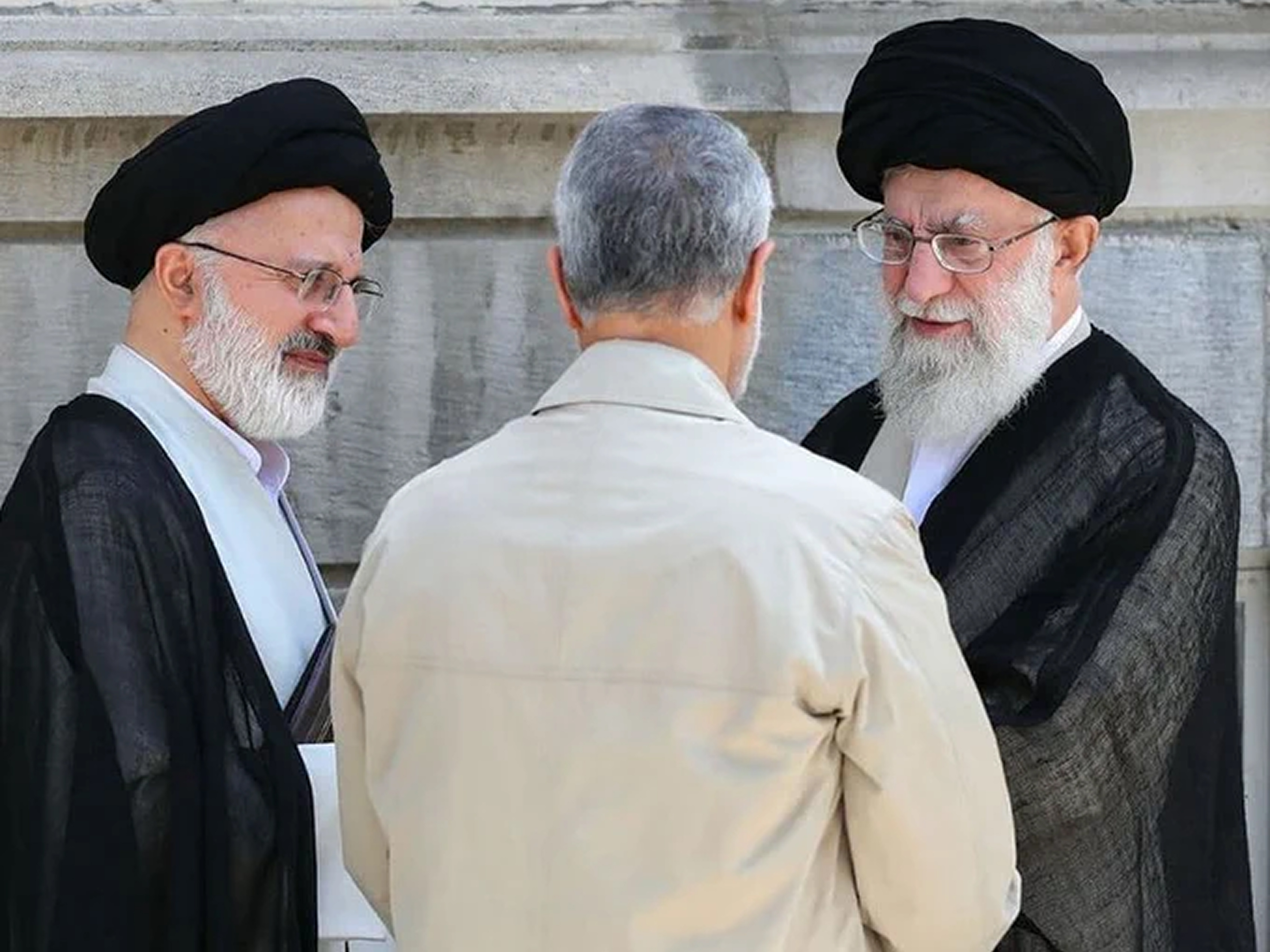




Inside the Khamenei Family Network: Kinship, Influence and the Succession of Power
Inside the Khamenei family network that blurred private kinship, state power, and succession.
|
Pars Barghandan

For much of Ali Khamenei's 37 years at the apex of the Islamic Republic, his family occupied an unusual position in public life. His children were rarely visible, rarely interviewed and, with the exception of occasional photographs, largely absent from the political theater surrounding their father. That absence helped sustain an official image of separation between family and state: the supreme leader exercised immense authority, but his children, the narrative suggested, remained outside government, commerce and the machinery of power.
The reality was more complicated.
Ali Khamenei and his wife, Mansoureh Khojasteh Bagherzadeh, had six children: four sons, Mostafa, Mojtaba, Masoud and Meysam, and two daughters, Boshra and Hoda. The children followed different paths, but almost every branch of the family became connected by marriage, religious education or institutional work to influential clerical, political or commercial families within the Islamic Republic.
Those connections did not mean that every Khamenei child became a political operator. Mostafa, the eldest son, appears to have remained principally within the clerical world. Masoud and Meysam were more closely associated with institutions responsible for preserving and disseminating their father's political and religious legacy. The daughters lived almost entirely outside public view. Mojtaba was the exception. Over time he became the family member most closely associated with the exercise of political power.
By 2019, the distinction between Mojtaba's lack of an elected or conventional government post and his practical influence had become difficult to sustain. When the U.S. Treasury sanctioned him that year, it said Ali Khamenei had delegated some leadership responsibilities to his son and alleged that Mojtaba worked closely with the Islamic Revolutionary Guard Corps' Quds Force and the Basij. The designation was a U.S. government assessment, not an independent judicial finding, but it placed an official description of his influence into the public record.
Then the question of family influence became a question of succession.
Ali Khamenei was killed in U.S.-Israeli strikes on February 28, 2026. On March 8, the Assembly of Experts selected Mojtaba Khamenei as his successor. The transfer placed a son directly into the office held by his father, even though the Islamic Republic's constitutional structure formally assigns the choice of supreme leader to the Assembly of Experts rather than hereditary succession.
The significance lies not merely in one father being succeeded by one son. It lies in the architecture that developed around the family over decades: strategic marriages, positions inside the supreme leader's institutional orbit, access to religious networks, connections with the security establishment, control over the presentation of the leader's legacy and, in Mojtaba's case, a gradual accumulation of influence without the normal visibility associated with executive office.
The family history therefore provides a window into a wider feature of the Islamic Republic: formal institutions continue to exist, but some of the most consequential relationships operate through informal networks, personal trust, family connections and organizations whose internal decision-making is difficult for the public to examine.
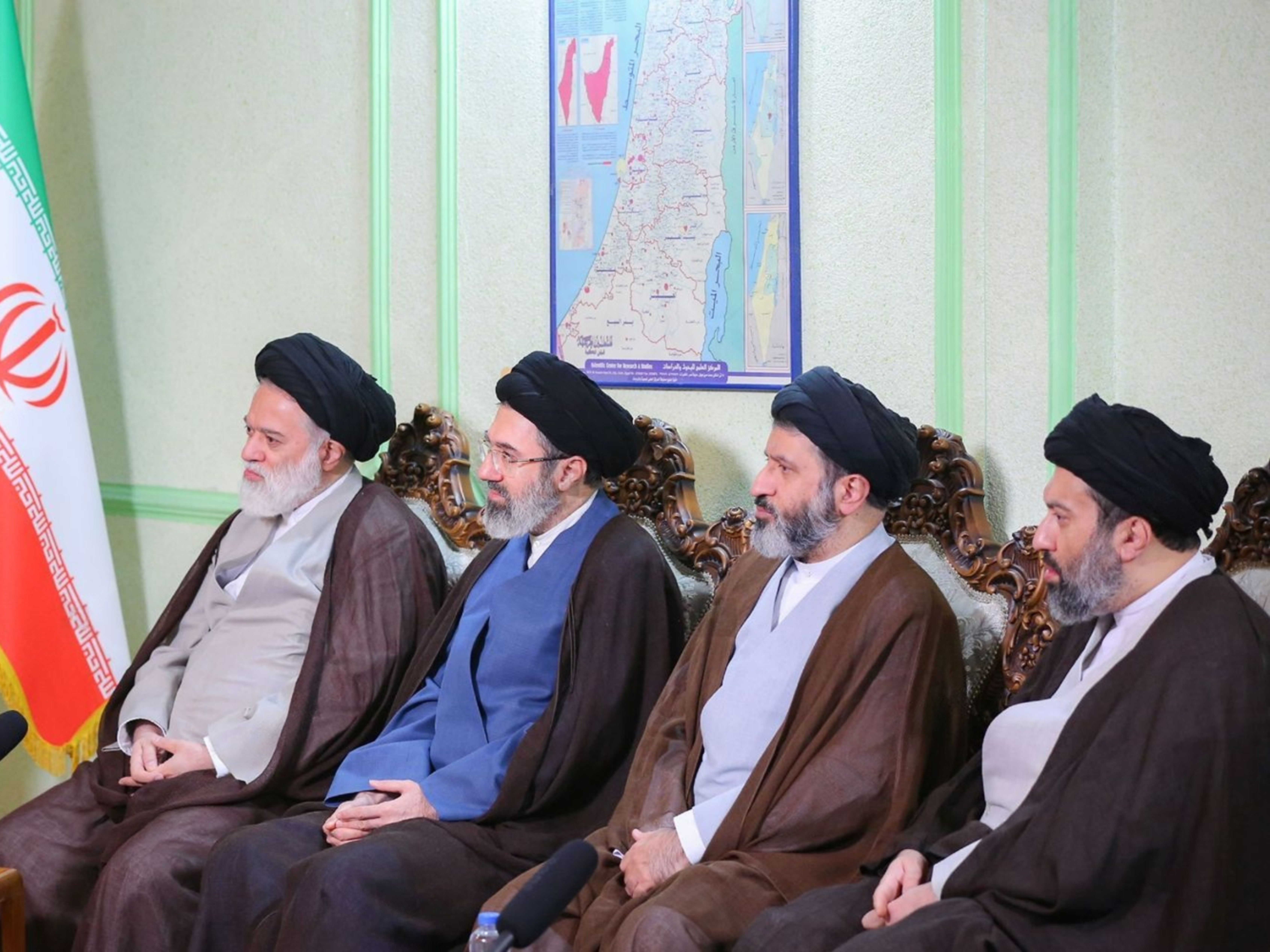
When Ali Khamenei became supreme leader in 1989, his children were still young. Mostafa, the eldest, had been born in 1965. Mojtaba followed in 1969. Masoud and Meysam were born in the 1970s, while Boshra and Hoda were born around 1980 and 1981. Public reporting differs slightly on the exact birth years of some of the sons, a reflection of how little verified biographical information circulated about the family for much of Khamenei's rule.
The sons shared an important characteristic: religious education. Mostafa pursued seminary studies and became associated with the clerical establishment in Qom. Mojtaba also entered the seminary system after studying theology and developed relationships with prominent conservative clerics. Masoud and Meysam similarly received religious training.
For years, this clerical profile supported a carefully limited public image. The sons could be presented as students, teachers or seminarians rather than members of a ruling family engaged in government.
Mostafa most closely fit that description. Accounts of the family portray him as the least politically assertive of the four brothers. He studied in Mashhad and Qom, taught in religious institutions and never developed a public political identity comparable with Mojtaba's. His marriage nevertheless linked him to another important clerical family: he married a daughter of Azizollah Khoshvaght, a cleric who had longstanding personal ties to Ali Khamenei.
The pattern became clearer across the other marriages.
Mojtaba married Zahra Haddad-Adel, daughter of Gholam-Ali Haddad-Adel, the former parliamentary speaker and a longtime political figure close to Khamenei. Masoud married into the family of cleric Mohsen Kharazi, giving him a connection to a family that also included diplomat Sadegh Kharazi. Meysam married a daughter of Mahmoud Lolachian, a wealthy Tehran merchant known for financial support of revolutionary clerics before 1979.
The daughters' marriages extended the network further.
Boshra married Mohammad-Javad Mohammadi Golpayegani, whose father, Mohammad Mohammadi Golpayegani, served for decades as the head of Ali Khamenei's office and was one of the central administrators of the supreme leader's institutional apparatus.
Hoda married Mesbah al-Hoda Bagheri Kani, a professor associated with Imam Sadiq University. His family belonged to a prominent clerical network. His father was Mohammad-Bagher Bagheri Kani, and his brother Ali Bagheri Kani rose through the Islamic Republic's diplomatic and national-security establishment.
Marriage alone cannot establish political coordination or wrongdoing. Powerful families frequently intermarry within the social and professional circles in which they live. What makes the Khamenei family noteworthy is the consistency of the pattern.
Across six children, family ties repeatedly led back into the same broad environment: senior clerics, the supreme leader's office, conservative political figures, influential merchants, diplomatic families and institutions responsible for educating or reproducing the Islamic Republic's political elite.
A 2024 review by the Persian-language fact-checking organization Factnameh challenged the broad claim that Khamenei's sons had no responsibilities within the system. It concluded that although they generally did not hold conventional posts in the executive, legislature or judiciary, some were active inside the supreme leader's institutional structure. The distinction is important. Political power in the Islamic Republic has never been limited to cabinet ministries and elected institutions.
That distinction became most consequential in the case of Mojtaba.
For years, Mojtaba Khamenei was a political figure without a conventional political career.
He had not served as president, cabinet minister, parliamentary speaker or provincial governor. He rarely gave public interviews. There was little public record through which Iranians could examine his policy positions. Yet his name repeatedly appeared in discussions about the supreme leader's office, conservative political networks and the security establishment.
His background helped create those connections. Like other members of his generation in the political elite, he had experience during the Iran-Iraq war. He later pursued religious education and developed relationships within clerical networks. His marriage to Zahra Haddad-Adel connected him to another family at the center of conservative political life.
By the 2000s, reports of Mojtaba's behind-the-scenes influence were widespread. Claims about his role in presidential elections, political appointments and security decisions varied significantly in quality and were often impossible to verify because the supreme leader's office offered little transparency about internal decision-making.
There was, however, firmer evidence that his role extended beyond that of an ordinary cleric or private family member.
In November 2019, the U.S. Treasury designated Mojtaba under sanctions targeting Ali Khamenei's inner circle. Treasury stated that he represented his father in an official capacity despite holding almost no conventional government position, that Ali Khamenei had delegated part of his leadership responsibilities to him, and that Mojtaba worked closely with the Quds Force and Basij. Those claims came from the U.S. government and should be understood in that context, but they contradicted the simpler portrayal of Khamenei's children as institutionally detached from political power.
By the final years of Ali Khamenei's leadership, Mojtaba was widely discussed as a possible successor. The prospect was politically sensitive because the Islamic Republic had been founded through a revolution that overthrew a hereditary monarchy. Critics argued that succession from father to son would give the leadership a dynastic appearance. Supporters emphasized that the Assembly of Experts possessed the constitutional authority to choose the leader and that a candidate's family relationship did not legally disqualify him. AP reported that Mojtaba's eventual selection renewed precisely this debate.
The hypothetical became reality after February 28, 2026.
Ali Khamenei was killed during the opening strikes of the U.S.-Israeli war against the Islamic Republic. After an interim period, the Assembly of Experts selected Mojtaba on March 8 as the third supreme leader since the 1979 revolution. Revolutionary Guard commanders and senior political institutions publicly pledged allegiance.
The succession represented both continuity and rupture.
It was continuity because Mojtaba came from the center of the previous leader's political network. It was rupture because never before had the Islamic Republic transferred its highest office directly from father to son.
The circumstances were even more extraordinary because Mojtaba himself had been wounded in the attack that killed his father.
Initial Iranian accounts described his injuries as limited. U.S. Defense Secretary Pete Hegseth later said Mojtaba had been seriously wounded and was probably disfigured. Reuters subsequently reported, citing people close to his inner circle, that he had suffered severe facial and leg injuries. He remained absent from public view for months after his appointment.
His wife, Zahra Haddad-Adel, was killed in the February 28 strikes. Iranian authorities later held a public funeral for her.
By July, Mostafa, Masoud and Meysam Khamenei appeared publicly during ceremonies for their father, while Mojtaba did not. Reuters described his prolonged absence as an emerging political problem for a system in which the supreme leader traditionally occupies not only a constitutional position but also a highly visible symbolic and religious role.
The son who had spent much of his political life operating outside public view had reached the highest office in the system, only to remain physically absent from the public stage.
Focusing only on Mojtaba risks obscuring another part of the story. The broader Khamenei family did not need to hold ministries for its members to occupy consequential positions around the infrastructure of the leadership.
Masoud Khamenei provides the clearest example.
Public reporting has linked him to the institution responsible for preserving and publishing Ali Khamenei's works, speeches, photographs, memories and official material. The organization plays a role extending beyond simple archival work. By selecting, organizing and publishing the supreme leader's statements and historical record, it contributes to the construction of the official narrative surrounding his leadership.
That institution also received substantial public funding.
A Radio Farda analysis of Iran's 1403 budget identified more than 423 billion tomans in public resources for the website and activities associated with the Office for the Preservation and Publication of Ali Khamenei's Works. The same review noted that the figure exceeded the budget allocated to IRNA, the country's official national news agency.
Publicly available information about the office's internal structure, expenditure and oversight has remained limited. Claims circulated outside official channels that the organization's real resources were considerably larger than the published budget, but such claims have not been independently substantiated by the public budget documentation reviewed here.
This distinction is essential. The existence of a large publicly financed organization associated with the supreme leader and managed in part by a family member is documented. Assertions about hidden multitrillion-toman financial flows require a higher evidentiary standard.
Meysam was also reported to have worked with Masoud in the organization. Like his brothers, he had a religious education, but his marriage connected the family to a different pillar of the Islamic Republic's traditional establishment: the Tehran bazaar. His father-in-law, Mahmoud Lolachian, was described in public reporting as a wealthy merchant who had financially supported revolutionary clerics before 1979.
This combination of religious, commercial and institutional ties made Meysam the subject of repeated speculation about economic activity. Yet claims concerning his personal businesses or hidden holdings remain difficult to establish from transparent corporate records.
One particularly striking allegation appeared in 2024. Iranian opposition outlets, citing a report attributed to the Turkish newspaper Vatan, claimed that Mojtaba and Meysam periodically stayed at a highly secured property in Izmir and that private security companies protected them. The report relied on an unnamed security source and suggested that the visits involved sensitive activity rather than ordinary travel. The allegations were reproduced by several outlets, but independent corroborating evidence has remained limited. They should therefore be treated as allegations, not established fact.
The broader financial environment surrounding the supreme leader's office is easier to document than the personal wealth of individual family members.
Over decades, institutions directly supervised by the supreme leader accumulated extensive interests across sectors of the Iranian economy. U.S. Treasury actions against organizations such as the Execution of Imam Khomeini's Order and the Mostazafan Foundation described vast holdings in energy, telecommunications, construction and finance. Those designations reflect the U.S. government's sanctions position, but the scale and diversity of the institutions' holdings themselves have been extensively documented.
More recently, investigations have extended scrutiny to financial networks associated specifically with Mojtaba. Bloomberg reported in January 2026 that a web of companies and international property holdings ultimately traced back to his interests. In July, the U.S. Treasury sanctioned Dubai-based Iranian businessman Ali Ansari, alleging that he managed international assets benefiting Mojtaba and other senior figures. Both sets of allegations concern opaque ownership structures that are difficult to independently audit from inside Iran.
The important institutional question is therefore larger than whether every allegation about a Khamenei family member can be proved.
It is how a political system can meaningfully distinguish private family influence from public authority when the supreme leader's office controls or supervises major institutions, when relatives work inside that ecosystem and when the financial and administrative boundaries of those institutions are not routinely available for public scrutiny.
The February 28 attack transformed what had been a decades-long debate over succession into an immediate struggle for continuity.
Ali Khamenei was killed. Mojtaba was wounded. Zahra Haddad-Adel, Mojtaba's wife, was killed. Other members of the extended family also died.
Later funeral ceremonies publicly identified Boshra Khamenei, Ali Khamenei's elder daughter, among those killed, alongside her 14-month-old daughter Zahra Mohammadi Golpayegani and Mesbah al-Hoda Bagheri Kani, Hoda Khamenei's husband.
The attack therefore struck not only the leadership of the Islamic Republic but several of the family connections that had linked the Khamenei household to other elite networks.
It also produced unusual uncertainties.
For years, the supreme leader's household had been opaque by political design and personal habit. After the strike, that opacity complicated even basic questions. Early reports struggled to determine which relatives were dead, which had survived and the extent of Mojtaba's injuries.
The absence of the new leader only deepened those uncertainties.
In March, Iranian officials acknowledged that Mojtaba had been injured but insisted he remained capable of performing his duties. Hegseth offered a much darker assessment. President Donald Trump later publicly questioned whether Mojtaba was still alive. By July, Reuters reported that Mojtaba continued to make decisions behind the scenes but had still not appeared publicly, while other members of his family attended ceremonies.
The question was no longer simply whether a son had inherited his father's political network. It was whether the enormous formal powers of the supreme leadership could be exercised by a figure whose physical condition, location and daily role were largely concealed.
At the same time, the system did not collapse around the family.
Reuters reported that the Revolutionary Guard and surviving political institutions continued to operate after the deaths of Ali Khamenei and other senior figures. President Masoud Pezeshkian, parliament speaker Mohammad Baqer Qalibaf, judiciary chief Gholam-Hossein Mohseni-Ejei, senior clerics and military commanders remained part of a broader structure capable of collective decision-making. The Islamic Republic had developed overlapping institutions precisely to ensure continuity during crisis.
That resilience also complicates any simple description of the Khamenei family as an all-controlling dynasty. The family has been important, and Mojtaba's succession is historically significant, but the Islamic Republic remains a system containing clerical bodies, elected offices, security institutions and patronage networks with interests of their own.
Mojtaba's rise occurred inside that structure, not outside it.
The Revolutionary Guard's support appears to have been particularly important. Reuters reported that the organization had assumed an even more central role in strategic decision-making after Ali Khamenei's death. Mojtaba entered office with longstanding connections to the security establishment but without his father's decades of accumulated religious and political authority.
That may become one of the defining questions of the post-Ali Khamenei period: whether the new leader controls the institutions around him, depends upon them, or operates through a negotiated arrangement among the clerical, military and political forces that sustained his succession.
For decades, the public presentation of Ali Khamenei's household relied heavily on absence.
The children were not supposed to resemble the highly visible descendants of an ordinary political dynasty. They rarely appeared in state media. They generally avoided electoral politics. Their business interests, where alleged, were difficult to document. Their official titles were often modest or nonexistent.
But invisibility is not the same as irrelevance.
The evidence points to a family embedded in the institutions and social networks surrounding the highest office of the Islamic Republic.
Mostafa represented the clerical path and remained comparatively removed from political controversy. Masoud and Meysam became associated with the infrastructure preserving and publishing their father's legacy. The daughters' marriages tied the household to the chief administrator of the leader's office and to another important clerical and diplomatic family. Mojtaba developed the deepest connections to political and security power and ultimately succeeded his father.
There is no evidence that every marriage was arranged for political purposes, nor that every family member participated in a coordinated project to control the state. Such conclusions would go beyond what the available evidence establishes.
What can be established is the concentration of relationships.
The supreme leader's children repeatedly formed connections with families already positioned inside the clerical establishment, the leader's office, conservative politics, diplomacy or the traditional commercial elite. Some worked in institutions linked directly to their father. One accumulated enough informal influence that the U.S. government publicly described him years before his succession as exercising delegated leadership responsibilities. He is now the supreme leader.
The March 2026 succession transformed those accumulated relationships into a constitutional fact: for the first time since the creation of the Islamic Republic, the country's highest office passed directly from a father to his son.
That does not legally make the office hereditary. The Assembly of Experts still made the formal selection, and the state's other institutions retain their constitutional roles.
But it creates an unavoidable question about how power reproduces itself.
In systems with limited transparency, succession is rarely only about written constitutional rules. It is also about who has access to decision-makers, who commands the confidence of security institutions, who belongs to trusted clerical networks, who controls information, who administers powerful offices and who has spent years close enough to the center to become indispensable before the public fully understands the extent of that influence.
The Khamenei family's history illustrates that process.
What began as a household kept largely outside public view gradually became intertwined with the institutions surrounding the supreme leadership. The boundaries between family relationship, ideological trust and institutional authority became increasingly difficult to separate.
By the time the question of succession finally arrived, the most consequential member of the family was no longer simply the son of the supreme leader.
He had become part of the machinery through which the supreme leader's power was exercised.
And when Ali Khamenei was gone, that machinery helped place the son in the father's office.