





The Man Behind the Beit: Ali Asghar Hejazi and the Architecture of Hidden Power
A hidden security operator's career reveals how unelected power shaped repression, legislation, and succession.
|
Pars Barghandan
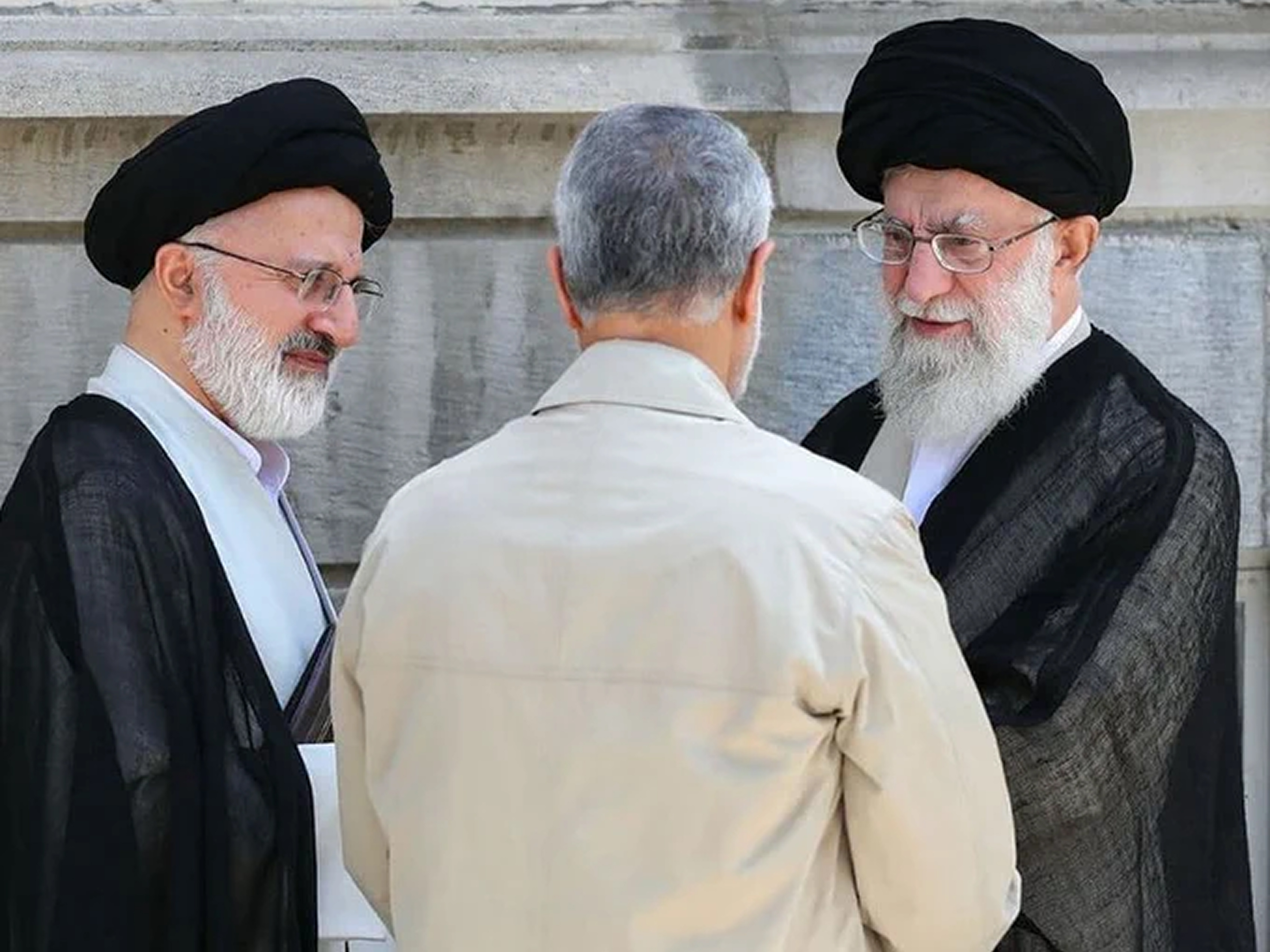
For decades, Ali Asghar Hejazi occupied one of the most consequential positions in the Islamic Republic without becoming one of its most recognizable officials. He rarely gave speeches, did not cultivate the public profile of a cabinet minister or military commander, and spent much of his career outside the routine glare of state television. Yet his proximity to Ali Khamenei placed him at a junction where intelligence, security policy, parliament, the judiciary and the office of the supreme leader converged.
That hidden influence became unexpectedly visible on July 9, 2026, when Hejazi appeared at Ali Khamenei's burial ceremonies in Mashhad. He had been absent from public view for more than four months. During that absence, reports had circulated that he had been killed in the February 28 strikes that destroyed parts of the leadership compound. Other accounts went further, alleging that he had survived only to fall under suspicion inside the state itself. His appearance at the Imam Reza shrine, speaking with senior officials, established at least one fact: Hejazi was alive.
His survival mattered for reasons extending far beyond the fate of a single official. Hejazi had spent more than three decades inside the political-security apparatus surrounding Khamenei. Public records identify him as a senior official responsible for security in the supreme leader's office, and the U.S. Treasury described him as closely involved in deliberations concerning military and foreign affairs. In 2013, Washington sanctioned him for supporting serious human-rights abuses and for providing support to the Revolutionary Guards and the Ministry of Intelligence.
His career provides a rare view into a central characteristic of the Islamic Republic: the coexistence of formal institutions with less visible networks capable of coordinating, pressuring or overriding them. Ministries existed, parliament voted, presidents governed and courts issued decisions. But beside and above those institutions operated the supreme leader's office, the Beit, whose influence depended not only on constitutional authority but also on intermediaries capable of moving information and instructions between competing centers of power.
Hejazi became one of those intermediaries. His significance was not primarily that he personally commanded a vast bureaucracy. It was that officials understood whom he represented. From the suppression of dissent and the intervention in parliamentary affairs to the management of intelligence relationships, Hejazi repeatedly appeared near moments when formal procedure collided with the preferences of the unelected leadership.
His name has also surfaced in unresolved allegations concerning some of the darkest episodes in the Islamic Republic's security history. Some of those allegations are documented only through testimony or political claims and have never been proven in court. Others, particularly his role in the security establishment and his involvement in the response to the 2009 protests, have been formally cited by foreign governments imposing sanctions.
The events of 2026 exposed another dimension of his position. The strikes that killed Ali Khamenei demonstrated that hostile intelligence services possessed unusually precise knowledge of the leadership's movements and meetings. Foreign Minister Abbas Araghchi, who was with Hejazi when their building was struck, later acknowledged the existence of a serious security breach and said the vulnerability could extend beyond electronic surveillance to other forms of penetration.
For a man whose career had been built around protecting the inner security architecture of the leadership, surviving such an attack inevitably placed him at the center of questions about how that architecture had failed.
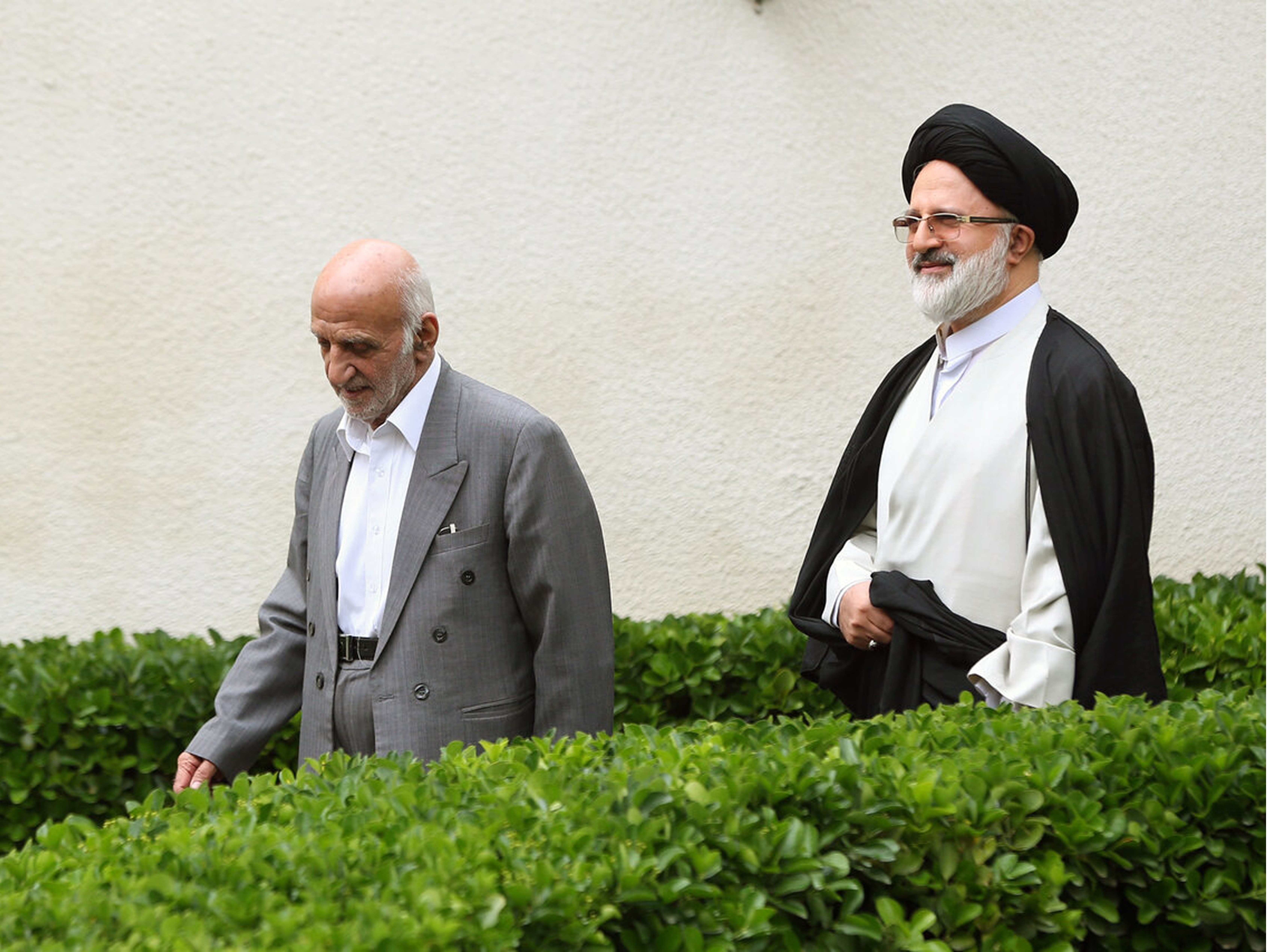
Hejazi emerged from the clerical-security networks that took shape during the Islamic Republic's formative years. Biographical accounts place his origins in Hamadan and describe longstanding connections between members of his family and Ali Khamenei. He studied at the Haqqani seminary in Qom, an institution whose graduates and affiliates later occupied influential positions in the judiciary and security establishment. One important figure in that network was Ali Qoddousi, the revolutionary prosecutor who helped bring Hejazi into the new state's judicial and security structures.
In the early post-revolutionary period, Hejazi became involved in committees responsible for purging and "sanitizing" government offices. These bodies examined the political, ideological and personal conduct of state employees and could facilitate dismissals or forced retirements. Accounts of Hejazi's work during this period describe ideological enforcement extending to women's clothing and behavior in government workplaces.
This early experience was significant. The revolutionary state was not merely replacing senior officials from the monarchy. It was restructuring the bureaucracy around loyalty to a new ideological order. The officials who performed these purges were learning a form of governance in which political reliability, security assessment and administrative employment were deeply intertwined.
Hejazi subsequently entered the intelligence apparatus of the Revolutionary Guards and later moved into the Ministry of Intelligence after the ministry was established in the 1980s. Public accounts identify him as one of the officials involved in building the early intelligence system, including service in senior positions connected to foreign and wartime intelligence. His decisive promotion came after Khamenei became supreme leader in 1989.
The office surrounding Khamenei was not developed as a conventional secretariat. Over time, it became a major coordinating center linking the leadership to the armed forces, intelligence agencies, judiciary, parliament, executive branch and powerful economic organizations. A Washington Institute study described the office as a center through which security, intelligence and political affairs were coordinated, with Hejazi heading its intelligence function.
Mohammad Mohammadi Golpayegani became the more visible administrative face of the office, while Hejazi operated deeper inside its political and security structure. That division suited him. A public political figure gains influence by being recognized. A security intermediary can gain influence by being recognized only by the people whose decisions matter.
By occupying the channel between Khamenei and institutions that formally possessed their own authority, Hejazi accumulated a different kind of power. A message transmitted through him could be interpreted not as advice from another bureaucrat but as an indication of the supreme leader's position. This distinction allowed the Beit to intervene without always issuing a formal decree.
The system also provided deniability. Ministries could act while the leadership remained formally distant. Security organizations could coordinate without a single visible command structure. Political actors could be pressured through private communications before conflicts became public.
During Mohammad Khatami's presidency, these arrangements became particularly important. Reformists controlled the executive branch and, after the 2000 parliamentary elections, the legislature. But the elected government did not control the entire security establishment. Institutions associated with the Revolutionary Guards, judiciary and supreme leader retained their own intelligence capabilities. Iranian political discourse increasingly referred to "parallel intelligence", security operations functioning outside or alongside the Ministry of Intelligence controlled by the government. Hejazi was repeatedly identified in accounts of this system as a central coordinator.
The importance of such a network was structural. It meant that winning an election did not necessarily give reformists command over the coercive machinery of the state.
One of the clearest demonstrations of Hejazi's function came during the confrontation over press legislation in 2000. The reformist-dominated Sixth Parliament intended to amend restrictive press laws. The issue had become a central political battle. Independent and reformist publications were expanding, while conservative institutions were using courts and regulatory mechanisms to close newspapers and prosecute journalists.
On August 6, 2000, Khamenei intervened and instructed parliament to abandon consideration of the proposed reform. Human Rights Watch described the move as an unprecedented intervention in the legislative process. Mehdi Karroubi, then speaker, accepted the instruction and removed the measure from consideration.
Hejazi was one of the key messengers. Former president Akbar Hashemi Rafsanjani's published diary records that Khamenei used Hejazi to communicate with Karroubi and senior reformist Behzad Nabavi over the press-law dispute. The significance was larger than the delivery of a letter. The episode demonstrated how the leader's office could interrupt a legislative process through a communication delivered outside parliament's ordinary chain of authority.
Parliament remained constitutionally present, its members continued sitting in their seats, and the bill simply stopped. This method of control was less visible than dissolving parliament or deploying troops against legislators. It was also more effective. The supreme leader's preference was understood before the political confrontation could escalate into an institutional crisis.
Hejazi's name also became associated with a much darker dispute over accountability within the intelligence establishment: the serial murders of intellectuals and political dissidents in the late 1990s. The killings of Dariush and Parvaneh Forouhar and other intellectuals eventually forced the government to acknowledge that Ministry of Intelligence personnel had been involved. Saeed Emami, a senior intelligence official, was identified by authorities as a principal figure and later died in custody in what the government described as suicide.
Human Rights Watch reported that the judicial investigation failed to establish responsibility farther up the chain of command. Iranian parliamentarians complained that those who ordered or instigated the murders had escaped scrutiny. Allegations involving Hejazi have circulated around that unresolved chain of command, including purported accounts attributed to Emami suggesting that senior officials were informed of operations. Those allegations never produced a public judicial finding against Hejazi, and available evidence does not justify presenting his responsibility for the murders as established fact. What the episode illustrates more securely is the political protection surrounding the upper levels of the intelligence system: lower-ranking operatives were prosecuted while questions about senior authorization remained unresolved.
The same architecture reappeared in the aftermath of the disputed 2009 presidential election. Mass demonstrations challenged the announced victory of Mahmoud Ahmadinejad. Security forces, the Basij, the Revolutionary Guards and intelligence organizations conducted a broad crackdown involving arrests, violence and severe abuses against detainees.
The U.S. Treasury later singled out Hejazi. In imposing sanctions, it said he had used his influence behind the scenes to empower intelligence elements involved in violent suppression and described him as having played a leading role after the 2009 election. The designation also cited his support for the Revolutionary Guards and Ministry of Intelligence. The European Union had already placed him under restrictive measures in 2012.
These measures did not constitute judicial convictions, and the Islamic Republic has routinely rejected foreign sanctions as politically motivated. But the descriptions are consistent with a broader picture of Hejazi's position: a senior official whose influence derived from his ability to connect the supreme leader's office to coercive institutions without necessarily commanding them publicly.
His role was not confined to repression. In 2015, as parliament considered legislation connected to implementation of the nuclear agreement, Hejazi again appeared at the intersection between elected procedure and leadership preference. Conservative lawmaker Mehdi Kouchakzadeh claimed that parliamentary speaker Ali Larijani, Supreme National Security Council secretary Ali Shamkhani and Hejazi met immediately before the parliamentary process was accelerated. Contemporary reporting recorded accusations that the meeting was intended to prevent lengthy consideration of numerous proposed amendments.
Whatever the precise content of that meeting, Hejazi's presence conveyed something important. He was not the speaker of parliament. He was not the secretary of the Supreme National Security Council. He did not need either title. His political weight came from the assumption that when he entered such a meeting, the supreme leader's office had entered it with him.
The pattern across these episodes is striking. In the press-law dispute, he transmitted the leadership's position into parliament. During the reform era, he operated within the world of parallel intelligence. After the 2009 election, foreign sanctions authorities identified him as a senior coordinator of repression. During the nuclear agreement debate, he appeared again in a small meeting preceding a consequential parliamentary decision. The mechanism was not government by formal decree alone. It was government through access.
On the morning of February 28, 2026, the system built around secrecy, compartmentalization and protection suffered a catastrophic breach. Ali Khamenei was killed when U.S. and Israeli strikes hit the leadership complex during the opening phase of the war. Reuters later reported that Khamenei died in the first strikes and that his death brought his 37-year rule to an end.
Hejazi was inside the compound. Foreign Minister Abbas Araghchi later gave a detailed account of the morning. He said he had arrived at around 9 a.m. to brief Hejazi on negotiations and the deteriorating diplomatic environment. According to Araghchi, he was explaining why the risk of war had suddenly become much more serious when the strikes began.
Three explosions followed within seconds. Araghchi said the first was farther away, the second closer, and the third nearly adjacent to the building where he and Hejazi were meeting. The section containing Hejazi's principal office was directly hit and largely destroyed. His secretary, Eivazi, was killed. Araghchi and Hejazi were in another section of the building and were trapped amid collapsed walls, roofing and debris before making their way out.
The account is remarkable because of what happened next. Araghchi emerged without knowing whether Khamenei had survived. Vehicles and exits had been damaged. He eventually left the area with help from a civilian driver. For days, he said, surviving officials struggled to determine who among the leadership was alive and who had been killed.
The physical destruction was severe, but the intelligence implications were more serious. The attackers had not merely identified a general government district. Multiple senior meetings were being held inside different parts of the security and leadership apparatus. According to Araghchi, the precision with which those locations were targeted indicated a profound security breach. He publicly raised the possibility that the vulnerability involved more than mobile phones or electronic tracking and said authorities also had to consider human penetration.
That admission fundamentally altered the context surrounding Hejazi. For decades, his authority had been tied to precisely the kind of information-security system that had now failed. He was one of the officials expected to understand who had access to the leader, how meetings were organized, how intelligence flowed and how the Beit protected itself against penetration. Yet hostile forces knew enough to strike several sensitive targets at an extraordinary moment.
In the confusion following the attack, reports emerged that Hejazi himself had been killed. His absence from public life gave those reports credibility. Even public reference sources recorded a death date before later evidence contradicted them. Then information gradually emerged that he had survived.
Araghchi's testimony eventually provided the clearest explanation. The attackers had successfully identified Hejazi's building and destroyed the side containing his office, but Hejazi happened to be meeting elsewhere within the structure. Geography measured in meters appears to have separated him from the fate of his secretary and numerous other senior figures.
For more than 130 days, however, Hejazi remained unseen, until he appeared in Mashhad. Photographs from Khamenei's burial showed him among senior officials, apparently conversing normally. IranWire reported that it was his first public appearance since the war and noted that the sighting contradicted earlier claims that he had been assassinated. The mystery of whether he was dead was resolved, but the mystery of what had happened to him politically was not.
The vacuum created by Khamenei's death triggered the most consequential leadership transition inside the Islamic Republic since 1989. The Assembly of Experts selected his son, Mojtaba Khamenei, as the new supreme leader in early March. Reuters reported that the succession took place approximately a week after Ali Khamenei was killed.
Hejazi's relationship to that transition became the subject of conflicting accounts. Mohammad Reza Bahonar later said Hejazi had appeared before the Assembly of Experts during the early succession process and conveyed Ali Khamenei's insistence that his children should not intervene in political affairs. Bahonar said the issue was discussed by assembly members. His description supports the conclusion that Hejazi participated in the succession debate, but it is narrower than claims that he formally declared Mojtaba unqualified for leadership.
Separate reporting during the post-strike crisis described Hejazi and senior cleric Alireza Arafi as favoring a stronger role for the temporary leadership council amid disputes over the distribution of authority. Those reports relied on sources describing internal political maneuvering and cannot be treated as a complete public record of the succession struggle.
The more explosive allegations concerned espionage. Jaber Rajabi, a former figure connected to Iranian political and militia networks who later became an outspoken critic of the Islamic Republic, publicly claimed that suspicion had fallen on Hejazi after the February attack. Rajabi had previously worked as a foreign-policy adviser during Mahmoud Ahmadinejad's presidency and acted as an intermediary with Iran-backed militia networks in Iraq, according to subsequent profiles.
According to the allegations attributed to Rajabi, intelligence officials had warned that an attack was imminent, but Hejazi rejected or discounted the warning. The account further alleged that Hejazi contacted senior commanders and officials before the fatal meeting around Khamenei while himself attending a different meeting with Araghchi and intelligence officials. Rajabi went on to claim that Hejazi was placed under house arrest and investigated for possible collaboration with the enemy. Another allegation linked him to a supposed network referred to as "Zeytun."
These are serious accusations, but they are also unproven. No publicly available charge sheet, judicial proceeding or independently verified body of evidence has established that Hejazi passed information to Israel or the United States. Rajabi himself was reported as stopping short of claiming that espionage had been conclusively proven. The extraordinary intelligence penetration demonstrated by the February strikes creates a factual basis for investigating leaks inside the state, but it does not by itself identify the source of those leaks.
The circumstances can be read in more than one way. One possibility is the most dramatic: that a senior insider assisted the attackers. Another is that Hejazi became a convenient target for suspicion because he was responsible for security at the moment of an unprecedented security failure. A third is political. In a succession crisis, accusations of espionage can become instruments for weakening rivals, removing officials from sensitive positions or explaining institutional failures without exposing the broader system that produced them.
Hejazi's prolonged absence after the attack provided space for all three narratives to circulate. His eventual public appearance weakens claims that he had been killed or permanently disappeared into detention. It does not establish what restrictions, interrogations or internal investigations may have occurred during the months in which he remained unseen.
More importantly, the episode reveals a paradox at the heart of the Islamic Republic's security model. The system invested enormous authority in officials who operated away from formal transparency. Men such as Hejazi accumulated influence precisely because their work remained difficult to observe. Instructions moved privately. Intelligence networks overlapped. Security institutions reported through multiple channels. Political intervention could occur without a public record of who ordered what.
That opacity offered protection when the system was strong, but during a crisis, it produced uncertainty. After the February strikes, officials did not immediately know who had survived. Outside observers could not determine whether Hejazi was dead, arrested, suspected or still serving. Competing factions and defectors could circulate allegations that were difficult to prove or disprove because the institutions involved had never operated transparently in the first place. The same secrecy that protected the Beit also made it vulnerable to rumor, penetration and internal distrust.
Hejazi's career therefore matters less as the biography of a single cleric than as a study of how authority has functioned within the Islamic Republic. His rise shows how revolutionary judicial networks fed into intelligence institutions. His tenure under Khamenei illustrates the development of the supreme leader's office into a political-security command center. The press-law confrontation demonstrates how private intervention could halt an elected legislature. The unresolved questions surrounding the serial murders demonstrate the difficulty of tracing accountability upward through intelligence chains. The 2009 crackdown shows how foreign governments came to identify senior officials inside the leader's office as participants in repression. The 2015 nuclear debate demonstrates how a figure without an elected mandate could still carry decisive political weight. And the events of 2026 expose the vulnerability of the entire structure.
A system designed to concentrate sensitive information within a trusted inner circle faced an adversary capable of locating that circle with lethal precision. A security official whose influence had depended on secrecy survived the destruction of his own office, disappeared from view, became the subject of espionage allegations, and then resurfaced at the funeral of the man he had served for more than three decades.
There is no public evidence sufficient to conclude that Hejazi betrayed Khamenei. There is substantial evidence that he belonged to the small group of officials through whom Khamenei exercised power beyond the visible boundaries of Iran's elected institutions. That distinction is important.
The most consequential story is not whether every allegation surrounding Ali Asghar Hejazi ultimately proves true. It is that one relatively obscure official could sit for decades between intelligence agencies, security forces, parliament and the supreme leader, repeatedly appearing at moments when private authority displaced public procedure. His survival has preserved one of the last living links to that system. It may also preserve one of its most important witnesses.

