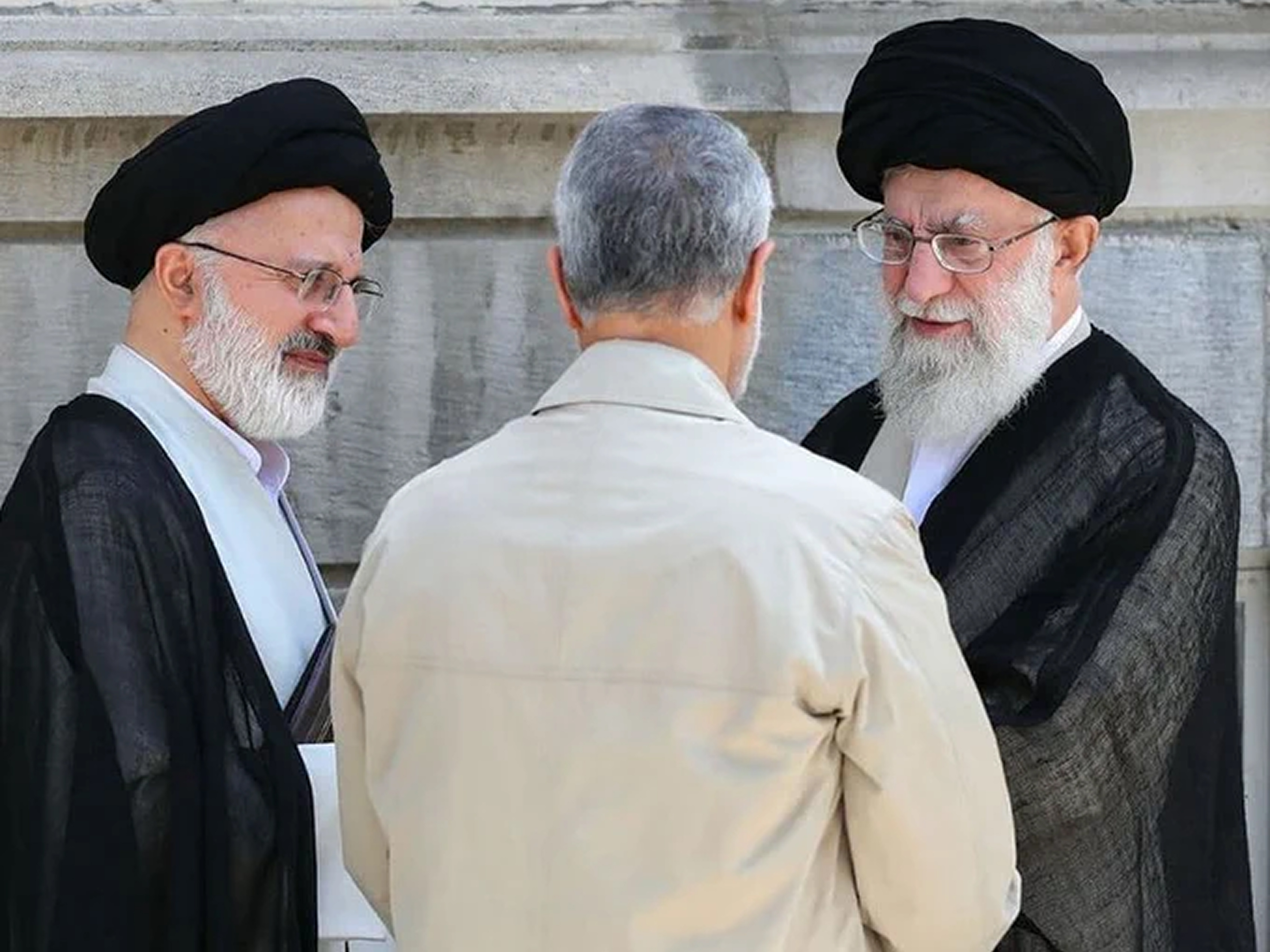




The Man Behind the Command Chain: Mohammad Shirazi and Khamenei's Hidden Military Office
How Mohammad Shirazi turned personal trust into a durable command channel inside the Islamic Republic.
|
Pars Barghandan

On the morning of February 28, 2026, Mohammad Shirazi left the home where he and his wife had been living since their previous residence was damaged during the earlier 12-day war and travelled to the office where he had spent most of his professional life. For close to 36 years, Shirazi had occupied one of the least publicly understood but most sensitive positions around Ali Khamenei: head of the military office of the commander-in-chief. His name rarely carried the public recognition of figures such as Qassem Soleimani, Mohammad Bagheri or Hossein Salami, yet the office he controlled sat at the junction between Khamenei and the senior leadership of the armed forces, dealing with military appointments, instructions, communications and the implementation of decisions emanating from the commander-in-chief. Contemporary reporting described the office as an intermediary between Khamenei and the military establishment, responsible for following military affairs and conveying appointments, decrees and orders to the armed forces.
That morning, however, the machinery surrounding the leadership was itself under attack. Heavy explosions began in Tehran as the United States and Israel launched major strikes against the Islamic Republic. Shirazi's wife, Fatemeh Dianati, later described repeatedly calling his office after learning that the area around Khamenei's compound had been hit. The telephone rang without an answer, while relatives and acquaintances were unable to provide reliable information about what had happened. The uncertainty continued for hours. Eventually, the family learned that Shirazi had been killed in the attack, one of several senior military and security officials lost during the opening phase of the war. Iranian authorities publicly confirmed his death, while subsequent reporting identified him among the officials killed in strikes against the upper levels of the command system.
The circumstances of his death were extraordinary, but the more revealing story lies in the decades that preceded it. Shirazi's career illustrates how authority functioned around Khamenei through a combination of formal institutions and relationships of personal confidence that often predated the establishment of the Islamic Republic itself. His influence did not depend principally on commanding troops in the field or holding the highest military rank. He spent much of his career identified as a brigadier general, while many of the commanders passing through the institutions with which his office dealt held higher rank. His leverage came instead from his position at the entrance to the commander-in-chief's military chain, where proximity to Khamenei could matter as much as the insignia on a uniform.
The structure was visible whenever senior officers were appointed or transferred. Shirazi regularly appeared at military ceremonies not simply as an observer but as an official conveying Khamenei's expectations to newly installed commanders. When senior Army officials were appointed in 2017, Shirazi explained publicly that the appointments had been proposed through the Army command and accepted by Khamenei, adding that the new officials were expected to put the leader's expectations into practice. When Hossein Salami became commander-in-chief of the Revolutionary Guards in 2019, Shirazi again appeared at the transition ceremony and said that the instructions contained in the decrees concerning Salami and his predecessor Mohammad Ali Jafari had to be studied carefully and converted into practical action. These episodes provide rare public evidence of an office that usually operated away from public scrutiny.
Shirazi's position also extended into the security environment surrounding domestic unrest. In June 2023, months after nationwide protests triggered by the death of Mahsa Jina Amini, he participated in a high-level meeting in Mashhad attended by senior intelligence, military and political officials. The gathering focused on improving coordination between the Ministry of Intelligence, the Revolutionary Guards Intelligence Organization and other institutions in preparation for possible future unrest. Shirazi called for what authorities described as prevention of "sedition" to become operational through intelligence awareness, preparedness and timely action. His participation does not by itself establish that he personally issued specific lethal orders against demonstrators, and the public record does not provide verified evidence proving that he personally ordered shootings during earlier protest movements. It does, however, place the head of Khamenei's military office within the senior institutional architecture responsible for coordinating the state's response to internal challenges.
By the time Shirazi was killed, the network that had protected and empowered him for decades had entered a period of unprecedented vulnerability. His home had already been struck in the earlier war. Senior commanders had been killed and replaced. The February 2026 attacks then reached the leadership compound itself, killing Khamenei and numerous officials from the military and security establishment. The official appointed to succeed Shirazi, Aboulghasem Babaeian, was reported killed only about a week later.
The sequence exposed a contradiction at the heart of the system Shirazi had served. Centralizing authority around a small circle of long-trusted officials created continuity and allowed Khamenei to exercise direct influence across the armed forces. It also created identifiable points of dependency. Once those individuals and locations became accessible to hostile intelligence, the same concentration of authority that had strengthened central control could magnify the effects of a successful strike.
Mohammad Shirazi's life therefore offers more than the biography of an obscure general. It provides a window into the institutional culture of Khamenei's leadership, where personal loyalty and administrative authority repeatedly overlapped, where officials with limited public visibility could exercise considerable influence, and where consequential decisions travelled through offices whose internal records remained largely inaccessible to the public. His death, after decades spent inside one of the most protected circles of the Islamic Republic, also revealed how quickly an architecture designed around secrecy and trusted intermediaries could become vulnerable once its inner structure was mapped by an adversary.
The origins of Shirazi's position cannot be understood only through military promotions or official appointments because his access to Khamenei began before either man occupied the positions that would later define their careers. Mohammad Shirazi was born in Kashkuiyeh, near Rafsanjan in Kerman Province, in the mid-1950s. Unlike many senior military personalities who later published extensive memoirs or became recurring figures in state media, relatively little was publicly recorded about his youth and private life. What is much clearer is the role played by his family in establishing a relationship with Khamenei before the 1979 revolution.
The key figure was Mohammad's older brother Abbas Shirazi, a cleric who had developed ties with Khamenei during the pre-revolutionary period. Accounts of the family relationship state that when Khamenei travelled to Rafsanjan for religious or political activity, he stayed at Abbas Shirazi's home. The connection continued during the period in which Khamenei was exiled to Iranshahr, when members of the Shirazi family visited him there. These were not relationships created after the Islamic Republic had distributed official positions and patronage. They belonged to the earlier network of clerics, activists and trusted associates whose bonds were forged under the monarchy and later carried into the new state.
After the revolution, Abbas Shirazi entered the wartime ideological apparatus and eventually became involved in propaganda activities connected with the front during the Iran-Iraq war. He was killed in 1985. By that point, however, the relationship he had helped establish between his family and Khamenei had already opened a path for Mohammad. According to published accounts of Khamenei's inner network, Mohammad Shirazi was serving as a conscript officer in an armored section of the Army when his brother introduced him to Khamenei. The introduction would prove decisive because Khamenei's own responsibilities were rapidly expanding.
In 1980, Ruhollah Khomeini appointed Khamenei as his representative to the Supreme Defense Council at a moment when the newly established political order was confronting the outbreak of war with Iraq. Shirazi entered the same institutional environment and became deputy in the council's self-sufficiency section. The position placed him close to a national wartime decision-making body and, importantly, close to Khamenei while the latter was acquiring direct experience in military affairs. Shirazi was not emerging from this period as one of the war's famous field commanders. His career instead developed within the administrative and political structures surrounding command, a pattern that would define his influence for the rest of his life.
By 1988, according to later reporting on Khamenei's network, Shirazi's name was being discussed in connection with the position of deputy commander-in-chief, a role that ultimately went to Akbar Hashemi Rafsanjani. Even without receiving that appointment, the episode suggests that Shirazi had already advanced considerably beyond his initial position. The decisive change came after Khomeini's death in June 1989 and Khamenei's elevation to supreme leader. As commander-in-chief under the constitutional order, Khamenei now sat above the Army, the Revolutionary Guards and the wider armed establishment. Shirazi moved into his office and assumed responsibility for the military office, beginning a tenure that would continue without interruption until 2026.
The longevity of that appointment is difficult to overstate. During the same period, presidents entered and left office, Revolutionary Guards commanders were replaced, Army leadership changed repeatedly, chiefs of the General Staff came and went, and senior officers who had appeared indispensable at one point in the Islamic Republic's history disappeared through retirement, political displacement or death. Shirazi remained in place. By 2019, outside analysis of civil-military relations was already identifying the military office as the body providing Khamenei with a direct line to the country's military leadership and describing Shirazi as a Basij brigadier general whose unusually long tenure was connected to his close personal relationship with Khamenei.
His brothers' trajectories further illustrate how a pre-revolutionary relationship developed into a family presence within strategically important institutions. Abbas had served the wartime propaganda apparatus before his death. Ali Shirazi, another brother, later became Khamenei's representative in the Quds Force after previously serving in a similar representative role within the Revolutionary Guards Navy. Ali also produced writing about Khamenei that presented his life and leadership in strongly favorable terms. The result was a family network in which one brother had been associated with wartime ideological mobilization, another occupied the military office immediately surrounding the commander-in-chief, and another worked inside the ideological representation system of the Quds Force.
It would be speculative to reduce Mohammad Shirazi's entire career to family connections alone. He spent decades acquiring institutional experience and clearly became familiar with the internal workings of the armed forces. Nevertheless, the available history demonstrates that his access began through a personal network established before the revolution and survived long enough to become embedded within the formal machinery of state. This combination of personal trust and institutional responsibility was characteristic of the way Khamenei managed several sensitive parts of his office. Officials were valuable not simply because they possessed technical expertise, but because their reliability had been tested over long periods, often beginning well before they received their most important titles.
In Shirazi's case, that trust became unusually durable. Instead of moving periodically between ministries, military commands or political positions, he remained attached to the same center of authority. His career consequently became inseparable from Khamenei's own tenure. The military office evolved, commanders changed and the security environment transformed, but the individual controlling one of the principal administrative channels between the commander-in-chief and the armed forces remained the same.
The title "head of the military office" can sound bureaucratic, particularly when compared with positions such as commander of the Revolutionary Guards or chief of the General Staff. Yet the actual importance of the office derived from where it sat in the chain of authority. Khamenei, as supreme leader, exercised constitutional command over the armed forces. The implementation of that authority required a permanent institutional channel through which policies, appointments, instructions and evaluations could move between the leadership office and the military organizations below it. Reporting on the structure identified Shirazi's office as responsible for following military affairs, facilitating senior appointments and conveying the leader's decrees and orders to the armed forces.
This gave Shirazi an unusual position because his formal rank did not capture the significance of the authority passing through his office. He was commonly described as a Basij brigadier general rather than as a career commander occupying the highest rank structure of either the Army or the Revolutionary Guards. Around him were officers who held the rank of major general and commanded organizations containing tens or hundreds of thousands of personnel. Shirazi did not automatically outrank them in the conventional military sense, and it would be misleading to describe every senior commander as his formal subordinate. Nevertheless, when those commanders dealt with the military office, they were interacting with an institution operating immediately on behalf of the commander-in-chief.
The distinction between personal rank and delegated authority explains much of Shirazi's otherwise unusual career. He did not need to command a major formation because his importance was derived from proximity to the person who possessed ultimate command authority. His office could communicate Khamenei's expectations to officials whose formal rank exceeded his own, and the authority of those communications came not from Shirazi personally but from the political and constitutional position behind him.
Public ceremonies provide some of the clearest examples. In November 2017, at an Army transition ceremony, Shirazi explained that appointments had been proposed by the Army commander and accepted by Khamenei, and he emphasized that the new officials were expected to realize Khamenei's expectations in practice. The comment revealed a process in which the military hierarchy could propose personnel while final approval and strategic expectations remained connected to the commander-in-chief. Shirazi's presence at such ceremonies placed him at the point where those two sides met.
A similar pattern emerged after Hossein Salami was appointed commander-in-chief of the Revolutionary Guards in April 2019. During the formal transition, Shirazi publicly referred to Khamenei's instructions to Salami and argued that the contents of the appointment decrees concerning both Salami and outgoing commander Mohammad Ali Jafari required detailed consideration and practical implementation. This was more than ceremonial language about respecting a decree. Shirazi described the decree as a working document containing instructions that had to be translated into institutional action.
Later that year, during another Revolutionary Guards appointment, Shirazi explained the reasoning behind Ali Fadavi's selection as deputy commander, pointing to the operational experience required alongside Salami. Once again, he was publicly discussing the logic behind personnel decisions inside one of the most important military organizations in the country.
Other appearances reveal that the military office was involved in questions extending beyond personnel. In 2017 Shirazi spoke at an Army gathering about implementing Khamenei's directives concerning organizational agility and called for an intelligence posture capable of understanding and confronting adversaries. In another meeting he emphasized the importance Khamenei placed on close interaction between the General Staff and the ideological-political structures surrounding the commander-in-chief. Individually, these statements could be dismissed as ordinary official rhetoric, but collectively they show an official consistently appearing where the leader's military priorities were being translated into organizational expectations.
His remarks about Qassem Soleimani in January 2024 provide another insight into the informational hierarchy surrounding Khamenei. During a lengthy visit to the Documentation and Research Center of the Sacred Defense, Shirazi stated that only part of Soleimani's activities had become visible publicly and that, in his assessment, nobody other than Khamenei knew the full extent of what the former Quds Force commander had done. The comment was delivered in a commemorative context and carried the reverential language typical of official discussion of Soleimani, but it nevertheless revealed something about how Shirazi understood the system in which he worked. Sensitive military activity could be known completely only at the apex, while officials and institutions below that level possessed partial views of a larger picture.
Shirazi himself was positioned unusually close to that apex, yet his public profile remained limited. He appeared in photographs behind senior commanders, attended transition ceremonies and carried messages, but rarely cultivated a personal political identity independent of Khamenei. Unlike Soleimani, he was not turned into a national military symbol. Unlike senior Revolutionary Guards commanders, he was not routinely used as a public commentator on regional strategy. His power was quieter and more administrative, exercised through continuity, access and the ability to operate across institutional boundaries.
This relative invisibility should not be confused with absence of influence. In highly centralized systems, some of the most consequential officials are not those who dominate television coverage but those who control access, information and the transmission of decisions. Shirazi's career demonstrates precisely that distinction. His name rarely stood at the center of political debate, yet for decades commanders moving through the upper reaches of the Army, the Revolutionary Guards and the General Staff encountered the same official at the military office surrounding Khamenei.
That continuity made Shirazi a repository of institutional memory. A commander appointed in the 1990s and another appointed two decades later might belong to entirely different generations of the armed forces, yet both operated under a supreme leader whose military office was still headed by the same man. Such continuity could make coordination more efficient because Shirazi understood personalities, institutional rivalries and Khamenei's preferences across decades. At the same time, it concentrated knowledge and access inside an unusually narrow circle, reinforcing a command culture in which personal confidence could become almost indistinguishable from bureaucratic permanence.
The significance of Shirazi's position becomes more politically sensitive when the military command system is examined alongside the Islamic Republic's response to domestic protest movements. The armed and security institutions ultimately answer to a political structure in which the supreme leader possesses extensive authority over the coercive apparatus, and Shirazi spent decades inside the office designed to maintain the connection between that authority and the institutions carrying it out. This does not mean that every security operation can automatically be attributed to him personally, but it makes his participation in internal-security coordination important when assessing the broader architecture of decision-making.
One of the clearest documented examples came in June 2023, less than a year after the death of Mahsa Jina Amini and the nationwide protests that followed. Senior officials gathered in Mashhad for a meeting involving the Ministry of Intelligence and the Revolutionary Guards Intelligence Organization. Those reported present included Mohammad Mohammadi Golpayegani, chief of Khamenei's office; Revolutionary Guards commander Hossein Salami; Interior Minister Ahmad Vahidi; Supreme National Security Council secretary Ali Akbar Ahmadian; senior intelligence officials; and Mohammad Shirazi as head of the military office. The purpose of the gathering, according to reporting at the time, was to improve coordination among the principal intelligence and security organizations and establish a more unified approach to future unrest.
The language used by participants made the preventive character of the meeting clear. Khamenei's message to the gathering reportedly addressed weaknesses in cooperation between the major intelligence institutions, while officials discussed moving beyond routine information-sharing toward joint cases, joint missions and common operational structures. Shirazi emphasized the need to prevent what officials called "sedition" through intelligence dominance, preparation and timely action, saying that prevention had to become fully operational.
The importance of this episode lies less in proving that Shirazi controlled individual units on the street than in showing the level at which he participated in planning. He was sitting alongside the heads of institutions responsible for intelligence collection, policing, internal security and military power while they discussed how those organizations should coordinate in anticipation of renewed protest. The gathering therefore challenges any portrayal of the military office as a purely ceremonial secretariat concerned only with protocol and appointments.
At the same time, an evidence-based account requires a clear boundary between institutional proximity and proof of personal responsibility for specific killings. The available record cited here does not establish that Shirazi personally ordered security personnel to fire on demonstrators during the 2009 protests, the 2017-18 unrest, the November 2019 protests or the movement that followed Amini's death in 2022. Nor is there independently verified evidence in the public record presented here proving claims that he personally transmitted particular coded authorizations for lethal force. Such assertions require documentation that has not been publicly established.
What can be documented is more structural. Shirazi headed the military office of the commander-in-chief throughout those periods, participated in a high-level meeting explicitly concerned with preventing renewed protest mobilization, and publicly occupied a role dedicated to implementing Khamenei's military instructions. These facts place him within the institutional environment in which strategies of internal control were coordinated, even where the precise chain leading to an individual operation remains hidden.
This distinction helps explain why accountability inside opaque command structures is so difficult to establish. The visible ends of the process are usually easier to identify. At the top sits a political leadership issuing broad directives about restoring order, confronting unrest or defending the political system. At street level are police, Basij units, Revolutionary Guards personnel and other security forces whose actions can sometimes be recorded through video, witness testimony or official documents. Between these levels lies a less visible administrative network where instructions are refined, passed between institutions, coordinated and translated into operational priorities.
For almost 36 years, Shirazi worked inside that middle layer. His office was not necessarily the sole conduit for every security decision, and the Islamic Republic maintained numerous parallel institutions, including the Supreme National Security Council, the General Staff, the Interior Ministry, the Revolutionary Guards and multiple intelligence organizations. Yet the military office's direct connection to Khamenei gave it a distinctive function within this crowded command environment.
The Mashhad meeting in 2023 is particularly revealing because it brought several of these parallel institutions into the same room. Intelligence officials discussed operational integration, senior political officials addressed coordination, and Shirazi represented the office situated directly next to the commander-in-chief. The meeting therefore offers a rare public glimpse of how separate components of the security apparatus sought to overcome fragmentation and operate as a more unified system.
It also illuminates a recurring feature of Khamenei's leadership. Rather than relying exclusively on ordinary cabinet structures or ministries, authority was distributed across overlapping organizations whose senior officials often maintained direct or semi-direct relationships with the supreme leader's office. This gave the leadership multiple channels of information and influence, but it also made the true line of responsibility difficult for outsiders to reconstruct. A decision might involve a formal security council, a military command, an intelligence organization and the supreme leader's own office simultaneously, with only fragments of their communication entering the public record.
Shirazi's position was important precisely because he operated where those formal and personal channels converged. His public statements repeatedly framed institutional action in terms of implementing Khamenei's expectations. His presence in internal-security coordination showed that those expectations were not limited to conventional national defense. Yet because the military office remained opaque, the full record of what it communicated during periods of unrest has never been made public.
His death closed one potential source of future testimony about that system. Shirazi never appeared before an independent judicial or parliamentary process capable of examining his role in disputed security operations, and the records of the military office have not been opened to public scrutiny. The result is an incomplete picture in which institutional importance can be documented more clearly than individual operational responsibility.
For victims of state violence and families seeking accountability, that distinction may be unsatisfying, but it remains essential to serious investigation. A credible reconstruction cannot simply substitute assumption for evidence. What can be said is that Shirazi spent decades inside a command structure that linked Khamenei to the institutions responsible for the Islamic Republic's coercive power and that, when senior officials gathered to strengthen coordination against future protests, he was part of that process.
By 2025, the security environment surrounding Shirazi had changed dramatically. For decades, his career had been built on the assumption that proximity to the supreme leader provided not only authority but also access to some of the most protected spaces in the country. The successive wars of Khamenei's final period exposed how vulnerable those spaces had become.
During the earlier 12-day war, the Shirazi family's residence was struck. Dianati later said that the damage made the house uninhabitable and that she moved to her father's home while her husband spent much of his time at the leadership compound. The available account does not establish whether Shirazi was physically present when the residence was attacked, nor does it prove exactly how the property was identified or whether the strike was specifically intended to kill him. What it demonstrates is that the war had already reached directly into his personal environment before the attack that ultimately killed him.
The significance of this episode becomes clearer when viewed alongside the broader losses sustained by the Islamic Republic's command structure. The earlier conflict had killed senior military officials and forced rapid replacements inside the armed forces. The leadership was therefore not entering the February 2026 war with the same personnel structure it had possessed previously. It was already operating under pressure, reconstructing command arrangements after targeted losses and adapting to evidence that adversaries possessed unusually detailed information about the location of senior officials.
Shirazi nevertheless continued performing the same function he had held since 1989. According to his wife's later account, he spent the night before February 28 at home and left for work according to his normal routine the following morning. She also went to work. At approximately 9:30 a.m., explosions began. A friend near Khamenei's compound contacted her and said the surrounding area had been struck, prompting her to call Shirazi's office repeatedly.
No one answered.
For the wife of a man who had spent decades inside one of the most connected offices in the Islamic Republic's military structure, the following hours were marked by an extraordinary absence of information. Calls to other people did not produce a reliable account of his condition. The office that had served as a communications channel between Khamenei and the senior military hierarchy had itself fallen silent.
Eventually, one of Shirazi's brothers reached the area and the family learned that Mohammad Shirazi had been killed. Iranian authorities publicly announced his death on March 1, identifying him among seven senior commanders killed in the attacks. Later reporting connected him to the strike on the senior leadership and defense meeting.
The family account contains another detail that illustrates the confusion of the first hours. When Shirazi's brother asked about Khamenei, he was reportedly told that Khamenei was safe. That information was subsequently overtaken by confirmation that Khamenei himself had been killed during the opening attacks. The discrepancy does not establish whether officials deliberately concealed the death or whether those speaking to the family simply lacked accurate information at that moment. In the immediate aftermath of a major strike on the command center, compartmentalized information, destroyed communications and uncertainty about casualties could each have contributed to the contradictory message.
Whatever the explanation, the episode revealed an astonishing breakdown at the summit of a system designed around controlled information. A family with unusually close access to the leadership could know that Shirazi had been killed while still receiving inaccurate information about Khamenei's fate. The uncertainty extended into the very network that had spent decades managing communication around the commander-in-chief.
The physical destruction was also severe. Dianati later described being unable to have a conventional final farewell with her husband because of the condition in which he was recovered. Iranian state reporting published months later characterized Shirazi as having been killed beside Khamenei on February 28 and described him as perhaps the military figure closest to the former supreme leader.
Shirazi's death was only one part of a much larger decapitation of senior military and security leadership. Contemporary assessments identified a long list of officials killed in the opening attacks, including senior Revolutionary Guards, defense, intelligence and General Staff personnel. The scale of the losses suggested that the operation had been designed not merely to damage military infrastructure but to disrupt decision-making and command continuity at the highest level.
The fate of Shirazi's successor reinforced that interpretation. Aboulghasem Babaeian was appointed to head the military office after Shirazi's death, but Radio Farda later reported that Babaeian was killed on March 8, only about a week after assuming the position. The rapid elimination of two successive heads of the same office was especially striking given that Shirazi had held the post uninterrupted for more than three decades.
The contrast could hardly have been sharper. Under Khamenei, the office had achieved extraordinary personnel stability. A single trusted official had remained in place through several generations of commanders. Once the war reached the command center, however, the same office lost two leaders in little more than a week.
That sequence raised questions that went beyond physical protection. The successful targeting of senior officials suggested that the problem was not simply insufficient air defense around isolated buildings. An adversary had apparently developed enough intelligence about command locations, movements, meetings or communications to identify moments when senior personnel were vulnerable. In such an environment, the closed and personalized nature of the leadership network could become a weakness because a relatively small number of people represented unusually valuable points of continuity.
For decades, concentrating responsibility in trusted individuals such as Shirazi had offered Khamenei clear advantages. The supreme leader could rely on officials whose loyalty had been established over many years, reduce dependence on changing political administrations and maintain direct influence over military organizations even as their commanders rotated. Yet centralization also meant that some individuals accumulated irreplaceable knowledge about relationships, procedures and the preferences of the leadership. Removing such officials could therefore create disruption disproportionate to their formal rank.
The February 2026 attack exposed precisely this vulnerability. Shirazi was valuable not because he personally controlled the largest number of missiles or troops, but because he connected people and institutions. He represented memory, access and continuity. Destroying that link at the same time as other senior leaders were being killed magnified the effects of the strike.
The war thus exposed two very different kinds of visibility. To the public, the inner workings of Khamenei's military office remained largely opaque. Much of what Shirazi did could only be reconstructed indirectly through ceremonies, official statements and occasional reports about his participation in meetings. To hostile intelligence services, however, senior leadership networks had apparently become visible enough to target with lethal precision.
That disparity may be one of the most revealing aspects of the final period of Shirazi's career. The architecture of secrecy remained effective at limiting public understanding of how decisions moved inside the Islamic Republic, but secrecy did not necessarily prevent an external adversary from mapping the people and places at the center of the system.
Mohammad Shirazi's career demonstrates how the architecture around Khamenei operated through two overlapping hierarchies. The first was visible and formal, consisting of military ranks, organizational charts, commanders, ministries and the General Staff. The second was less visible and depended on proximity to the supreme leader, personal trust, privileged access and offices capable of transmitting his authority across institutional boundaries. Shirazi's unusual longevity resulted from his position within both structures, but particularly from the second.
Seen only through rank, his career can appear puzzling. Senior commanders with greater formal status repeatedly passed through the armed forces while Shirazi remained a brigadier general working from an office. Seen through the logic of access, the arrangement becomes easier to understand. He did not need to outrank every commander because he represented an authority that did. When he spoke at appointment ceremonies, conveyed expectations or discussed how leadership decrees should be implemented, he operated as the institutional extension of the commander-in-chief rather than as an independent military power.
This helps explain why personal trust mattered so much. Shirazi had known Khamenei's circle through his family since before the revolution, worked close to him during the wartime period and then remained beside him for virtually the entirety of his leadership. Over time, personal reliability became embedded in the administration of the armed forces. An official initially introduced through a family connection ultimately became part of the permanent architecture connecting the supreme leader to the military establishment.
The arrangement provided continuity but also complicated transparency and accountability. When power passes through stable but opaque offices, outsiders may know where a decision formally originated without knowing how it was interpreted, communicated or enforced. Shirazi's public record repeatedly shows him translating Khamenei's expectations into institutional language, yet the complete documentary record of that process remains unavailable. This is particularly consequential when examining episodes involving domestic security, because determining responsibility requires knowing not merely which forces acted but also which offices coordinated them, what instructions they received and how those instructions changed as they moved through the chain.
The 2023 Mashhad meeting offered a rare moment when this normally obscured architecture came into view. Senior figures from the intelligence establishment, Revolutionary Guards, Interior Ministry, national security apparatus and Khamenei's own offices gathered to discuss coordination against renewed unrest. Shirazi's participation demonstrated that the military office belonged inside this wider security ecosystem rather than outside it. Yet even that meeting revealed only the public edge of a system whose internal discussions remained closed.
His career therefore raises a broader question about political accountability under Khamenei: how can responsibility be established when decision-making is distributed through institutions whose authority is formally clear but whose internal interactions remain secret? The answer cannot simply be to presume individual guilt by association, because serious investigation requires evidence connecting officials to specific actions. At the same time, secrecy cannot be allowed to erase institutional responsibility. Officials who occupy senior positions within structures that coordinate coercive policy remain relevant to understanding how those policies are produced, even where the evidence does not support attributing every operational decision to them personally.
Shirazi embodied this tension more clearly than most. He was simultaneously highly placed and relatively invisible, institutionally powerful and personally difficult to assess from the outside. His office touched military appointments, organizational priorities, intelligence thinking and communications with senior commanders, yet he rarely became the public face of those decisions.
His final months exposed another consequence of the same system. The reliance on long-serving trusted officials created resilience during ordinary political transitions because personnel at the center did not change whenever governments or military commands changed. But under conditions of targeted warfare, those officials became critical nodes whose loss could disrupt the network precisely because so much experience and access had accumulated around them.
For almost 36 years, Shirazi's permanence symbolized the stability of Khamenei's inner military structure. Presidents changed around him. Revolutionary Guards commanders changed around him. Army commanders changed around him. Chiefs of staff changed around him. Qassem Soleimani was killed, new generations of officers rose, regional conflicts transformed the role of the Revolutionary Guards, and repeated waves of domestic unrest forced the security apparatus to adapt. Through all of this, Shirazi remained at the same institutional intersection.
Then, within the space of a morning, the relationship ended with the destruction of the command environment both men had inhabited.
Shirazi's death prevented any future independent examination in which he could be questioned about the full scope of his work, the instructions that passed through his office or the role he played during the most controversial military and domestic-security decisions of Khamenei's leadership. What remains is therefore necessarily incomplete: a record of appointments, speeches, family connections, security meetings, wartime testimony and the remarkable fact of his continued presence at the center of military administration for almost four decades.
Yet those fragments are enough to reveal the larger pattern. The military system surrounding Khamenei was not governed by formal rank alone. It relied heavily on trusted intermediaries who could carry authority across bureaucratic boundaries, preserve institutional memory and maintain direct connections between the supreme leader and the coercive institutions of the state. Personal loyalty could become administrative permanence, and administrative permanence could produce influence that was far greater than public visibility suggested.
The same structure also carried a hidden cost. Concentrated authority produced concentrated vulnerability. By the final year of Khamenei's leadership, an architecture built to keep the most sensitive relationships away from public scrutiny had become penetrable enough for an external adversary to strike its central figures in rapid succession.
Mohammad Shirazi spent most of his adult life helping maintain the connection between Khamenei and the armed forces. His rise was made possible by trust, his power was sustained by proximity, and his endurance reflected the extraordinary stability of the inner circle around the supreme leader. His death revealed the opposite side of that arrangement: once the circle itself could be located and targeted, the personal networks that had made the system durable became some of its most consequential points of failure.