



The Closed Coffin: How Ali Khamenei's 131-Day Funeral Became a Test of Power and Credibility
A delayed funeral exposed secrecy, succession fears, propaganda battles, and fractures inside the Islamic Republic.
|
Pars Barghandan

For 131 days after Ali Khamenei was killed, the most important physical evidence of his death remained hidden from the Iranian public. There was no verified photograph of his body after it was recovered, no publicly authenticated image showing rescuers removing him from the wreckage of his compound, and no detailed official account establishing the condition in which his remains were found. When his funeral finally began more than four months later, what the public saw was a closed coffin.
The absence was conspicuous because the Islamic Republic has historically incorporated the bodies of senior officials into the political theater of mourning. Images of deceased political and military figures, their faces, funeral preparations, coffins and burial rites have repeatedly formed part of official ceremonies. In Khamenei's case, however, the central physical object of the funeral remained concealed. This does not establish that his body was disfigured beyond recognition or otherwise impossible to display, since there is no publicly available evidence sufficient to support such a conclusion, but the secrecy created an information vacuum that quickly became one of the defining features of the transition following his death.
Israeli broadcasters reported on February 28, 2026, that a photograph of Khamenei's recovered body had been shown to Israeli Prime Minister Benjamin Netanyahu and US President Donald Trump. The photograph itself was never publicly released. Separately, fact-checkers identified at least one widely circulated image purporting to show Khamenei beneath rubble as an AI-generated fake. Satellite imagery did confirm extensive destruction at Khamenei's Tehran compound, while the scale of the damage was reinforced by testimony from the family of Abdolrahim Mousavi, the armed forces chief of staff, whose son said his father's body remained beneath the rubble for almost 30 days after he was killed in the same opening phase of the attack.
Khamenei, 86, was killed on February 28, 2026, during the opening US-Israeli strikes of the war. State media confirmed his death the following day, yet his burial did not take place until July 9 in Mashhad, exactly 131 days later. The delay was extraordinary, although wartime conditions offered an obvious explanation. The state had lost its leader in the opening hours of a major conflict and was unwilling to assemble senior officials and enormous civilian crowds while further attacks remained possible.
When the funeral was eventually organized, however, it became far more than a delayed burial. It was designed as a demonstration that the Islamic Republic remained intact after losing the man who had dominated its political structure since 1989. It provided an opportunity to display surviving political, clerical and military leaders, to present the state as capable of mobilizing enormous crowds, and to create an image of institutional continuity after months of war and uncertainty. At the same time, it became an unofficial census of senior figures who had disappeared from public view and a contest over whether official images and attendance figures represented reality.
Above all, the funeral exposed the opacity surrounding the succession. Mojtaba Khamenei, selected to succeed his father, did not make a verified public appearance. His absence transformed a ceremony intended to project continuity into a highly visible demonstration of the uncertainty surrounding the new political order.
The secrecy surrounding Khamenei began almost immediately after the strike. The compound where he lived and worked had been heavily damaged, but the public record of what happened inside the ruins remained fragmentary. Photographs of destruction emerged, accounts of casualties circulated and statements about surviving relatives appeared, sometimes only to be contradicted later.
The confusion surrounding Khamenei's wife, Mansoureh Khojasteh Bagherzadeh, illustrated the wider problem. Initial Iranian reports said she had died from injuries sustained in the attack, while later reports said she was alive without providing substantial information about her condition. Such contradictions mattered because the attack had struck not simply a political office but the innermost physical center of the leadership. Khamenei's workplace, family residence, security apparatus and command structure had effectively become part of the same battlefield.
Several relatives were killed, while senior military and security figures either died or disappeared from public view. Some officials who survived stopped appearing before cameras for weeks or months. In a political system where senior figures regularly appear in official meetings, religious ceremonies and state television broadcasts, extended absence acquired political significance even when it could not prove death or injury.
The uncertainty was compounded by reports that a photograph of Khamenei's remains existed and had been shown to foreign leaders while remaining unavailable to Iranians. Israeli television networks said Netanyahu and Trump were shown an image after the body was recovered. International media repeated the claim, although the photograph itself has never been publicly released or subjected to independent examination. The result was a remarkable asymmetry in which foreign governments were reported to possess visual evidence of the fate of a man who had ruled Iran for nearly four decades, while the Iranian public had no access to it.
The closed coffin eventually became the most visible symbol of that asymmetry. Four months later, when Khamenei's remains were finally presented during the funeral ceremonies, the state still offered no visual resolution of what had happened on February 28. The physical reality of the attack remained hidden behind ceremony, and public attention shifted from the condition of the body toward the political meaning of the funeral itself.
The government announced a multi-city program extending through Tehran, Qom, Najaf, Karbala and Mashhad. Ceremonies began in Tehran in early July and ended with Khamenei's burial at the Imam Reza shrine in Mashhad on July 9. The geography carried obvious political and religious significance. Tehran represented the center of state power, Qom the clerical establishment, Najaf and Karbala the wider Shiite religious world, and Mashhad, Khamenei's hometown and the site of the shrine of Imam Reza, provided the final symbolic destination.
The funeral was therefore constructed not merely as mourning but as a ritual of succession and continuity for the Islamic Republic. Its political significance depended not only on who attended and how many people came into the streets, but also on whether the ceremony could convince the public that the institutions surrounding Khamenei had survived his death intact.
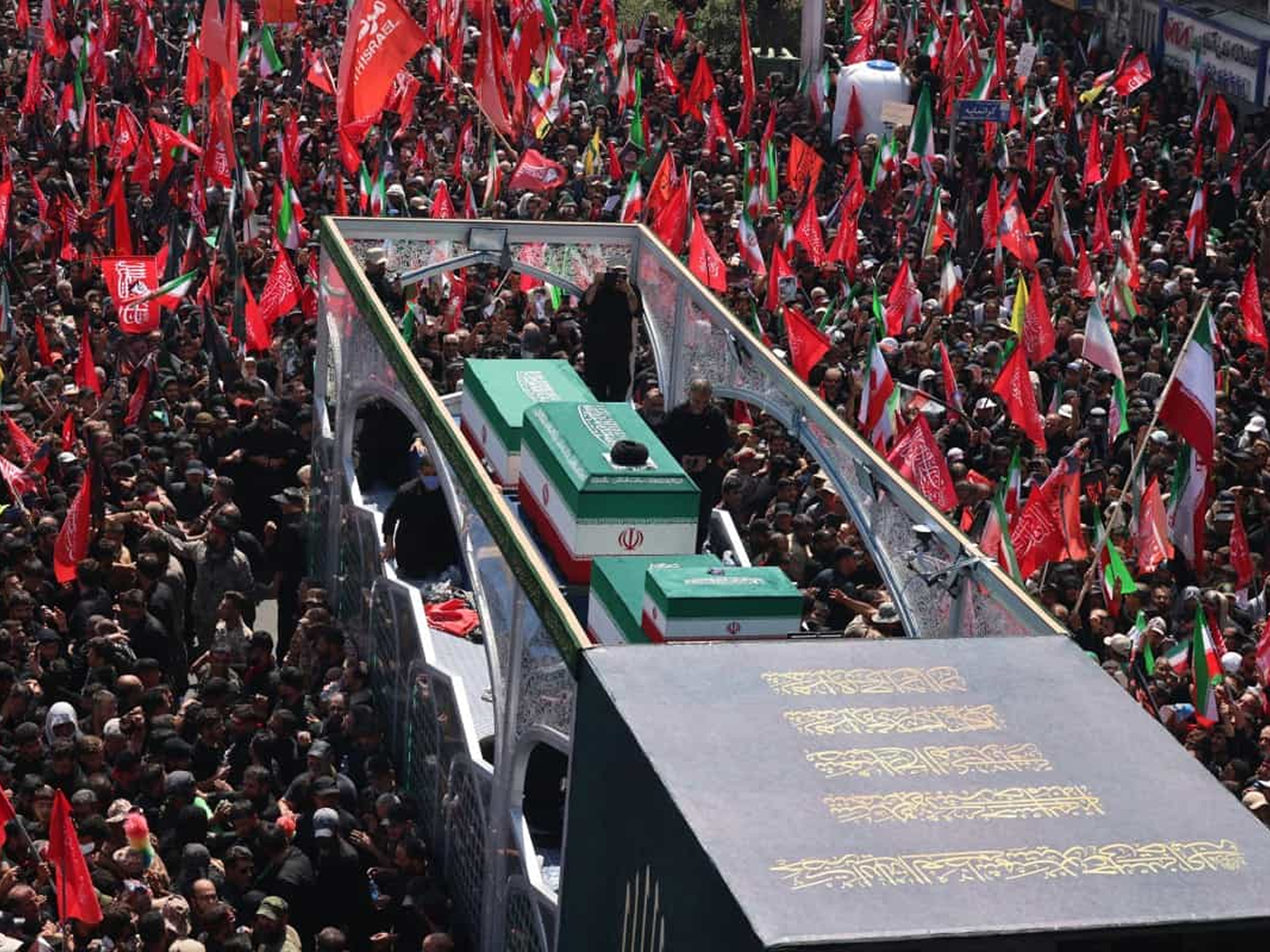
Preparations in Tehran began well before the coffin reached the streets. The original plan envisioned a procession stretching across a substantial section of the capital, beginning in eastern Tehran and continuing through Damavand Street, Imam Hossein Square, Enghelab Street, Azadi Street and toward the western side of the city. Authorities modified infrastructure along the planned route, removing some barriers used by the bus rapid transit system and establishing security arrangements around bridges, underpasses and elevated positions.
Accounts of the operation described approximately five kilometers of prefabricated concrete barriers, including roughly 1,250 large sections. Estimates circulated that preparation of the Tehran route alone cost more than 100 billion tomans once construction work, equipment, transport and labor were included. The complete expenditure was never publicly itemized, leaving the overall cost of security, accommodation, transport, ceremonial facilities, food distribution and other logistics impossible to independently audit.
The state was preparing for an exceptional mobilization. Temporary accommodation and service points were arranged for people expected to arrive from elsewhere in the country, emergency and security forces were deployed, and airspace restrictions were imposed around important stages of the funeral. The concern was understandable. The country's leader had been killed in a direct strike, and any public gathering of senior political and military figures presented a potential security risk.
The ceremony also offered the government its first major opportunity to place many surviving members of the establishment in front of cameras at the same time. Khamenei's death had been accompanied by uncertainty about the fate of senior commanders, members of his office, security officials and relatives. The funeral therefore became an unofficial roll call of the postwar political structure.
Three of Khamenei's four sons, Mostafa, Meysam and Masoud, appeared prominently during the funeral prayers. Their presence was significant because the brothers had largely disappeared from public view during the conflict. The fourth son, however, was the person whose appearance mattered most. Mojtaba Khamenei was now supreme leader, yet no independently verifiable image showed him participating in his father's funeral.
Expectations that he might lead funeral prayers or use the occasion for his first major public appearance faded shortly before the ceremony. In the absence of confirmation, social media filled with speculation. Blurred images of men on rooftops circulated as alleged sightings, while other users identified masked individuals, men wearing hats or people without clerical clothing as possible disguised appearances by the new leader. None of those claims produced reliable visual evidence.
The importance of the speculation lay less in the individual images than in what they demonstrated about the succession itself. A transfer of leadership would normally be accompanied by visibility, ritual and confirmation. In this case, the son had succeeded the father but remained unseen, even during the funeral that brought much of the political establishment into one place.
Other absences also attracted attention. Mohammad Mohammadi Golpayegani, Khamenei's longtime chief of staff, had disappeared from public view after the attack before eventually reappearing around the hundredth day after Khamenei's death. Ali Asghar Hejazi, another powerful figure in the supreme leader's office, remained out of sight longer and was subsequently seen during the final stages of the funeral period in Mashhad.
Hossein Taeb, the former head of the IRGC intelligence organization and a figure widely associated with Mojtaba Khamenei's security network, was initially absent from public imagery. Speculation circulated that he had survived and was operating as an intermediary between the new leader and the political-security establishment, although no independent evidence established such a role. A later video showing Taeb meeting a senior cleric ultimately confirmed that he had survived.
At the same time, several officials who had been subjects of wartime speculation reappeared. Ahmad Vahidi, Mohammad Bagher Zolghadr and Quds Force commander Esmail Qaani were among those seen publicly again. Police commander Ahmadreza Radan and politician Saeed Jalili were also visible, alongside senior officeholders, clerics and members of the government. Former president Mahmoud Ahmadinejad resurfaced after an extended period without fresh public imagery, ending some of the speculation that had followed an attack near his residence.
The funeral therefore provided something that the state had failed to provide systematically in the preceding months: visual evidence of which important figures remained alive and politically present. Yet this only sharpened the contradiction surrounding Mojtaba Khamenei. If senior commanders, officials, clerics and three members of the immediate Khamenei family could appear publicly, the continued absence of the new supreme leader inevitably became more conspicuous.
The most visible controversy in Tehran concerned the procession route. Authorities had repeatedly told residents that the funeral would pass through a long corridor beginning in eastern Tehran, and people were encouraged to gather along Damavand Street and through the central sections of the capital. On the day itself, however, the vehicle carrying the coffins did not travel along much of the announced route.
Accounts from the scene indicated that the procession entered much later, near the western portion of the planned route, significantly reducing the distance through which the actual coffin traveled. The change immediately became political. Hassan Hassanzadeh, commander of the IRGC in Tehran, said organizers had intended to bring the vehicle through the longer corridor but that the density of the crowd had made the plan impossible. Other officials cited security, safety and health concerns. Authorities later apologized to people who had waited elsewhere in Tehran and never saw the coffin.
Critics offered a different interpretation, arguing that turnout along sections of the original route had been weaker than expected and that organizers compressed the procession into a smaller area to produce denser television images. Available evidence does not establish that motivation conclusively, but the basic operational failure is clear: a route publicized for weeks and prepared at considerable cost was changed on the day of the funeral, leaving supporters waiting in areas through which the coffin never passed. Even figures sympathetic to the Islamic Republic criticized the organization and accused officials of poor communication and misleading attendees.
The episode was particularly significant because the funeral had been designed as an exercise in administrative control after months of uncertainty. Instead, the state was forced to explain why one of the central elements of the Tehran ceremony had not followed its announced plan. The controversy added to a broader struggle over how the scale of the event should be understood.
Attendance figures became another central dispute. Fars News Agency eventually claimed that between 41 million and 43 million participations had been recorded across the ceremonies in Iran and Iraq, including roughly 10 million in Najaf and Karbala. According to its explanation, the calculation incorporated public transport usage, active mobile devices, crowd-density analysis and figures supplied from Iraq. No independently auditable dataset accompanied the claim, and no international organization verified the total.
Independent descriptions differed sharply depending on location and stage of the ceremonies. Some reporting described hundreds of thousands of participants in Tehran, while other accounts used substantially larger estimates for the broader events. Precise reconstruction is difficult because crowds moved across multiple cities and ceremonies over several days, but independent reporting did not substantiate the aggregate figure of more than 40 million announced by Fars.
The dispute went beyond mathematics because attendance was being used as political evidence. The Islamic Republic presented massive participation as proof of popular loyalty following the assassination of its leader and months of war, while opponents highlighted images of thinner sections of the route as evidence that the state's social support was being exaggerated. The same photographs and videos were therefore interpreted in opposite ways by competing political narratives.
A similar struggle over interpretation emerged during the funeral prayers. Three prominent clerics had initially been associated with ceremonies in Tehran, Qom and Mashhad, but those arrangements changed. In Qom, Abdullah Javadi Amoli led the funeral prayer in place of Naser Makarem Shirazi. During the prayer, Javadi Amoli did not recite a customary phrase stating that nothing but good was known of the deceased.
The omission quickly attracted attention because Ali Khamenei himself had omitted the same phrase while leading prayers over former president Akbar Hashemi Rafsanjani in 2017, an episode widely interpreted at the time through the lens of their political differences. In Khamenei's funeral, however, the significance of Javadi Amoli's omission cannot be established with certainty. The phrase was absent, but the prayer otherwise contained extensive honorific language, meaning the omission alone cannot reliably demonstrate political intent.
In Najaf, expectations that Grand Ayatollah Ali al-Sistani might participate also failed to materialize. His representatives cited his health and advanced age. Given that Sistani was 95 and had rarely personally led funeral prayers for political figures, his absence on its own provides little basis for a political conclusion.
The planned arrangement in Mashhad changed as well. The office of Hossein Nouri Hamedani said the 101-year-old cleric could not make the journey because of his physical condition and the distance involved. Mostafa Khamenei, Ali Khamenei's eldest son, ultimately stood before the coffin for the final prayer. On July 9, 131 days after Khamenei's death, his remains were finally buried in Mashhad.
The central paradox of the funeral was that it simultaneously demonstrated institutional survival and exposed political fragility. The Islamic Republic had survived the death of the man who had dominated its political structure since 1989. Ministries continued to operate, the armed forces retained a chain of command, and the presidency, judiciary, parliament, clerical establishment and IRGC remained functional. Senior officials were able to assemble publicly despite the security risks created by the war.
At the same time, the ceremony revealed how dependent political confidence had become on controlled visibility. Officials who disappeared generated rumors, while officials who reappeared became evidence of survival. A photograph of a commander could acquire more political significance than a written statement, and the absence of a family member could produce weeks of speculation. Even a change in the route of a funeral procession became evidence in a broader argument about the legitimacy and credibility of the state.
The most important example remained Mojtaba Khamenei. His succession placed another member of the same family at the apex of a political system formally organized around clerical institutions rather than hereditary monarchy. Yet his prolonged absence deprived the transition of the most elementary form of political confirmation: the ability of citizens to see and hear the new supreme leader.
Officials maintained that he had survived the February attack, suffered serious injuries and continued to exercise authority. If that explanation is accurate, remaining hidden may offer obvious security advantages because the strike that killed his father demonstrated the vulnerability of senior leaders whose locations could be identified. Yet prolonged invisibility also imposes political costs by making the functioning of the leadership dependent on intermediaries, official media and public trust in institutions that were already facing significant credibility problems.
The funeral repeatedly demonstrated this problem. Officials said the Tehran route changed because too many people had gathered, while critics said it changed because turnout was weaker than expected. Fars claimed that tens of millions participated, while independent reporting produced substantially different estimates. Early reports said Khamenei's wife had died, while later reports said she had survived. The government presented the funeral as proof of continuity, while the continuing absence of the new supreme leader kept uncertainty at the center of the succession.
None of these contradictions by itself proves that the political system was collapsing, just as the presence of large crowds cannot by itself establish broad political consent. Mass state funerals can combine genuine grief, religious devotion, political loyalty, institutional mobilization, organized transportation and social pressure. The significance of Khamenei's funeral lies instead in the widening gap it exposed between ceremony and verification.
The Islamic Republic demonstrated that it could organize an immense ritual, mobilize security forces, move a coffin through several religious and political centers, bring senior officials before cameras and use state broadcasting to construct an image of national mourning. What it could not completely control was the interpretation of every missing person, every changed plan, every disputed crowd estimate and every contradiction in official information.
The extraordinary effort invested in Khamenei's funeral reflected the scale of the political era that ended with his death. He became supreme leader in 1989 and remained the central authority of the Islamic Republic until February 2026. Over almost 37 years, he helped oversee the transformation of the Revolutionary Guards into one of the country's dominant military, political and economic institutions, while maintaining decisive influence over security policy, foreign affairs, the judiciary and the limits of political competition.
His rule also encompassed repeated confrontations between the state and its own population. The 2009 post-election protests, demonstrations in 2017 and 2018, the 2019 protests, the Woman, Life, Freedom uprising beginning in 2022 and subsequent unrest all generated extensive allegations and documentation of unlawful killings, arbitrary detention, torture and other abuses by Iranian security forces. Behind those episodes were thousands of individual stories involving bereaved families, former political prisoners, protesters who were injured or killed, women punished over political protest or social restrictions, and relatives who spent years seeking clear answers about the deaths or disappearances of family members.
The international consequences of Khamenei's rule extended far beyond Iran's borders. Under his leadership, the Islamic Republic developed and supported a network of armed partners in Lebanon, Iraq, Syria, Yemen and the Palestinian territories. The IRGC, particularly through the Quds Force, became the central institution linking Tehran with much of this network. Supporters described the strategy as deterrence and strategic depth, while critics argued that it embedded Iran in costly regional conflicts and diverted resources toward foreign priorities during a period of serious economic and infrastructural deterioration at home.
Those policies unfolded while Iran faced persistent problems involving inflation, declining purchasing power, damaged infrastructure, water and energy shortages, pressure on health and education systems and continuing emigration. For millions of Iranians, the Khamenei era was therefore not merely a period of constitutional or institutional history. It directly intersected with experiences of censorship, imprisonment, protest, compulsory social rules, economic insecurity, military confrontation and decisions over whether to remain in the country or seek a future elsewhere.
His supporters viewed him as a symbol of resistance, ideological continuity and defense of the post-1979 political order. His opponents, including many victims of state repression and their families, associated his office with the authority under which those policies were implemented. The funeral could not reconcile those radically different understandings of his legacy, but it made the division visible in the competing interpretations surrounding almost every aspect of the ceremony.
The closed coffin passed through Tehran, Qom, Najaf, Karbala and finally Mashhad under an elaborate security and ceremonial operation. State television presented enormous crowds and a political order continuing after the death of its longest-serving leader, while critics examined the same footage for empty sections, shortened routes and signs of statistical manipulation. Officials who had disappeared for months reappeared before cameras, others remained absent, planned clerical appearances changed, and attendance figures expanded into the tens of millions without transparent independent verification. Throughout those ceremonies, the man who had succeeded Khamenei remained outside verified public view.
The 131-day interval between Khamenei's death and burial therefore became more revealing than a conventional funeral could have been. The Islamic Republic demonstrated that its institutions were capable of surviving the loss of their central political figure and organizing a ceremony of enormous logistical and symbolic ambition. At the same time, the events surrounding the funeral left unresolved questions about the physical condition and public role of the new supreme leader, the distribution of authority among surviving institutions, the accuracy of official information and the growing importance of secrecy within the leadership.
Khamenei's burial marked the formal end of one of the longest periods of individual political dominance in the history of the Islamic Republic, but the ceremony surrounding it also offered an early portrait of the political structure that followed him. It was a system that had survived a devastating attack and preserved its institutions, yet one that increasingly relied on controlled imagery, intermediaries and incomplete information to demonstrate that power remained coherent at the top.
