



The Mystic in the Regime: How Esfandiar Mashaei Bent Iran's Presidency to His Will
A former spy turned occultist gained unprecedented influence over Iran's government through spiritual claims and nationalist ideology.
|
Pars Barghandan
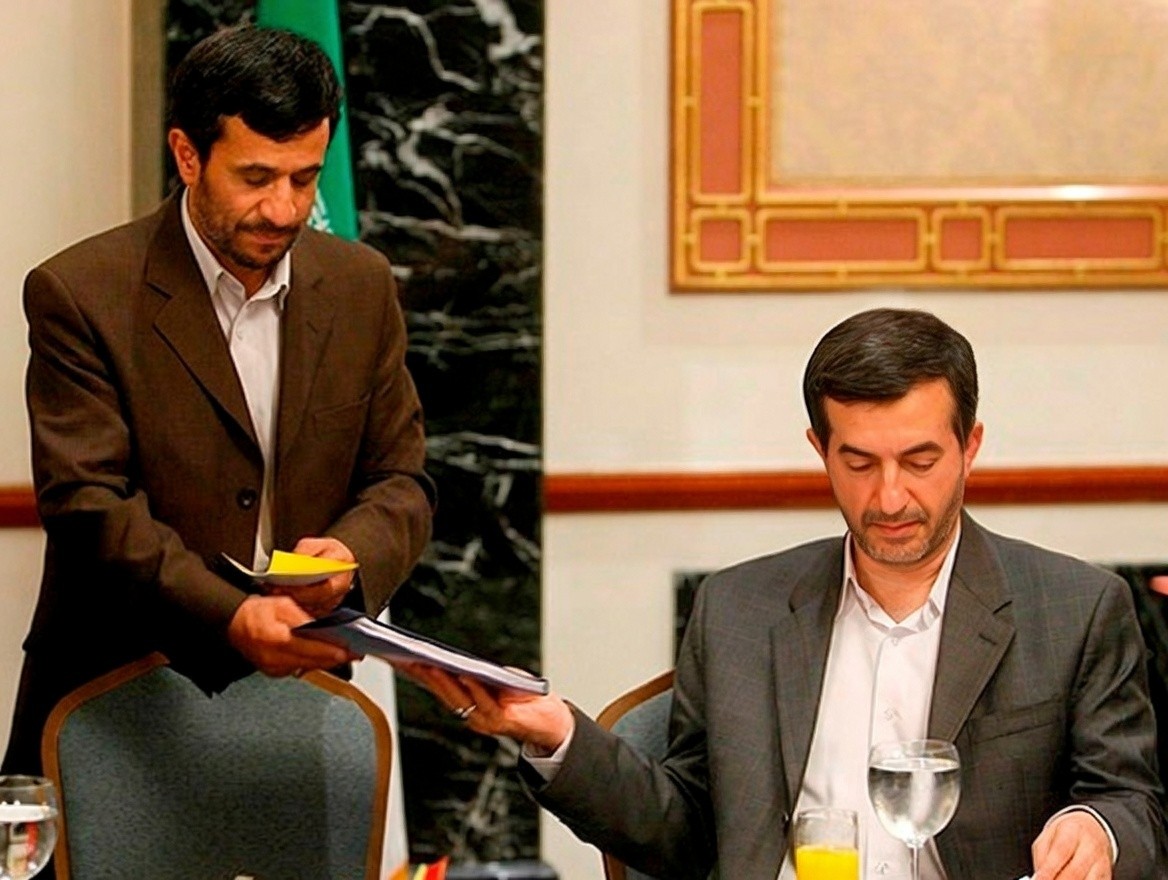
Esfandiar Rahim Mashaei, once a security operative with an alias and a hidden intelligence portfolio, rose to become the most influential advisor to President Mahmoud Ahmadinejad during Iran's ninth and tenth governments (2005-2013). Behind closed doors, he advocated for the "Iranian School" over Islamic orthodoxy, promoted contact with the supernatural through fortune tellers and spirit mediums, and claimed privileged communication with the Hidden Imam. His public statements rejecting the Islamic Republic's core policies on hijab enforcement, alcohol prohibition, and relations with Israel triggered cascading crises, yet he remained shielded by the president even after Supreme Leader Ali Khamenei demanded his removal from the first vice presidency. Accused of espionage for Israeli and British intelligence services, complicity in a 30 billion toman embezzlement scheme, and orchestrating a "deviant current" designed to undermine clerical authority, Mashaei nonetheless avoided sustained imprisonment. His network, labeled the "Urmia Circle" by political analysts, included senior Revolutionary Guard commanders, intelligence veterans, and economic managers who collectively controlled vast patronage channels. This investigation reconstructs Mashaei's trajectory from his security assignments in Kurdistan during the early 1980s to his conviction and mysterious release under President Ebrahim Raisi, drawing on internal testimony, parliamentary records, judicial proceedings, and leaked communications to show how mysticism, nationalism, and personal loyalty forged an alternative power center that challenged the foundations of the Islamic Republic from within.
Esfandiar Rahim Mashaei was born in November 1960 in Ramsar, a Caspian coastal city in Mazandaran province. In his youth he was a Quranic reciter and chanted eulogies at religious gatherings. During the 1979 revolution, at age eighteen, he participated in organizing demonstrations, drafting communiqués, distributing Khomeini's proclamations, and leading mourning ceremonies. After earning a degree in electronic engineering from Isfahan University of Technology, he entered the security apparatus. According to available sources, between 1979 and 1982 he was active in suppressing unrest in Kurdish-majority areas, eventually serving as deputy for intelligence at the Hamza Sayyid al-Shuhada headquarters.
It was during this period that Mashaei first met Mahmoud Ahmadinejad. When Ahmadinejad served as district governor of Maku and later governor of Khoy in West Azerbaijan province, Mashaei was a member of the provincial security council. Hossein Allahkaram, a conservative political figure, wrote that Ahmadinejad's knowledge of Mashaei's "cultural work style in Kurdistan" later prompted him to summon Mashaei to Tehran's municipality when Ahmadinejad became mayor. Mashaei operated under the alias Morteza Moheb-Owlia during intelligence and security actions in Kurdish regions, while simultaneously holding official positions under his real name.
Another narrative places the genesis of this relationship in the so-called Urmia Circle, formed around 1980 when Sadegh Mahsouli was appointed governor of West Azerbaijan province to suppress unrest. Core members included Mahsouli, Ahmadinejad, and Mashaei, later joined by Parviz Fattah, Mohammad Ali-Abadi, Mojtaba Samareh Hashemi, and others. Some accounts trace the circle's origins further back to the University of Science and Technology, where Samareh Hashemi was a student before the revolution. Mohammad Javad Akbarin, speaking in 2010, described a cohort that had remained together for thirty years, unified by a worldview that might be called "temporal" rather than strictly Islamic.
After the Ministry of Intelligence was established in 1984, Mashaei was tasked with drafting the Islamic Republic's strategy toward Iranian Kurds. During Mohammad Mohammadi Reyshahri's tenure as intelligence minister, Mashaei assumed intelligence responsibility for areas including Kurdistan. He was known within the ministry as the expert on Kurdish affairs. He also co-founded the Institute for Scientific Studies affiliated with the Ministry of Intelligence, which focused on research concerning Iran's ethnic groups and published a periodical in Kurdish (Kurmanji dialect) for two decades.
Eventually Mashaei transitioned to the Ministry of Interior, becoming director general of social affairs under Ali Mohammad Besharati. He subsequently moved to Radio Payam and then to Tehran municipality. A source close to conservative factions noted that when Ahmadinejad appointed Mashaei as head of the municipality's cultural and artistic organization, many objected, citing Mashaei's cultural sympathies with the Hojjatieh Society, a millenarian group controversial within the establishment. A group of young advisors resigned collectively in protest. Ahmadinejad's indifference signaled the depth of his trust.
With the ninth government's formation in 2005, Mashaei was appointed head of the Cultural Heritage, Handicrafts, and Tourism Organization. His tenure was marked by controversial decisions that drew sustained criticism. One of the most damaging episodes concerned the Sivand Dam. The dam, located 95 kilometers north of Shiraz, 50 kilometers from Persepolis, and about 17 kilometers from Pasargadae, sits on the Sivand River in an area known as Tang-e Bolaghi. Experts warned that the reservoir would cause irreversible damage to the historical monuments of Pasargadae. In winter 2006, Mashaei claimed that thirteen domestic and foreign expert teams had reviewed the project and that the organization, "considering national interests," had given the Ministry of Energy permission to proceed. More than eight thousand trees, some five hundred years old, were destroyed, and reports indicated that moisture began seeping into the tomb of Cyrus the Great.
Additional errors included allowing the Tehran metro to pass under Naqsh-e Jahan Square in Isfahan and approving a tunnel excavation beneath Chahar Bagh Abbasi Street. Yet the most internationally contentious affair involved the Achaemenid tablets held by the University of Chicago. In 1992 the U.S. Congress passed legislation permitting victims of terrorist acts to sue state sponsors of terrorism. Seven governments, including the Islamic Republic, were designated sponsors. Following a September 1997 suicide bombing in a Jerusalem market that killed five and wounded two hundred, victims' families sued the Islamic Republic, alleging it supported Hamas. In 2004 a U.S. court found the Islamic Republic complicit and ordered payment of $71.5 million. When payment was refused, the court authorized seizure of Iranian artifacts deposited at the University of Chicago's Oriental Institute.
The tablets, discovered at Persepolis in the 1930s, had been sent to Chicago for study. Some were returned in 1948 and 1950. In May 2004, during Mohammad Khatami's presidency and under Cultural Heritage chief Mohammad Beheshti Shirazi, the university returned an additional 300 tablets. A fourth shipment was blocked by the compensation lawsuit. Despite expectations that the Ahmadinejad government would pursue legal remedies, Mashaei's organization took no effective action between 2004 and 2006. Specialists repeatedly called for international litigation to recover the tablets. Only in summer 2006, after the prosecutor general ordered action, did Mashaei announce that an American lawyer had been retained. Yet no visible progress was made, and the tablets remained impounded. Ultimately, in February 2018, Iran prevailed in the U.S. Supreme Court, but Mashaei's inaction prolonged the dispute.
In 2005, at Mashaei's direction, a collection of precious Achaemenid artifacts, including statues, column capitals, vessels, and jewelry, seventy pieces in total, was shipped to the British Museum for exhibition. British specialists assisted with packing inside Iran. The exhibition delighted Mashaei. In winter 2008 he approved a second shipment of Safavid-era objects to the British Museum, including dozens of pieces dedicated by Shah Abbas to the shrine of Sheikh Safi al-Din in Ardabil and rare illuminated manuscripts. Many heritage experts believe a significant portion of the items returned from these exhibitions were substitutes rather than originals.
In October 2007 Mashaei announced that a stolen Achaemenid soldier's head would be returned from New York, yet in November it was auctioned off. The Cultural Heritage Organization issued a statement saying "this was not our understanding." Theft of ancient objects from Kermanshah, auctions of Iranian antiquities in France and Britain during 2006, and the theft of a manuscript copy of Avicenna's "Canon of Medicine" were among the failures recorded during Mashaei's leadership. In June 2008, the Achaemenid Khark Inscription, discovered in late 2007 during road construction by the Ministry of Petroleum on Khark Island, was destroyed by unknown individuals with sledgehammers. Archaeologists had described the inscription, written in Old Persian, as critical evidence confirming the name of the Persian Gulf.
Mashaei traveled almost annually to Mecca and Medina, always with his chosen team. He proposed merging the Hajj and Pilgrimage Organization with the Cultural Heritage Organization. Ahmadinejad complied, detaching Hajj from the Ministry of Islamic Guidance and attaching it to Cultural Heritage. Mashaei even replaced the head of the Hajj Organization. Khamenei intervened immediately, writing to Mohammad Mohammadi Reyshahri, the Leader's representative for Iranian pilgrims, that "merging the Hajj Organization with the tourism complex is inappropriate. It was decided that the situation remain as before."
On 30 December 2007, Ahmadinejad appointed Mashaei head of the National Center for Globalization Studies. The Center for Dialogue of Civilizations was merged into the new body "with all facilities and personnel." The decree concluded by requesting all ministries, organizations, and agencies to extend full cooperation. Ahmadinejad's attachment to Mashaei was undeniable. Mashaei's influence led to persistent rumors that he exerted control over the president.
One example came when Ahmadinejad ordered his deputy in charge of physical education to lift the ban on women entering stadiums, an action that provoked clerical protest in Qom. The initiative was attributed to Mashaei. Periodically, Mashaei created new controversies. In October 2008, as first vice president, he declared that "angels are constantly flying over the country," and stated that "one must prove man to prove God, because a God who has lied in history is rejected, spurned. God up to this moment has not, I do not say lied, but His promise has not been demonstrated."
These remarks triggered fierce backlash from traditional conservatives, including Hossein Shariatmadari. Yet they had no effect on Ahmadinejad's loyalty. In 2008 Ahmadinejad entrusted Mashaei with chairing the supreme committee on the Iran-Pakistan-India gas pipeline. More significantly, during the Persian New Year of 2008, Ahmadinejad's elder son became engaged to Mashaei's daughter. The marriage cemented the bond, adding family ties to ideological and professional ones. Mashaei was a regular companion on Ahmadinejad's most important trips.
The relationship reached full visibility when Ahmadinejad defended Mashaei's controversial statement that the Iranian people were "friends of the Israeli people." Mashaei made and repeated the comment despite mounting criticism. Ahmadinejad refused to retract or reprimand him. Mashaei was intensely scrutinized after a cultural heritage conference included simultaneous musical performances, an event attended by Mashaei and featuring women dancers. This prompted condemnation from clerics and calls for his dismissal. Yet Ahmadinejad brought him on foreign trips, and Khamenei, in a Friday sermon in Tehran, issued only a mild rebuke, asking critics to cease pressuring government members.
Controversy persisted. In early July 2006, in an interview with the Turkish newspaper Sabah, Mashaei claimed that hijab use in Iran was voluntary and not compulsory, stating that "no government official will reprimand you" for not wearing it, though they might suggest it aligns with national custom. When asked whether he was bothered by Iranians vacationing in Turkey drinking alcohol and going to the beach in swimsuits without hijab, Mashaei laughed and said these were personal matters, adding that Iranians "can use alcoholic beverages, be without hijab, and go around in swimsuits" outside Iran. He called Turkey Iran's model for tourism development. In the same interview he declared that "the era of Islamism has ended. Humanity's speed has increased, its comprehension sharpened, and it reaches truths that no longer need to be approached through the shell of Islam."
After publication, parliamentary deputies reacted. The conservative newspapers Kayhan and Jomhuri-ye Eslami condemned the statements. Conservatives initially overlooked the matter due to the government's novelty, but Ahmadinejad's refusal to discipline Mashaei initiated clerical disenchantment. One cabinet member advised Mashaei to deny the report. He replied that it was not important enough to deny.
A major scandal occurred in November 2005, when Mashaei attended the opening of a tourism exhibition for member states of the Organization of the Islamic Conference, a ceremony accompanied by women's singing and dancing. Thirteen months later, a news agency broadcast video footage showing Mashaei in the front row, watching the performance and applauding. Mashaei claimed the footage was fabricated and sued two Tehran lawmakers, Saeed Abotaleb and Emad Afroogh, for "spreading lies" after they confirmed the video's authenticity in parliament and criticized his participation. Government spokesman Gholam-Hossein Elham bizarrely claimed Mashaei had left upon noticing the dancers, though the video ran over an hour.
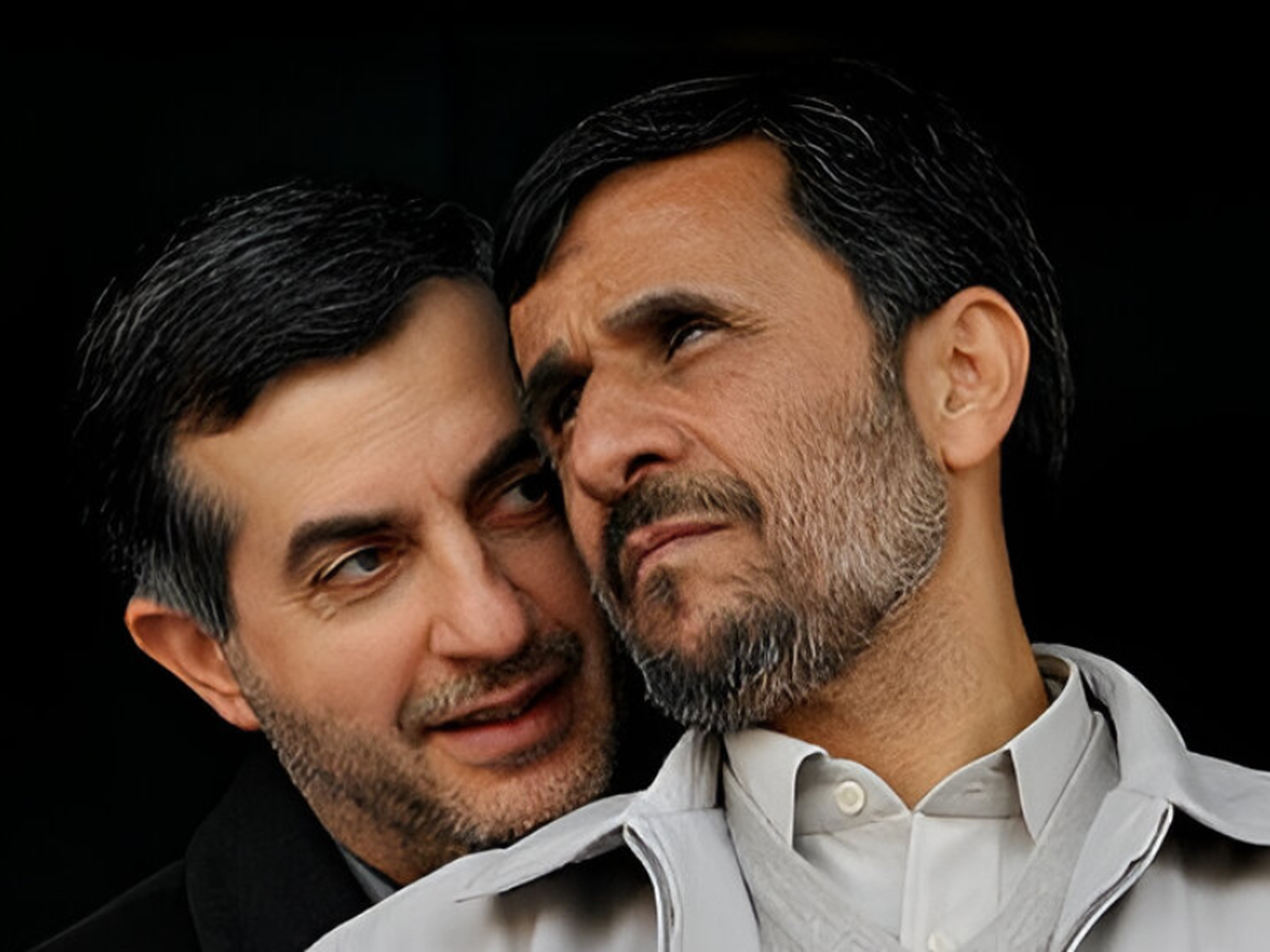
Serious criticism of Mashaei intensified at the start of the tenth government. On 26 July 2009, Ahmadinejad appointed him first vice president. Grand Ayatollah Naser Makarem Shirazi called the appointment "illegitimate." Kayhan, Jomhuri-ye Eslami, and Ahmad Khatami, Tehran's temporary Friday prayer leader, all denounced the choice. Kayhan, edited by Hossein Shariatmadari (Khamenei's representative at the paper), wrote on 27 July 2009 that Mashaei had "repeatedly caused discontent among revolutionary well-wishers with ill-considered and imprudent statements." Many conservatives expected Ahmadinejad to exclude Mashaei from the tenth cabinet, "but this did not happen. He is now the second figure in the cabinet. This appointment will undoubtedly face widespread opposition from revolutionary and principlist forces and the masses of Dr. Ahmadinejad's supporters."
Jomhuri-ye Eslami wrote the same day that "experts considered this action a kind of nose-thumbing at dignitaries who had called for the removal of this individual from the Cultural Heritage and Tourism Organization… Mr. Mashaei in the past four years repeatedly spoke against Islamic principles and called the occupying Zionists of Palestine friends of the Iranian people under the title 'the people of Israel.' In his latest action, he tried to attach the Hajj Organization to the tourism organization, which met with the Leader's explicit opposition and failed."
Ahmad Khatami stated: "In the past I heard rumors that the honorable president intended to choose Mr. Mashaei as his first deputy. But I did not believe, given existing sensitivities of which the president himself is aware, that this appointment would occur."
Mashaei's selection also met with Khamenei's objection. Nevertheless, Ahmadinejad initially refused for one week to implement Khamenei's demand for Mashaei's removal. Finally, he relented. On 2 August 2009, Khamenei's directive was published, and the next day Mashaei announced his resignation. Yet this was not the end. Ahmadinejad immediately dismissed Gholam-Hossein Mohseni-Ejei, the intelligence minister and a principal Mashaei critic. About a month later, in September 2009, he appointed Mashaei chief of staff, a position he held until 2011.
The rift between Ahmadinejad and Heydar Moslehi also centered on Mashaei. The Ministry of Intelligence allegedly wiretapped Mashaei's conversations, and knowledge of this surveillance prompted Ahmadinejad to issue Moslehi's dismissal order, which Khamenei blocked, leading to a serious standoff. Some media reported Ahmadinejad's house confinement, even speculation of resignation or removal.
Attacks on Mashaei continued. Mansour Arzi, a figure close to Khamenei, openly cursed him and prayed for his death, saying: "May God kill our enemies, God willing. May God kill this Jew-like individual, God willing. Everyone should shout. If all eulogists and reciters shout, it is correct. This will be their end. Their ugliness is becoming apparent. Others spoke badly, but they spoke the truth, and it is becoming clear why they are arresting their associates one by one."
Arzi's reference was to the arrest of twenty-five individuals connected to Mashaei. In spring 2011, a significant number of Mashaei's circle were detained by a security agency. Abbas Amirifar, a close associate, was arrested for involvement in distributing a CD titled "Emergence is Near" and was interrogated by the Special Court for Clergy. Media also reported the detention of Abbas Ghaffari for practicing divination and spirit summoning.
In May 2011 criticism peaked. Mashaei and Hamid Baghaei were identified as central figures in the "deviant current," a term conservatives used for Ahmadinejad's close associates accused of holding views incompatible with Khamenei's. Ali Motahari remarked: "This deviant current was an unexpected phenomenon. No one thought Mr. Ahmadinejad harbored such thoughts and was devoted to such a person, that a contradiction would emerge between the jurisprudential guardianship of society and his mentor, leaving him uncertain which to heed. Ahmadinejad is caught between the jurisprudential guardian and his mentor. The matter of Mashaei and Ahmadinejad is one of devotion. If he says 'die,' he dies, and we really must save Mr. Ahmadinejad."
In 2011 several parliamentarians, continuing their criticism of the government, demanded a serious boundary-setting within the conservative camp, emphasizing the necessity of such purification ahead of the ninth Majles elections. Parviz Sorouri, a member of the principlist faction's leadership board, stated: "Given the transformations that have occurred and the deviant current's statements regarding lack of unity with principlists, this current's face has become clear to the people, and I think there should be a purge in the principlist current so the deviant current is removed from this orbit."
Mohammad-Taqi Rahbar, a member from Isfahan, called Ahmadinejad's entourage "a deviant group suffering from delusions about their social base." Mashaei, identified as leader of the deviant current, remained silent under this flood of accusations, though he had previously said he did not fear criticism and would not retreat. Regarding rumors of his heart attack spread by conservative media, he had stated: "I am not the type for heart attacks, but I will give some people heart attacks, and you will see."
Gholam-Reza Mesbahi-Moghaddam, another principlist deputy, said the deviant current had no belief in the Imam of the Age or the jurisprudential guardian. Concerning the rumor of hiring sorcerers and fortune tellers by Ahmadinejad's circle, he remarked: "The deviant current, in order to establish a position in the country, seeks to attract certain people by resorting to spirit summoning and fortune telling."
Shaban Saadati, Majles deputy speaker, responding to escalating conflict between parliament and government and Ahmadinejad's incomplete obedience to Khamenei, declared: "The deviant current's formation is a conspiracy against the system. This current opposes people's religious beliefs and directs their rational, insightful, wisdom-based faith toward superstitious and baseless matters."
Mashaei's emphasis on the "Iranian School" and its priority over the Islamic school in 2010 provoked intense controversy. He stated: "Wherever you go, wherever a heart beats in belief in God and love for humanity, there is Iran. Today all Iranians feel pride in being Iranian... Iranian pride is not from the perspective of domination and power. We must create an opportunity for new Iranian generations to understand, with scholarly comprehension, the pride, the philosophy of Iran, the school of Iran. I insist on the school of Iran. Some may object, asking why I do not say the school of Islam. From the school of Islam, there exist diverse interpretations. The pure understanding of the truth of faith, the truth of monotheism, the truth of Islam is the school of Iran. I believe the word Iran is an invocation. What do invokers seek from invocation? Seek the same from Iran. Iran is invocation, because Iran is the manifestation of faith."
In the wake of controversy, Kazem Motamed-Far, director of Fars News Agency, listed the characteristics of the deviant current, believing "excessive emphasis on antiquarianism, Iranianness, the Iranian school, Nowruz celebrations, and nationalism" to be among its hallmarks. He added: "Instrumental use of the concept of Mahdism, disregard for religious authority, belief in the disappearance of clergy's social authority, and promotion of Islam without clergy are signs of this deviant current."
He continued: "Propagation of the concept of global peace, prescriptive justice, and a positive approach to modernity while pretending to be traditionalist" were other indicators. "False mysticism, superstitious meaning-seeking, and contact with spirits and spirit summoners are also considered features of the deviant current."
Kayhan's editorial on 11 May 2011 reported "a major project implemented to destroy principlist unity," adding that one must distinguish between Mahmoud Ahmadinejad and his circle, calling the president's associates "a contaminated current needing quarantine and treatment," and writing that "this circle sought confrontation between the president and the jurisprudential guardian."
Another accusation leveled at Mashaei concerned claims of communication with the Imam of the Age, the Twelfth Imam of Shiite belief. Kayhan, managed under the Leader's supervision, held that the deviant current aimed to bypass the system and leadership by claiming contact with the Hidden Imam and announcing imminent appearance. Mashaei sued Kayhan over these allegations, saying: "I have sued Kayhan and this paper will certainly be convicted. If it is not convicted, I am not a Muslim."
The matter even reached the judiciary. Sadegh Larijani, then judiciary chief, warned of "certain groups and deviant thoughts," saying: "Unfortunately in our era deviant groups have emerged that promote spirit summoning and fortune telling, which have no relation to our religious principles... In some places I have read that Mashaei is the founder of a particular school."
Despite all criticism, Ahmadinejad continued to stand by Mashaei and defend him in every circumstance. On 20 February 2013, he awarded Mashaei the first-degree medal of culture and art. During this period, Mashaei's meetings with a number of actors, especially actresses such as Homa Rusta, Niloofar Khosh-kholgh, Marzieh Vafamehr, Mahtab Keramati, and Mahnaz Afshar, became another basis for criticism.
Despite fierce criticism, Mashaei in Ahmadinejad's second government assumed the presidency of the Non-Aligned Movement secretariat. He also held the positions of presidential advisor, secretary of the government's cultural commission, chairman of the coordinating council for free and special economic zones, head of the young advisors' group to the president, head of the Razavi pilgrimage and culture working group, deputy to the president on the Supreme Council for Iranians Abroad, chairman of the government's information council, and the president's special representative for Middle Eastern affairs.
The tenth government's end was not the end of Mashaei's troubles. In 2015 he was accused of complicity in a 30 billion toman embezzlement uncovered in 2011. In 2017, Mashaei was arrested and tried on various charges, including espionage and contact with Israeli and British intelligence services.
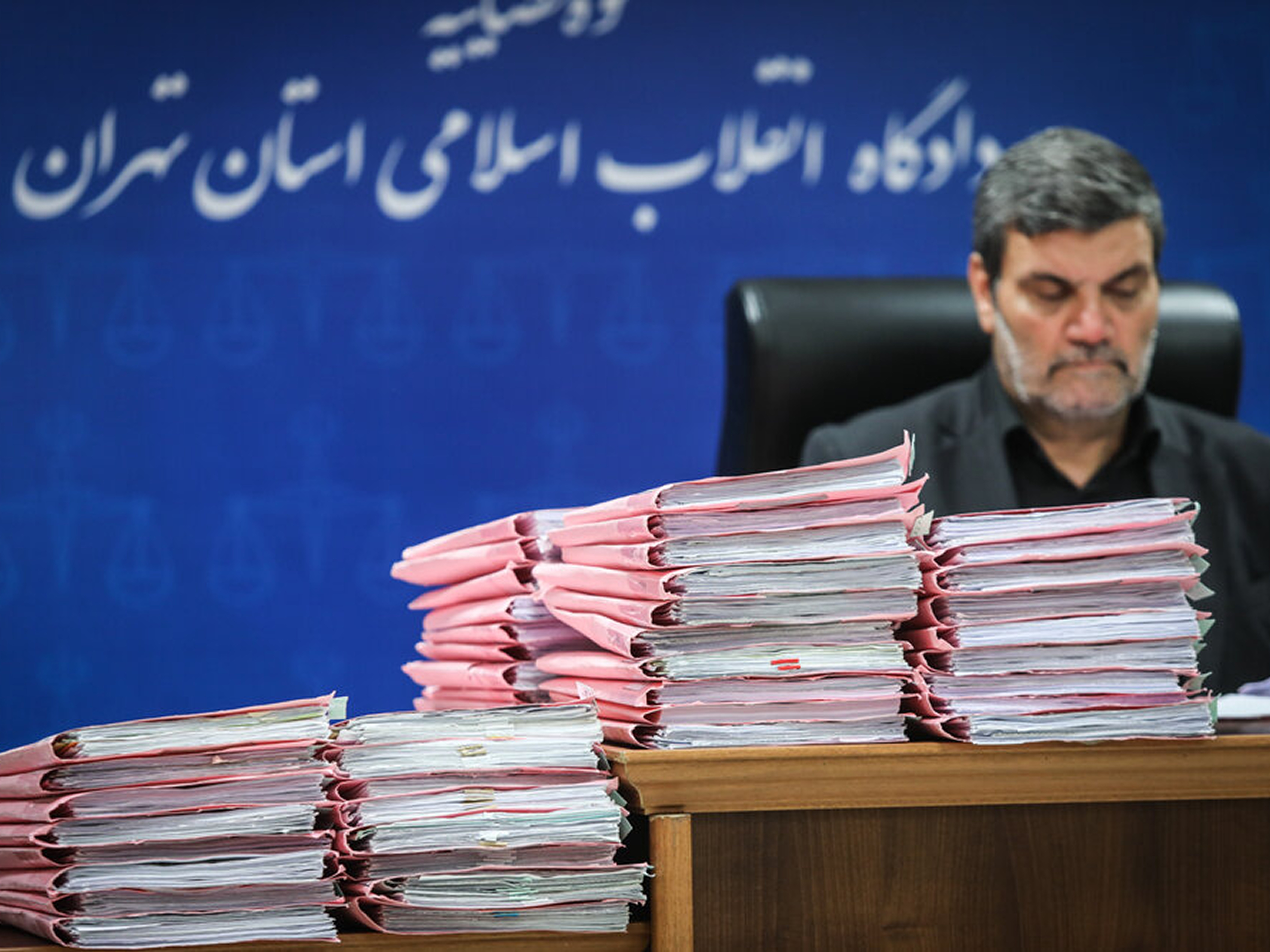
After a portion of the indictment was read, the defendant, claiming ignorance of its contents, attempted to disrupt proceedings through "provocative atmosphere-setting and abnormal behavior and conduct," trying to "influence the trial process."
In September 2018, the judiciary spokesman announced that Mashaei had been sentenced to five years' imprisonment for "assembly and collusion to commit crimes against national security," one year for "propaganda against the system," and six months for "insulting judicial authorities in the course of duty." In total, the initial court sentenced him to six years and six months, five of which were enforceable. In November 2018, the appellate court upheld the verdict. Yet life behind bars did not last long. In February 2019, nearly two weeks after Ebrahim Raisi assumed the judiciary leadership, news emerged that Mashaei had gone on leave, and subsequently images circulated showing him outside prison instead of serving his sentence.
In 2023, a reformist outlet wrote critically: "Esfandiar Rahim Mashaei must be in prison because his sentence has not ended, but last June, media quoted the judiciary spokesman as reporting that Rahim Mashaei claimed illness and referred twice to the medical commission, saying he lacked the capacity to endure imprisonment, but the medical commission confirmed his capacity for punishment, and he must return to prison."
A number of individuals close to Mashaei were reportedly absorbed into the thirteenth government during Raisi's presidency, causing alarm among some political activists. Some labeled the thirteenth government "Ahmadinejad's third administration," believing these individuals perpetuated Ahmadinejad's thinking, a framework grounded in Mashaei's theories. Some analysts interpret the 2016 founding of the Spring of Thought Development Institute by Ahmadinejad and his associates as an effort to sustain Mashaei's ideology, organizing sympathizers into an emerging current and inserting them into the power structure to claim a share of political influence.
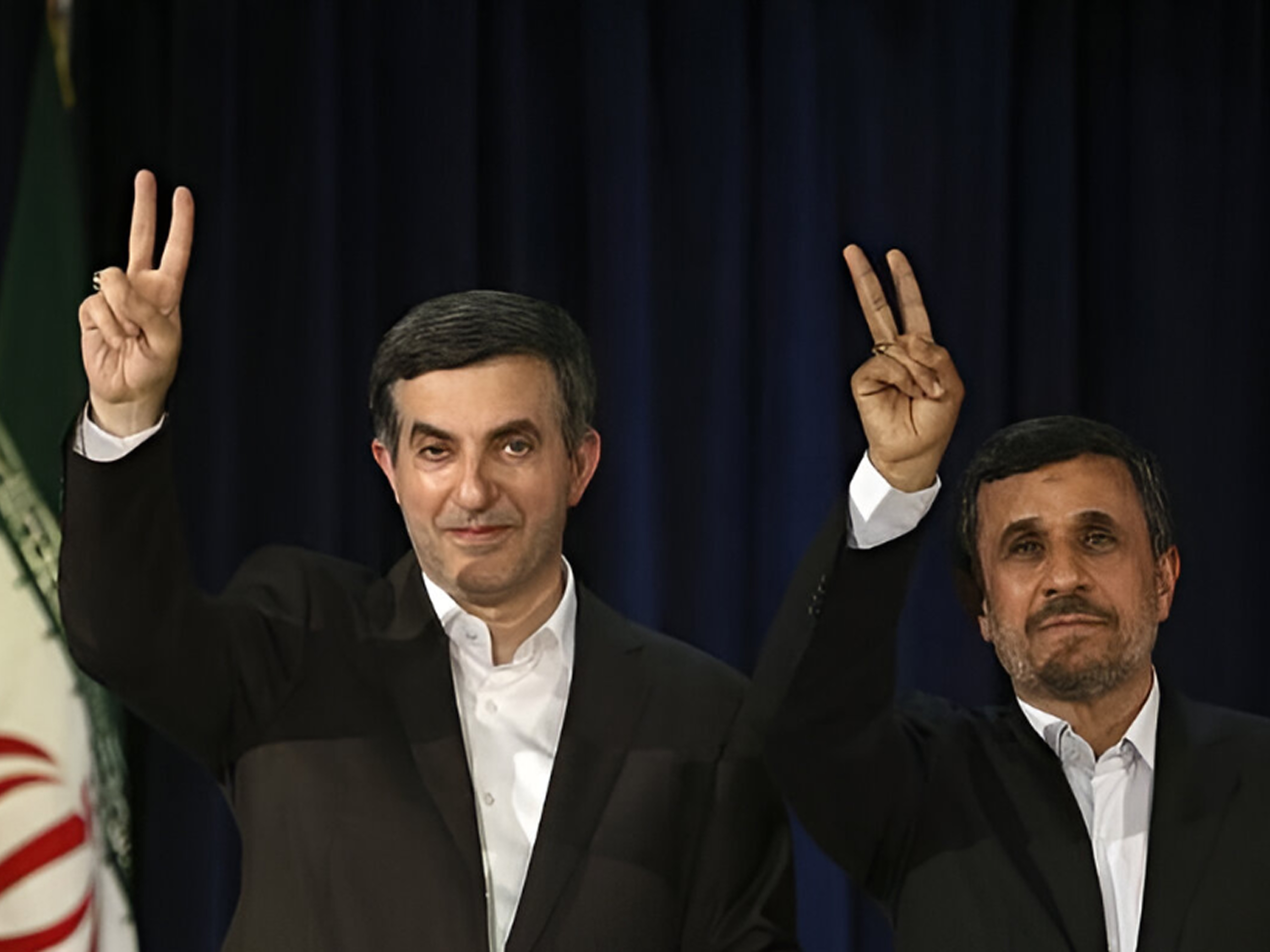
The most serious charge against Esfandiar Rahim Mashaei from his critics was leading Ahmadinejad into the realm of magic and fortune telling. In one formal session, a participant asked Mashaei to explain clearly the matter of the "400-year-old mentor" and the "Kermani jinn." Mashaei replied by asking, "Do we have a 400-year-old human?" One attendee mentioned hearing about the Kermani jinn and requested clarification. Mashaei answered: "The Kermani jinn, if it exists, pertains to certain other individuals. I am from Mazandaran."
Mashaei denied involvement with spirits and fortune tellers, responding to criticism by saying: "Some claim Mashaei has bewitched Ahmadinejad. Why do they say '400-year-old mentor' or 'Kermani jinn'? Because they cannot justify the government and our questions, and therefore they resort to these matters."
Despite these denials, Mashaei's influence over Ahmadinejad is undeniable. Their relationship resembled that of a disciple with his spiritual guide. Many politicians believe much of Ahmadinejad's conduct was directed or endorsed by Mashaei, and that officials seeking to accomplish anything had to inform Mashaei after Ahmadinejad. Mashaei remains among Ahmadinejad's closest and most loyal associates. For many, the question persists: how did Mashaei manage to exert such influence over Ahmadinejad? Were fortune tellers and spirit mediums truly involved?
What the transcript evidence reveals is not merely personal eccentricity but a systematic challenge to the Islamic Republic's foundational architecture. By promoting the "Iranian School" over Islamic jurisprudence, claiming direct mystical insight that bypassed clerical intermediaries, and cultivating an aura of esoteric knowledge, Mashaei offered an alternative legitimacy. His public dismissal of hijab enforcement and alcohol prohibition contradicted state ideology, yet Ahmadinejad's unwavering defense insulated him. When Khamenei intervened directly to remove Mashaei from the vice presidency, Ahmadinejad's week-long defiance and subsequent appointment of Mashaei to another senior post demonstrated that personal loyalty outweighed institutional hierarchy.
The judiciary's actions further expose the system's internal fractures. Mashaei was convicted on grave charges, including espionage, assembly against national security, and propaganda against the system, receiving an enforceable five-year sentence. Yet within months of a new judiciary chief's appointment, he was granted medical leave and effectively released, despite medical panels affirming his capacity to serve the sentence. His subsequent freedom, and the absorption of his network into a later administration, suggest that factional calculus, patronage obligations, and elite impunity supersede judicial process.
The human cost is diffuse but significant. Cultural heritage under Mashaei's stewardship suffered measurable losses: the Sivand Dam inundated archaeological zones, ancient trees were destroyed, priceless manuscripts and artifacts were sent abroad under questionable conditions and returned, if at all, as suspected forgeries. The Achaemenid tablets litigation festered for years without effective advocacy. Public trust eroded as exhibitions of occult influence, claims of angelic flight, and boasts of mystical communication became routine government discourse. Critics who raised alarms, from parliamentary deputies to clerics, were marginalized, sued, or ignored.
Moreover, the deviant current's challenge to clerical authority carried ideological implications. By asserting that "the era of Islamism has ended" and that "humanity no longer needs to approach truth through the shell of Islam," Mashaei articulated a post-Islamic nationalism that contradicted the regime's raison d'être. His insistence that "Iran is invocation" and that the purest understanding of monotheism is "the Iranian School" positioned Iranian identity above Islamic identity, inverting the revolutionary ideology. The system's response, fierce rhetorical condemnation combined with practical tolerance, revealed its incapacity to enforce doctrinal coherence even within its own executive branch.
The case also illustrates the role of mysticism and superstition as instruments of power. Allegations of spirit summoning, reliance on fortune tellers, distribution of apocalyptic CDs announcing imminent messianic emergence, and Mashaei's cryptic claims of supernatural communication served both to distinguish his circle and to insulate it from rational critique. When asked for evidence, Mashaei deflected; when criticized, he sued; when convicted, he was released. The pattern is one of opacity, impunity, and factional protection.
Mashaei's trajectory offers a lens into the operation of an authoritarian system where formal rules, judicial verdicts, and constitutional provisions bend to accommodate networks built on personal loyalty, shared history in the security apparatus, and control of patronage. The Urmia Circle's decades-long cohesion, from Kurdistan operations in the early 1980s through municipal posts, ministerial offices, and presidential advisory roles, exemplifies how revolutionary-era bonds endure and evolve into power bases that rival, and sometimes override, formal state institutions.
The systemic meaning is clear: the Islamic Republic tolerates, and at times empowers, figures whose ideology and conduct undermine its own legitimacy, provided they command sufficient elite protection. Mashaei was never a marginal provocateur; he was a central advisor, a presidential confidant, a family member by marriage, and a network leader with tentacles in intelligence, culture, economics, and foreign policy. His survival, despite espionage accusations and judicial conviction, demonstrates that the rule of law is subordinate to the rule of factions. His continued influence, even from outside formal office, confirms that the real governance structures lie beneath the surface, in circles formed decades ago, bound by shared secrets, mutual dependency, and a willingness to challenge orthodoxy when it serves their collective interest.
This is not a story of one eccentric mystic. It is the story of a system that institutionalizes impunity, valorizes personal loyalty over principle, and permits parallel power centers to flourish as long as they do not fundamentally destabilize the elite consensus. Mashaei's rise, fall, and resurrection map the contours of that system with precision.