



The Hidden Network: How the Islamic Republic Weaponized the Maddahs
Investigation into regime-backed maddahs turned security assets, financial brokers and major security liabilities.
|
Pars Barghandan
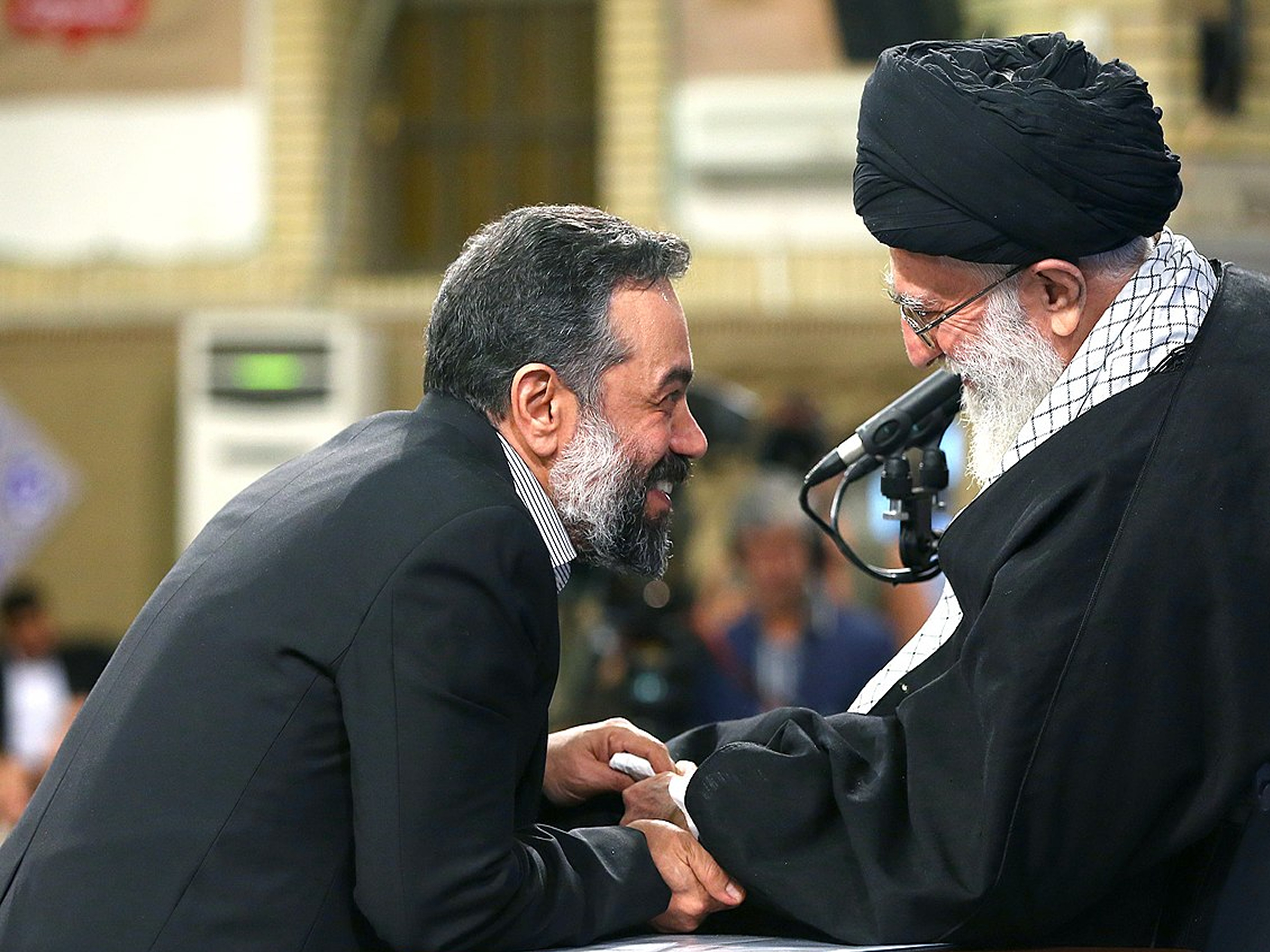
For decades, the Islamic Republic painstakingly promoted state-aligned religious eulogists – known as maddahs – as symbols of purity, humility and pious service. They were marketed as men who made people weep for the martyrs, revived faith in the hearts of the young and kept religious tradition alive. Behind the curtain, something very different was being constructed.
What began as a post-war social engineering project to blend nationalism and religion around mourning ceremonies gradually evolved into a multi-layered power structure. In this structure, the maddah was no longer only a performer on the pulpit. He became:
a psychological operations officer who could turn a crowd from tears to rage in minutes
an informal security and intelligence auxiliary who gathered names, sentiments and information
a financial conduit embedded in multi hundred-billion-toman ventures tied to power networks
Under the direct patronage of Ali Khamenei and the security institutions around him, a new para-clerical class of regime maddahs was cultivated. Their heyats – religious congregations and mourning assemblies – became recruitment factories for the Basij and the Islamic Revolutionary Guard Corps (IRGC), and later operational hubs for political mobilization and repression.
Over time, what had been presented as a spiritual project began to generate scandal after scandal: gun incidents, protection rackets, murky business empires, allegations of sexual misconduct, and, most explosively, claims of infiltration by foreign intelligence services. In one case, the head of the regime's own "Basij of maddahs" publicly admitted that several maddahs "trained in Israel" had been arrested, raising the question of how a supposedly ultra-loyal religious corps had become a security vulnerability at the heart of power.
A striking pattern emerged during a recent nationwide uprising. As foreign proxy fighters reportedly entered Iran to help suppress protests, a number of prominent regime maddahs and ideological figures quietly left the country under religious pretexts, settling in Iraq and not returning. Their departure, at the very moment they had long urged others to "stand and defend the system," exposed a deep crisis of faith within the regime's own propaganda elite.
This investigation traces the origins, evolution and unraveling of this hidden network: from its roots in post-war social engineering, through its operational role in security and propaganda, to its entanglement with corruption and its growing perception inside Iran as a disgraced, dangerous caste.
The starting point of this project lies in the immediate aftermath of the Iran-Iraq war. The country was exhausted. Official slogans had lost their mobilizing power. The war generation had paid heavily in blood and sacrifice, and the gap between the state's rhetoric and social reality was widening.
It was in this environment that a deliberate plan formed inside the leader's office: to build a new emotional pillar for the system, one that could simultaneously fill the post-war emotional vacuum and re-anchor loyalty to the Islamic Republic. The chosen vehicle was not the traditional clerical establishment, but the seemingly humble maddah.
Unlike a cleric, the maddah carried little formal religious or political baggage. He was perceived as a "man of the people" who recited elegies, beat his chest with the crowd and wept alongside them. Psychologically, his role was powerful: he could draw tears, create fervor, and, with the change of a melody or a line, propel a crowd from grief into anger or militant enthusiasm.
In the 1990s, this intuitive understanding crystallized into what insiders describe as "the engineering of maddahi." Multiple institutions moved in concert: the Islamic Propaganda Organization, the Basij, the IRGC and the offices of the Supreme Leader's representatives across the country. Together, they assembled what amounted to a hidden school for regime maddahs.
Key elements of this engineering included:
Systematic selection and training of young maddahs with political loyalty
Reorganization and registration of key heyats under supervisory networks
Material support and privileged access for those who accepted political guidance
From the outset, the mission was explicit: to fuse national and religious identity through the heyat and the maddah, and to ensure that every elegy carried, alongside its traditional content, a political payload aligned with the leader's office.
By the late 1990s, the outlines of a new, informal religious class were visible. This was not the traditional clergy, with its seminaries and jurisprudential hierarchies, but a parallel elite of religious performers whose true power lay in their unrivaled emotional access to the faithful and their growing institutional backing.
Once the system realized what it had built, the role of the regime maddahs expanded rapidly beyond the pulpit.
In the late 1990s and early 2000s, major heyats in Tehran and provincial capitals increasingly functioned as recruitment and organization hubs. Young men drawn by religious passion found themselves, through the guidance of maddahs and their entourages, channeled into the Basij, IRGC units and later into informal pressure groups involved in street enforcement and attacks on dissidents.
The transformation proceeded along several visible lines. Sermons and elegies began to incorporate explicit themes of "enemy," "obedience," "martyrdom," "resistance" and "infiltration." Every Muharram turned into what insiders called "a drill of emotions" in which people were taught who was a traitor and who was "velayi" – loyal to the leader. Heyats evolved from traditional mourning spaces into platforms for psychological operations, complete with aggressive lighting, heavy music, militarized slogans and violent imagery.
Security institutions quickly recognized the operational value of this infrastructure. Regime maddahs were invited into IRGC sessions, consulted on mobilization, and, in some cases, granted permits to carry weapons. A distinctive inner circle emerged: the "maddahs of the leader's office," a group whose access to the leader and senior commanders gave them de facto political clout far beyond their formal status.
Figures such as Mahmoud Karimi, Saeed Haddadian and Mohammad Reza Taheri became fixtures at major religious and political events. Their performances carried as much weight among rank-and-file Basijis and IRGC members as many official sermons and speeches.
At this stage, the role of the regime maddahs can be understood along three converging axes. First, as emotional media: crafting and delivering narratives that fused religious devotion with loyalty to the leader and hostility to designated enemies. Second, as organizational mobilization: transforming heyats into reservoirs of manpower for demonstrations, counter-protests, pressure groups and street-level repression. Third, as informal security: acting as both sensors and levers within religious communities, capable of reporting sentiments upward and transmitting instructions downward.
Over time, this dual-use role turned the maddahs into untrained but highly embedded intelligence assets. They had unprecedented access to both the emotional life of religious communities and the informal inner circles of the leader's office and security organs. Crucially, they enjoyed this access with minimal security vetting and almost no systematic oversight.
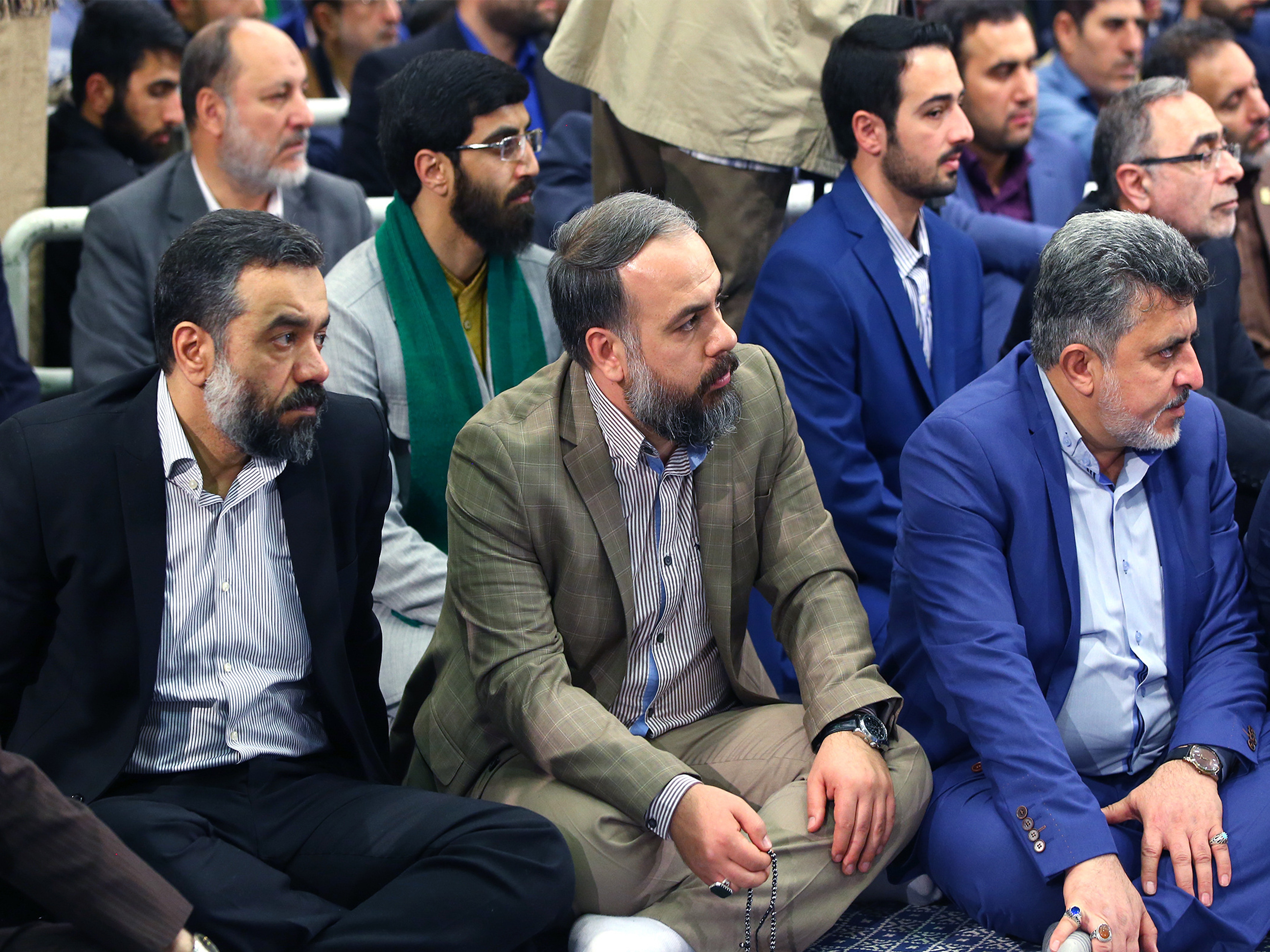
As with many power structures in the Islamic Republic, proximity to the leader's office and the security apparatus eventually translated into economic privilege. An emergent "maddah class" arose whose members stepped into large-scale business, leveraging their political protection and access to state contracts.
The story of Hassan Mir Kazemi, widely known as Hassan Rayat, is a central case study of this transformation. Rayat was not, on paper, a senior cleric or high-ranking military commander. He was a businessman whose defining asset was his close partnership with two of the most prominent maddahs of the leader's office, Mohammad Reza Taheri and Mahmoud Karimi. Through these relationships, "every closed door of power" opened to him.
His villa along the Tehran-Karaj highway became a de facto club for Beyt maddahs – those closest to the leader's office. It was described as a venue where financial meetings were held, commercial deals discussed and behind-the-scenes decisions affecting religious and political mobilization were made.
Around this nucleus, a constellation of companies arose. These entities operated in diverse sectors: imports and trade, steel and heavy industry, media equipment and cultural products, and lucrative state-linked procurement and contracts. The alleged scale is measured in "hundreds of billions" of tomans, underscoring that the business of devotion had become a gateway to serious wealth.
This economic empire became linked to one of the most infamous public scandals involving a regime maddah: the "Babayi highway shooting" case. One night, a Peugeot 206 reportedly collided with the car carrying Mahmoud Karimi. What began as a traffic incident rapidly escalated into something far more serious.
Initial public reports framed it as a minor altercation in which Karimi allegedly fired several shots. Outrage grew at the suggestion that a religious figure, often presented as a model of humility, had used a firearm on a public highway. Yet subsequent internal findings revealed a different reality: the person who discharged the weapon was not Karimi but Hassan Rayat, and the gun was described as an "organizational weapon."
Instead of a transparent judicial process, the case disappeared into silence. Within a year, Karimi was once again reciting in the leader's presence and receiving visibly warm treatment. For observers, the message was unmistakable: maddahs of the leader's office enjoyed de facto judicial impunity.
This episode was a turning point in public perception. It suggested that regime maddahs could carry weapons and use them without facing ordinary legal consequences, that investigative and judicial institutions were unwilling or unable to confront individuals sheltered by the leader's network, and that the pious image projected from the pulpits concealed a culture of entitlement and immunity.
Rayat's subsequent arrest exposed part of the financial architecture that had grown around these figures. Yet even that case was partially classified, with segments of the file sealed because they implicated maddahs and sensitive institutions. The pattern recurred: limited accountability, followed by institutional self-protection.
In parallel, the security uses of maddahs intensified. Some were invited into "security rooms" as informal sources, relaying what they heard in heyats about dissatisfaction, potential organizers, slogans and sentiments. Others, when traveling abroad, reportedly used embassies, private gatherings or religious networks to collect and pass on information. The same individual could, in the space of days, perform as a religious media figure stirring emotions at a heyat, a conduit of sensitive political messages from above, a business partner in elite economic ventures, and a source or handler in informal intelligence channels.
It was this convergence of roles that turned the maddah network from a useful propaganda tool into what internal security assessments began to describe as a "potential threat to national security." The system had created a class with deep emotional access, high-level political connections, economic power and minimal formal accountability.
By the mid to late 1390s, cracks in the façade were widening. A series of internal security alarms forced even loyal institutions to reconsider their blind trust in the maddahs.
One major shock came in 1396, when several well-known maddahs were reportedly detained in a composite case involving illicit relationships and transfer of information to a European embassy staff member. For the system, the scandal was explosive: how could individuals considered among the most trusted around the leader's office have established potentially compromising security contacts?
Rather than confront the issue publicly, the file was buried. Official disclosure would have amounted to an admission that the very corps the leader had personally honored and elevated had become a channel for foreign influence.
The true breaking point arrived when the head of the regime's own "Basij of maddahs" publicly acknowledged that several maddahs "trained in Israel" had been arrested. Even if framed as a success story of foiled espionage, the implication was devastating. If a hostile intelligence service could cultivate and train individuals within the maddah network, then the regime's supposed pillar of loyalty had become its softest security flank.
The underlying reasons were structural. Maddahs of the leader's office enjoyed direct or informal access to sensitive gatherings, closed religious ceremonies and even private meetings involving senior officials. They were present at IRGC events, closed heyats for military and security cadres, and in some "private audiences" around the leader. Their movements and conversations were not subjected to the stringent controls applied to formal officials, because they were perceived as pious, semi-sacred figures.
In effect, they carried more unmonitored, raw information than many titled officials, without equivalent training or vetting. When this reality finally reached the desks of senior security chiefs, both the Ministry of Intelligence and the IRGC Intelligence Organization were compelled to begin systematic monitoring of large heyats and the core group of Beyt maddahs.
By then, the political cost was already mounting. The network's image had been battered by recurring allegations of moral and sexual misconduct, ostentatious displays of wealth and privileged lifestyles, publicized incidents involving weapons and violence, and the gradual exposure of their role in surveillance and repression.
The most damning blow came in the eyes of many Iranians during a recent nationwide uprising. In those days, while reports circulated of Hashd-aligned units, Hezbollah-linked elements and Syrian mercenary fighters entering Iran to bolster the security forces, a different story unfolded behind closed doors. The very figures who had spent years on the pulpit urging citizens to sacrifice for the system quietly made their way to the exits.
Iraq, with its geographic proximity and the Islamic Republic's political influence there, became the "safest temporary station" for this exodus. Maddahs and their close associates traveled under religious pretexts – pilgrimages, ceremonies, inaugurations of shrines – but, once across the border, did not return as expected.
One prominent ideological figure, Ali Akbar Raefipour, exemplified this pattern. During a period when internet access inside Iran was heavily disrupted and the state tried to portray a controlled situation, Raefipour published social media posts from Najaf, acknowledging he was outside the country. He claimed to be waiting for the reopening of the Iwan of Najaf after years of renovation, a ceremony he said was supposed to host senior political and religious figures but had been brought forward unexpectedly.
Those few lines were enough for many readers to understand the timing: he had left precisely when the streets were at their most volatile. Shortly afterward, he appeared from the Mosque of Kufa in a video address portraying himself as the audience's "representative" at holy sites, while simultaneously pushing a narrative that the protests in Iran were not genuine economic grievances but part of a foreign plot, likening the situation to Venezuela.
At the same time, Iraqi sources reported that a number of regime maddahs and their dependents had entered Iraq under cover of such ceremonies and simply failed to return once the events ended. Days went by without their reappearance in Iran's religious circuit.
To insiders, the pattern was clear. Those who had spent years commanding others to stand firm and die for the Islamic Republic now saw the country as unsafe for themselves and their families. Their decision to wait out events from across the border, in relative safety, was interpreted by many as a tacit assessment that the system's future was uncertain and its fall conceivable.
This sense of betrayal compounded during a later episode: a 12-day war involving Israel, during which the Islamic Republic tried once again to mobilize domestic support by intensifying religious narratives, processions and pro-resistance rhetoric in heyats. The strategy backfired. A society that had already detached itself from the regime's religious messaging proved largely indifferent to the spectacle. Attempts to repackage the conflict in religious terms and link it emotionally to domestic loyalty were met, in large segments of the population, with rejection or open hostility.
By this point, the regime maddahs had ceased to be a bridge between the state and religious society. Instead, they had become, for many, symbols of hypocrisy: men who benefited materially from their closeness to power, helped surveil and suppress their own communities, and then sought personal safety when the consequences of that repression escalated.
Taken together, these accounts offer a case study in how an authoritarian system's attempt to manufacture a loyal emotional elite can spiral into a complex web of security risks, corruption and reputational collapse.
The project to politicize maddahi was, in its own terms, initially successful. It created a reservoir of emotionally mobilized cadres, a powerful propaganda channel outside the formal clerical and political hierarchies, and a network of loyalty that tied religious spaces directly to the leader's office and the security apparatus.
For years, this structure helped the Islamic Republic manage crises, rally supporters and suppress dissent. Heyats functioned as staging grounds for counter-demonstrations and as signaling hubs transmitting the system's preferred narratives deep into religious communities. The cost, however, was profound.
First, by tying religious mourning so tightly to state power, the system eroded the perceived independence and sanctity of these rituals. As more citizens saw heyats transformed into political theaters and recruitment centers, trust in their spiritual authenticity declined.
Second, the fusion of emotional authority, informal security roles and economic privilege created a class that was structurally prone to abuse. Maddahs who could move seamlessly between the pulpit, the security room and the boardroom were exposed to temptations of money, status and impunity. The lack of robust oversight made corruption and excess more likely, not less.
Third, the belief that piety provided automatic protection against infiltration proved disastrously naive. The network's very informality – its reliance on personal relationships, unrecorded meetings and unmonitored movements – made it an attractive target for foreign intelligence services. When signs of penetration finally emerged, the damage to internal trust was severe.
Finally, and perhaps most importantly, the behavior of key figures during periods of national crisis fundamentally altered how large parts of Iranian society see them. The image of maddahs fleeing the country, or relocating their families and assets while encouraging others to endure hardship and repression, has become a powerful symbol of the system's moral dislocation.
In today's Iran, the term "regime maddah" no longer conjures the state's idealized image of a humble servant of faith. For many, it evokes complicity in surveillance and repression, ostentatious wealth and opaque business ties, involvement in scandals and security breaches, and, ultimately, loyalty not to religion or community, but to a shrinking circle of power at the top of the Islamic Republic.
The broader lesson extends beyond this specific network. When a political system systematically instrumentalizes religious sentiment for control, it risks not only delegitimizing its tools but also poisoning the very wells of belief and community that it depends on. The maddah project began with the promise of binding people to the state through shared grief and devotion. It now stands as evidence of a system that has lost both its moral compass and its sense of strategic restraint.
In the memories of many Iranians, the regime maddahs will likely be remembered less as "servants of the household of the Prophet" than as the emotional and financial brokers of a power structure that demanded sacrifice from others while shielding itself from consequence. As their social standing has eroded and their role as a bridge between state and society has collapsed, they have become part of a broader story: a system whose own instruments of control are turning into sources of vulnerability, resentment and historical indictment.