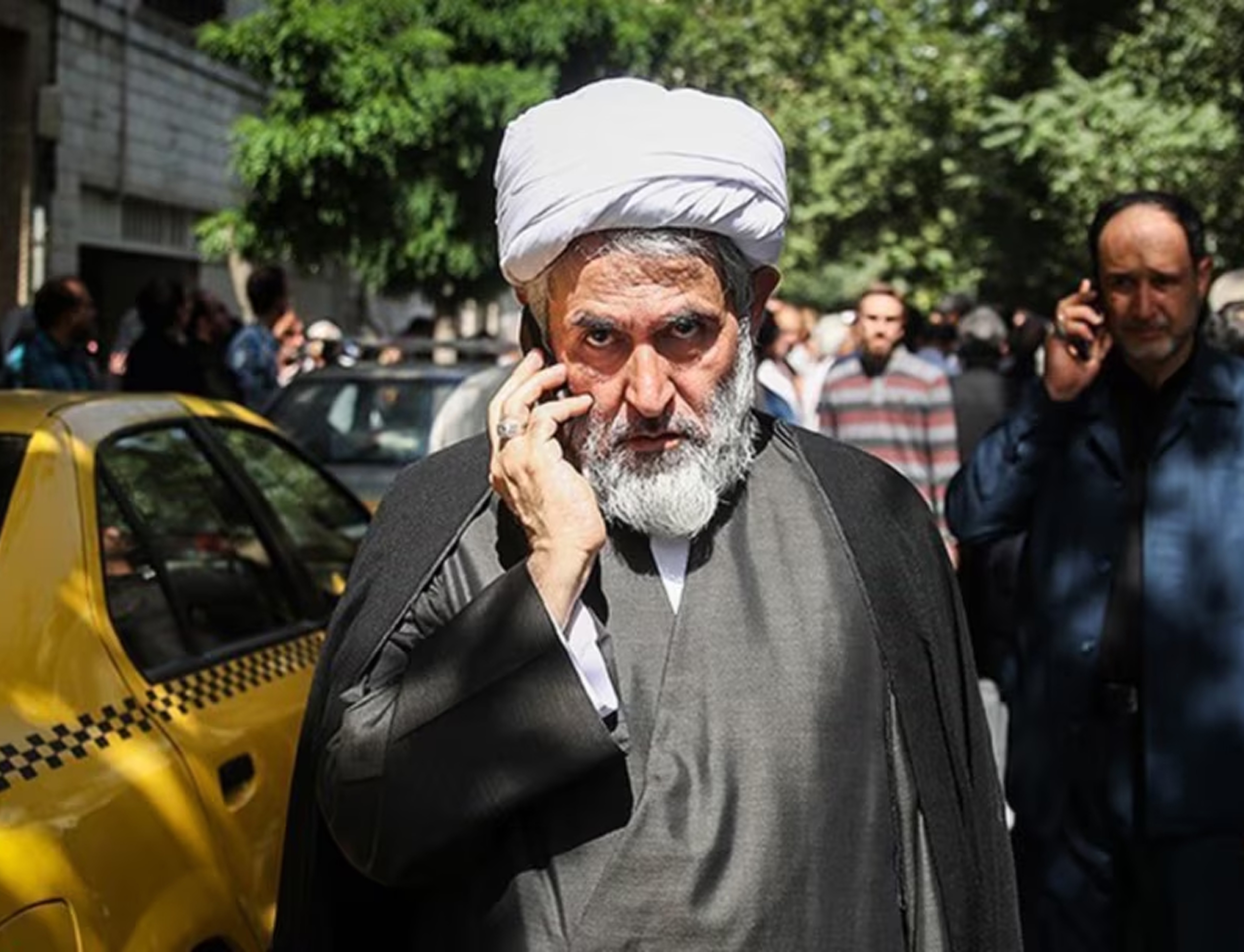




The Guardian of the Leader Who Fell Outside the Guard
A former commander’s rise and fall exposes the security networks surrounding the Islamic Republic’s leader.
|
Pars Barghandan

For more than a decade, Ebrahim Jabbari occupied one of the most sensitive positions in the Islamic Republic's security establishment. As commander of the Islamic Revolutionary Guard Corps unit responsible for protecting Ali Khamenei, his residence, offices, movements and immediate security environment, Jabbari stood at the intersection of military power, personal loyalty and the survival machinery surrounding the country's highest authority.
His tenure was extraordinary not only because of the position itself, but because of its duration. Jabbari commanded the IRGC's Vali-e Amr Protection Corps from 2010 until 2022, according to the available account, a 12-year period spanning nationwide unrest, deepening political polarization, repeated challenges to state legitimacy and growing concern inside the establishment about infiltration and internal security. Few military officers were positioned closer to the physical center of power for so long.
Yet by March 2026, the same officer was publicly disowned by the military establishment.
After Jabbari gave an interview to Al Jazeera in which he was presented as an adviser to the IRGC commander and made sweeping claims about Iran's missile reserves and military capabilities, the General Staff of the Armed Forces issued an unusually direct statement. It said that Jabbari no longer held any responsibility in the IRGC, lacked access to current military information and that his statements should therefore be considered invalid.
The rebuke was striking because Jabbari had spent years cultivating the image of a senior insider. Even after losing his command in 2022, he repeatedly appeared in the media, commenting on military affairs, Israel, the United States, senior commanders and the Islamic Republic's missile capabilities. His public posture suggested continued access and influence. The General Staff's statement suggested the opposite: that a man once entrusted with the security of Ali Khamenei had been pushed far enough from the center that the military now considered his claims unreliable.
The trajectory is revealing. Jabbari's story is not simply that of a military officer who rose and fell. It illustrates how advancement inside the Islamic Republic can depend on a combination of battlefield credentials, political reliability, demonstrated willingness to confront dissent, personal relationships and access to clerical and family networks around the leader.
It also reveals the fragility beneath apparently durable positions of power. An officer may spend decades proving his loyalty, oversee the security of the country's most protected political figure, and still be removed when the establishment's threat perceptions change. In Jabbari's case, the decisive rupture appears to have come during the 2022 security shake-up that also removed Hossein Taeb from the leadership of the IRGC Intelligence Organization.
What followed was an unusual second act. Jabbari did not disappear quietly. Instead, he continued to speak as though he remained close to the military command structure. That decision ultimately exposed the gulf between the authority he projected publicly and the status the establishment was prepared to recognize.

Jabbari was born in Tehran in 1957 to a family with roots in Zanjan and entered the war generation of the Revolutionary Guards. According to accounts promoted by media close to the IRGC, he served continuously at the front from 1982 and participated in major operations, including Beit ol-Moqaddas and the campaign that resulted in the recapture of Khorramshahr. The same account notes, however, that publicly available documentation does not clearly establish a significant command role for him in those operations.
More consequential than the mythology surrounding his wartime record was the network he appears to have entered during the Iran-Iraq war.
Jabbari has been associated with the circle of fighters around the Habib Battalion, where figures including Hossein Taeb, Mehdi Taeb and others developed relationships with Mojtaba Khamenei, Ali Khamenei's son. Mojtaba was still a teenager during the period in question and did not possess an independent formal command position. But relationships formed during wartime later acquired political significance after Ali Khamenei became leader in 1989.
The importance of those networks should not be reduced to friendship alone. In highly securitized political systems, personal familiarity can function as an alternative form of institutional verification. Officers known personally to members of the ruling circle may be judged not merely on competence but on predictability, ideological reliability and confidence that they will act decisively during crises. Jabbari's later career suggests that he met those requirements.
Not long after Ali Khamenei became leader, Jabbari was promoted to brigadier general second class and appointed commander of the IRGC in Zanjan. He remained there for approximately 13 years.
The most politically significant episode of that period came during the disputed parliamentary election of 1996.
In Zanjan, mathematics professor Mohsen Najafian emerged as the leading candidate in the constituency. Following complaints by defeated conservative candidates, the result was annulled and the election was ordered to be repeated. Najafian, who had reportedly won the initial contest by a substantial margin, did not ultimately enter parliament.
The reversal generated street protests.
Jabbari, then the provincial IRGC commander, responded by deploying forces against demonstrators. The account attributes the rapid suppression of the protests to his command and says that nine Basij bases believed to have supported Najafian were subsequently dissolved. Jabbari also targeted the local reformist press politically and legally. A publication called Payam-e Zanjan, associated with Najafian's supporters and local reformists, faced a complaint from Jabbari and was temporarily shut down.
The episode is important because it established a pattern that would recur throughout his career: Jabbari's value to the political order was linked not simply to conventional military command but to his capacity to contain politically dangerous situations.
After leaving Zanjan in 2002, he became IRGC commander in Qazvin, where he remained for another six years. Altogether, nearly two decades commanding the Guard in Zanjan and Qazvin transformed him into what the system prizes during moments of internal instability: a known quantity.
By late 2008, that experience had become especially valuable.
The Islamic Republic was heading toward the 2009 presidential election, a contest that would produce one of the most serious political crises in its history. The possibility of mass unrest was already shaping personnel decisions inside the security apparatus. Jabbari was brought to Tehran, first as deputy commander of the capital's IRGC structure and later to the Basij organization, where he served under Hossein Taeb.
The move connected three elements that had developed separately during his earlier career: a history of suppressing local unrest, longstanding hostility toward reformist political currents, and personal proximity to figures trusted by the ruling establishment.
When large demonstrations erupted after Mahmoud Ahmadinejad was declared the winner of the June 2009 presidential election, Jabbari was therefore positioned inside the security apparatus that confronted them.
The crackdown that followed involved mass arrests, extensive violence and deaths among protesters. The source account describes Jabbari as one of the significant figures involved in suppressing the demonstrations, although it does not provide an incident-by-incident evidentiary record establishing his personal responsibility for individual killings or detention operations. That distinction matters. His command position and political role place him within the machinery of repression, but specific criminal responsibility would require evidence beyond organizational proximity.
What is clearer is that his career continued to advance rather than suffer.
Later in 2009, Interior Minister Mostafa Mohammad-Najjar appointed him governor of Karaj and deputy governor of Tehran Province. But the appointment was reportedly blocked by IRGC commander Mohammad Ali Jafari, who wanted Jabbari for another assignment.
That assignment was Qom.
Qom was not a routine provincial posting. It was the country's clerical center, a city where religious authority, factional politics and opposition networks overlapped in ways that made security incidents potentially national in significance.
Jabbari's roughly one-year tenure there coincided with several politically explosive events.
Government supporters attacked the funeral of Grand Ayatollah Hossein Ali Montazeri, once designated to succeed Ruhollah Khomeini before becoming one of the Islamic Republic's most prominent clerical critics. There was also an attack on the residence of Grand Ayatollah Yousef Sanei during a visit by opposition figure Mehdi Karroubi, as well as demonstrations targeting Hassan Khomeini.
Jabbari's performance during these confrontations was viewed favorably by state authorities. The governor of Qom reportedly praised him for what was described as an effective response to the political movement that officials labeled the "sedition", the establishment's term for the protest movement that followed the 2009 election.
His final major assignment in Qom was even more consequential: preparing the city for a 10-day visit by Ali Khamenei.
Security surrounding such a visit requires far more than bodyguards. It involves route control, intelligence screening, crowd management, communications security, coordination among military and civilian bodies and pre-emptive monitoring of potential threats. A failure can have consequences extending well beyond physical danger. Even visible protest during a carefully orchestrated leadership visit can be interpreted as a political security failure.
Jabbari successfully managed the operation, according to the account. During the visit he also gave a speech in Khamenei's presence stressing the readiness of the Basij and Revolutionary Guards to confront opponents more forcefully and through more sophisticated methods.
Soon afterward, he was appointed commander of the Vali-e Amr Protection Corps.
The appointment placed him at the head of one of the Islamic Republic's most secretive security organizations. The unit was responsible for protecting Ali Khamenei personally, the leadership compound and associated facilities. The account puts the force at more than 12,000 personnel, although precise staffing levels for such organizations are difficult to independently establish.
Several factors appear to have converged in Jabbari's selection.
One was his record in Zanjan, Tehran and Qom. He had repeatedly been deployed where political unrest and regime security overlapped. Another was his relationship with Mojtaba Khamenei. A third was his proximity to Mohammad-Taqi Mesbah-Yazdi, an influential hardline cleric deeply respected by Ali Khamenei.
During Jabbari's period commanding the IRGC in Qom, he reportedly met Mesbah-Yazdi frequently and consulted him on political and operational questions. Accounts surrounding Jabbari's elevation suggest that Mesbah-Yazdi supported his appointment to the protection command.
Taken together, these elements illustrate how formal institutional promotion and informal networks can reinforce each other. Jabbari did not rise solely because he knew the right people, nor solely because he held the right commands. His career appears to have been built through the interaction of both.
He was politically reliable, operationally experienced, familiar to Mojtaba Khamenei's wartime circle and acceptable to a cleric with influence inside the leader's ideological environment.
Once installed, he remained.
By 2014, Jabbari had reportedly received the rank of full brigadier general from Ali Khamenei, further consolidating his standing inside the security hierarchy. Few appointments could have demonstrated greater institutional trust. The officer responsible for the leader's immediate protection must operate in an environment where suspicion is permanent and failure potentially catastrophic.
Information about the internal operations of the Vali-e Amr Protection Corps remains limited, but the available description offers a partial picture.
Personnel closest to Khamenei reportedly undergo special vetting and are expected to act as the innermost human barrier during an attack. They accompany him during public appearances, official meetings, domestic travel and inspections. The unit also maintains facilities outside central Tehran, including in areas such as Karaj, Varamin and Buin Zahra, which are described as training and support locations capable of reinforcing the capital in an emergency.
Its headquarters had previously been located near Pasdaran Square before being moved in 2007 to a building on Villa Street, now known as Nejatollahi Street. No official explanation was provided for the relocation. The account links it, speculatively, to concern about future unrest in Tehran.
During Jabbari's command, the force's responsibilities also reportedly expanded to include closer monitoring of Khamenei's physical condition, an increasingly relevant issue as the leader aged.
Another visible development was the appearance of close-protection personnel carrying black cases near Khamenei during official events. Security-linked reports have claimed that the cases could be rapidly deployed as ballistic shields capable of protecting parts of his body from small-arms fire. The exact specifications and capabilities of the equipment have not been publicly established.
What these details collectively show is the scale of the security ecosystem surrounding the leader. Protection in the Islamic Republic is not merely a matter of armed guards. It is an institutional architecture linking intelligence, ideological vetting, logistics, medical surveillance, reserve forces, urban security planning and the politics of personal trust.
For 12 years, Jabbari sat at its center.
Jabbari's command ended abruptly in June 2022.
The timing is central to understanding the significance of his removal.
On June 23, Hossein Taeb, one of the most powerful security officials in the country, was removed after approximately 13 years as head of the IRGC Intelligence Organization. Two days later, Jabbari was removed from the Vali-e Amr Protection Corps.
Government-aligned outlets sought to portray the changes as ordinary rotations among senior commanders. But two removals involving highly sensitive security institutions within days of one another immediately generated speculation that a wider crisis was underway.
The source account describes the episode as part of what was widely interpreted as a security "housecleaning" within the Revolutionary Guards. Reports circulating at the time alleged that evidence of Israeli intelligence penetration had reached unusually sensitive sections of the Islamic Republic's security infrastructure and potentially even networks close to the leadership compound.
Those allegations are serious and should not be treated as established fact without documentary evidence. But they provide essential context for the political meaning attached to the removals. Taeb headed the organization responsible for counterintelligence and internal security. Jabbari commanded the unit responsible for the physical protection of the leader. Removing both in rapid succession naturally raised questions about whether senior authorities had lost confidence in the existing security architecture.
The contrast between Jabbari's longevity and the speed of his departure is particularly striking.
For more than a decade, he had survived political upheaval, factional struggles, nationwide protests and repeated security challenges. His career had been built on trust. Yet once the establishment's assessment of threats changed, even that history appears to have offered little protection.
He was replaced by Hassan Mashrouei-Fard, according to the account, and was subsequently associated with an advisory title.
Advisory appointments are common tools within authoritarian and military bureaucracies. They can preserve status while removing operational authority. They can also allow an institution to sideline a powerful figure without openly describing his removal as a purge.
For Jabbari, however, the ambiguity of that arrangement became consequential.
Hossein Taeb largely disappeared from public view after his removal. Jabbari chose a different strategy. He continued appearing before cameras.
That decision preserved his public profile but gradually created a contradiction. Jabbari spoke with the confidence of a senior commander while his actual access to command structures was becoming increasingly uncertain.
In October 2024, after the killing of Hezbollah leader Hassan Nasrallah and amid speculation surrounding the temporary absence of IRGC Quds Force commander Esmail Qaani, Jabbari appeared publicly and said Qaani was safe. He also claimed Qaani would receive the Order of Fath from Ali Khamenei, something the account says did not subsequently occur.
By early 2025, his statements became still more aggressive. He spoke publicly about expanded missile ranges and threatened Israeli cities including Tel Aviv and Haifa.
After the conflict described in the source as the 12-day war, Jabbari increased his media appearances further, presenting claims about underground missile complexes, remaining stockpiles and the Islamic Republic's capacity for sustained missile attacks.
In one interview with Mehr News Agency in mid-2025, he claimed that the visible use of the IRGC Aerospace Force represented only part of its capabilities. He said underground missile facilities remained largely intact and asserted that Iran could launch missiles against Israel and the United States every day for two years without exhausting its resources.
These were extraordinary assertions. More importantly, they carried the apparent authority of a man who was regularly introduced as a former senior commander and, at times, an adviser to the IRGC's commander.
But the institutional basis for that authority was already eroding.
Jabbari appeared on Al Jazeera and was identified as an adviser to the commander of the Revolutionary Guards. He made a series of sweeping military claims, including that Iran had not yet committed its full military capabilities, that missile and drone depots remained well supplied and that 19 of every 20 missiles fired would reach their intended targets.
He also suggested that more advanced missiles would soon be used.
The response from the General Staff of the Armed Forces was unusually sharp.
On the final day of the Persian year in March 2026, the General Staff announced that Jabbari had no current responsibility in the Revolutionary Guards. It said he had been retired for some time, did not have access to accurate information about military planning and that statements attributed to him should therefore be considered invalid.
The language amounted to more than a technical correction.
Military organizations routinely distance themselves from retired officers, particularly when former officials comment on operational matters. But Jabbari was not an ordinary retiree. He had led the security force protecting Ali Khamenei for 12 years. He had spent decades inside the IRGC command structure. His old relationships reached into circles associated with Mojtaba Khamenei, Hossein Taeb and senior hardline clerical figures.
For the armed forces to state publicly that he lacked access to relevant information was to draw a formal boundary between his past status and his present position.
It also raised an unavoidable question: why had he been allowed to speak for so long in a manner that could be mistaken for an authoritative military position?
One explanation is bureaucratic ambiguity. Former commanders often retain honorific titles and informal relationships long after losing command. Journalists and state-linked media may continue presenting them using old titles or vague advisory designations.
Another possibility is that Jabbari retained some informal political access without possessing operational military information. In systems where formal authority and personal networks overlap, those two realities can coexist.
A third interpretation is less favorable to Jabbari: that his public profile increasingly depended on the prestige of positions he no longer held.
The pattern of his appearances lends weight to that possibility. After leaving command, he repeatedly addressed subjects ranging from the whereabouts of senior officers to missile capabilities and strategic threats. Such commentary created the impression that he remained inside the decision-making circle.
The General Staff ultimately destroyed that impression.
Its statement reframed all of his recent interventions. What had been presented as the warnings of a senior insider could now be read as the pronouncements of a retired commander without access to current plans.
The institutional repudiation also demonstrates the disciplined hierarchy of information inside the Islamic Republic's security system. Access itself is a form of power. When the military announced that Jabbari lacked it, the statement was not merely about factual accuracy. It was about status.
The message was that proximity to the leader in the past did not confer permanent authority to speak for the armed forces.
Ebrahim Jabbari's career offers a rare view into the political logic governing senior security appointments in the Islamic Republic.
His ascent was gradual but consistent. Wartime service supplied the foundational credentials. Provincial command demonstrated administrative ability. Suppression of dissent established political reliability. The 2009 crisis brought him into the capital's coercive machinery. Qom proved his capacity to manage a religious and political center under pressure. His handling of Ali Khamenei's visit then demonstrated his suitability for the most sensitive protection assignment in the system.
Alongside those institutional credentials ran a second track: personal networks.
His relationship with Mojtaba Khamenei reportedly dated to the wartime Habib Battalion circle. His career later intersected with Hossein Taeb, another figure associated with that network. His relationship with Mohammad-Taqi Mesbah-Yazdi provided an additional connection to the ideological establishment surrounding Ali Khamenei.
None of those relationships alone explains his rise. Together with his operational record, however, they help explain why he was trusted with a position that could not be filled on technical competence alone.
The pattern also highlights the close relationship between domestic repression and elite advancement.
Jabbari's career milestones repeatedly followed moments in which the state faced political opposition. The Zanjan protests demonstrated his willingness to use coercive power against local dissent. His relocation to Tehran placed him inside the security response to the 2009 demonstrations. His Qom command involved confronting figures and constituencies associated with opposition to the political leadership.
In each case, internal political control and military professionalism were not separate categories. They formed part of the same career ladder.
This is an important feature of the Islamic Republic's security architecture. The Revolutionary Guards are not structured solely around external defense. Their senior commanders may acquire influence precisely because they demonstrate an ability to manage domestic political threats. A record of controlling protests can become evidence of reliability when the establishment later considers who should protect its most senior figures.
Jabbari's eventual removal illustrates the other side of that system.
Loyalty can accumulate over decades, but it can also be overridden rapidly when the leadership perceives a new category of danger. The simultaneous displacement of Taeb and Jabbari in 2022 suggested that security officials were confronting concerns that differed from the street protests on which both men had built part of their reputations.
The threat was no longer simply visible opposition. It was alleged penetration.
Countering demonstrations requires manpower, surveillance, arrests and territorial control. Countering an adversary believed to have entered one's own institutions requires something more destabilizing: distrust of insiders.
That distinction may help explain why veterans of the security establishment could suddenly become liabilities. An organization confronting infiltration cannot rely indefinitely on seniority or personal history. The very networks that once created trust can become subjects of scrutiny.
Jabbari's subsequent behavior also illuminates a recurring problem in opaque political systems: the uncertain boundary between office and influence.
For years after his removal, he could still be presented publicly in language suggesting proximity to the IRGC command. He continued to speak about highly sensitive military matters. His past made those claims plausible to audiences.
Then a single official statement effectively erased the ambiguity.
He had no responsibility.
He lacked access.
His claims were not authoritative.
For a figure whose career had depended on proximity to the center, that was a particularly severe form of political demotion.
Whether Jabbari remains permanently excluded from elite politics cannot be known. His historic relationship with Mojtaba Khamenei has generated speculation that a future change in the leadership structure could revive old networks. But such scenarios remain speculative and should not be confused with evidence of present influence.
The more firmly supported conclusion is narrower and more significant.
Jabbari's career shows how the Islamic Republic's security elite is constructed around a fusion of ideological loyalty, coercive experience, personal trust and proximity to powerful networks. It also shows that none of those assets guarantees permanent protection.
For 12 years, Ebrahim Jabbari was entrusted with protecting the most guarded man in the country. Four years after losing that command, the armed forces found it necessary to tell the public that he no longer spoke from a position of knowledge.
The distance between those two realities is not merely the story of one retired commander.
It is a measure of how rapidly authority can disappear inside a system where access defines power, personal loyalty reinforces formal command, and the deepest security concern may ultimately come not from the crowds outside the perimeter, but from uncertainty over who can still be trusted within it.