





The General Behind the Guard: Mohammad Ali Jafari and the Architecture of Power in the Islamic Republic
How Mohammad Ali Jafari built influence across the Guards, politics, repression, and opaque finance.
|
Pars Barghandan

In the Islamic Republic, formal office does not always define the limits of power. Presidents, ministers and parliamentary leaders occupy the visible institutions of government, but some of the most consequential actors have built careers inside military, intelligence and security structures whose influence extends well beyond their official mandates.
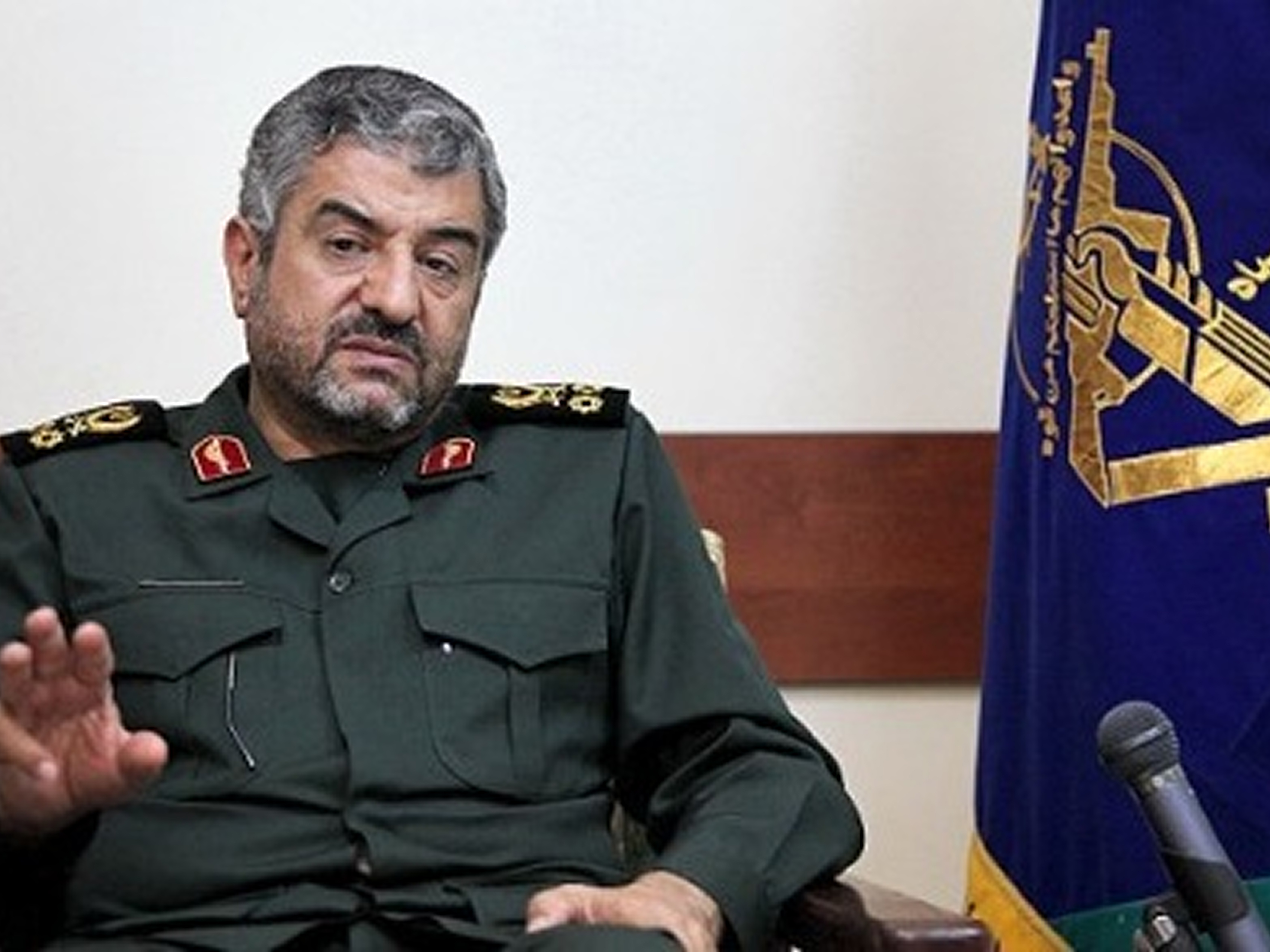
Mohammad Ali Jafari, widely known by his wartime nickname Aziz Jafari, belongs to that category. An architecture student before the 1979 revolution, a battlefield commander during the Iran-Iraq war, commander of the Islamic Revolutionary Guard Corps Ground Forces for more than a decade, and finally commander-in-chief of the IRGC from 2007 to 2019, Jafari spent much of his adult life inside institutions designed not merely to defend the state but to protect the political order itself.
His importance lies less in any single operation than in the transformation that occurred while he was rising through the system. During Jafari's tenure, the IRGC became more geographically decentralized, more deeply connected to the Basij, more capable in intelligence and cyber operations, more economically entrenched and more openly involved in defining the acceptable boundaries of politics. The organization that emerged was not simply an armed force. It increasingly resembled a parallel structure of governance whose functions overlapped with policing, intelligence, electoral politics, economic activity and ideological enforcement.
Jafari's record also connects several episodes that illuminate how that structure works in practice: the warning delivered by senior Guards commanders to President Mohammad Khatami after the 1999 student unrest; the institutional reorganization preceding the disputed 2009 presidential election; the suppression that followed that election; the expansion of IRGC economic interests; the controversial handling of the catastrophic 2019 floods; and, later, leaked recordings concerning the Yas Holding corruption affair and alleged political engineering from outside formal office.
The significance of those episodes has grown rather than diminished. Ali Khamenei's death in the US-Israeli war that began on February 28, 2026, and the subsequent elevation of his son Mojtaba occurred amid a dramatic expansion of the Guards' role in national decision-making. Reuters has described a wartime system in which the IRGC exercises unprecedented influence, while other reporting places Jafari within an older intelligence-security network that has retained access to the new leadership.
Jafari's career therefore offers more than the biography of a retired general. It is a case study in the construction of a political-security order where official retirement need not mean political disappearance, where military institutions can exercise civilian functions, and where networks accumulated over decades may matter more than the office printed beneath a man's name.
Jafari was born in Yazd in 1957, the third child in a large family headed by an architect. In 1977 he entered the University of Tehran, where he studied architecture and became involved in political activity during the final years of the monarchy. Accounts of his early career place him among the revolutionary students active during the upheavals of 1978 and 1979 and later inside the political struggles that reshaped the universities after the revolution.
The beginning of the Iran-Iraq war in 1980 redirected his career decisively. Jafari first went to the front through the Basij and joined the IRGC formally in 1981. He rose through a generation of commanders whose legitimacy inside the new order came from wartime service rather than conventional military education. He commanded formations and operational headquarters including Ashura and the Quds and Najaf commands, worked in western and southern theaters and was seriously wounded during major operations late in the conflict.
The relationships established during the war would become one of the enduring features of the Islamic Republic's security elite. Commanders who fought together in the 1980s later resurfaced as senior military officers, intelligence officials, politicians, municipal leaders and security administrators. Jafari's career repeatedly intersected with figures including Mohsen Rezaei and Mohammad Bagher Ghalibaf. The pattern matters because the postwar Guards were not built solely through bureaucratic promotion. They were shaped by networks of loyalty formed under battlefield conditions and preserved across institutions.
In 1992, Ali Khamenei appointed Jafari commander of the IRGC Ground Forces, a position he held for roughly 13 years. His responsibilities included operations in sensitive Kurdish regions and the southeast, areas where the Islamic Republic has historically treated political unrest, ethnic conflict, armed insurgency and border security as overlapping problems.
That period also placed him near an important threshold in the Guards' political evolution.
Following the July 1999 student protests, 24 senior IRGC commanders sent President Mohammad Khatami an extraordinary warning. The letter accused the administration of passivity and suggested that the Guards' patience was running out. Jafari was among its signatories. The intervention was significant not because tanks appeared in Tehran, but because uniformed commanders had openly indicated that there were circumstances in which they regarded the elected government's management of domestic politics as subordinate to their understanding of the revolution's survival.
The episode established a principle that would become more visible a decade later: the Guards did not necessarily regard political neutrality as a higher obligation than preservation of the ideological order.
By the mid-2000s, Jafari had moved from operational command into strategic planning. He was placed in charge of an IRGC strategic center created to examine future threats and military doctrine. The resulting approach became associated with what later came to be called "mosaic defense", a system designed to reduce dependence on a single centralized command structure by giving regional components greater capacity to operate independently if the center were disrupted.
The doctrine responded in part to lessons drawn from the rapid American overthrow of Saddam Hussein's highly centralized state in Iraq. But its political implications were equally important. Decentralized security structures could be useful against invasion while also producing locally embedded forces capable of responding rapidly to internal unrest.
When Jafari was promoted to major general and appointed commander-in-chief of the IRGC in 2007, the institution was therefore preparing for two categories of threat at once: military attack from abroad and political destabilization from within.
The distinction between those threats would become increasingly blurred.
The most consequential legacy of Jafari's command was organizational.
Under his leadership, the IRGC moved toward provincial commands linking regional Guard formations more closely with Basij structures. Tehran received separate commands because of its political and strategic importance. The arrangement strengthened territorial resilience but also placed a permanent security infrastructure inside provinces across the country. The Basij was brought under closer IRGC control during this period, a change analysts linked partly to the leadership's growing concern about internal political challenges.
At the same time, the IRGC's intelligence capabilities expanded. Hossein Taeb emerged as one of the most important security officials of the period, eventually taking charge of the IRGC Intelligence Organization. Mohammad Reza Naqdi became Basij commander, Hossein Salami became Jafari's deputy, and Amir Ali Hajizadeh rose to command the aerospace branch. Several of the men elevated during this institutional reconstruction would remain prominent for years afterward.
Missile capabilities, cyber operations and electronic warfare also grew in importance. The broader pattern was a movement away from a traditional conception of a military institution toward a network capable of operating across physical, political and information domains.
The test of that transformation came in 2009.
The presidential election that year produced one of the most serious domestic crises in the history of the Islamic Republic. Mahmoud Ahmadinejad was declared the winner over challengers including Mirhossein Mousavi and Mehdi Karroubi. Allegations of electoral manipulation triggered mass demonstrations, followed by arrests, prosecutions and violent repression. The Basij and other security forces played a central role in confronting protesters, and thousands of people were detained.
Jafari did not occupy a peripheral position during the crisis. He led the institution whose growing internal-security architecture had been built precisely for circumstances in which political unrest was interpreted as a threat to the system.
The political dimension became clearer in his later public explanations of the election. Jafari described the possible return of the reformist political current associated with the Khatami era as a red line for forces committed to the revolution. He argued that demands for the IRGC and Basij to remain outside elections would have left their opponents free to act without resistance. Critics seized on such remarks as evidence that the Guards did not see themselves as neutral guardians of an electoral process, but as participants with an ideological stake in its outcome.
This distinction is essential. The argument is not simply that individual Guards officers possessed political opinions. The more serious question is whether an institution possessing weapons, intelligence services, detention capabilities, media influence and a mass paramilitary organization could simultaneously define particular civilian political currents as threats to the revolution and participate in the environment in which those currents competed for power.
The events of 2009 suggested that, under Jafari, the answer was yes.
His rhetoric after the protests reinforced that interpretation. The unrest was framed not primarily as a dispute over votes or political legitimacy, but as a security confrontation in which the Islamic Republic, its supreme leader and the revolution itself had been attacked. That formulation converted political opposition into a category of threat. Once that transformation occurs, coercion can be presented not as interference in politics but as institutional self-defense.
The logic extended beyond the Ahmadinejad period. Jafari repeatedly criticized political currents identified with reformism and challenged civilian officials publicly in ways unusual for senior commanders in conventional military systems. His interventions illustrated an institutional culture in which the Guards' senior leadership regarded itself as qualified to determine not only how the Islamic Republic should be defended, but what kinds of political outcomes constituted acceptable defense of the system.
The same architecture was becoming increasingly powerful in the economy.
As the IRGC expanded its engineering, contracting and commercial reach, organizations connected to the Guards became involved in infrastructure, finance and municipal business. This economic expansion gave the institution resources independent of ordinary military budgeting while creating relationships between commanders, companies, foundations and political authorities. The result was a structure in which security power and economic patronage increasingly overlapped.
Those relationships would later surface in one of the most damaging internal recordings ever attributed to senior IRGC officials.
Jafari's final months as IRGC commander exposed two very different weaknesses in the institution he had helped construct.
The first involved the catastrophic floods of spring 2019.
In Golestan and other provinces, extraordinary rainfall submerged towns and farmland, destroyed infrastructure and displaced large numbers of people. By mid-April, Reuters reported at least 76 deaths nationwide and more than 220,000 people forced into emergency shelters. The Guards mobilized personnel and equipment as part of the state response.
But footage from Aqqala offered a less polished view of military crisis management. Jafari was shown personally arguing over how accumulated water should be released, insisting that a road be breached while a local official warned that the situation required a tunnel. Elsewhere, IRGC forces cut sections of the railway line in an effort to open a path for floodwater. President Hassan Rouhani later criticized infrastructure destruction that he said had failed to alter the water level meaningfully. Jafari defended the Guards' intervention.
The episode was revealing because the institution's enormous authority had created an expectation that its commanders could intervene across fields far removed from conventional warfare. A senior military officer was not merely allocating rescue equipment. He was making on-site engineering judgments while civilian authorities and technical officials disputed the method.
The second controversy was considerably more serious.
Jafari was replaced by Hossein Salami in April 2019, earlier than expected after Ali Khamenei had previously extended his tenure. His reassignment to the Baqiatallah cultural and social headquarters was widely interpreted as a reduction in formal military authority.
No single publicly established explanation accounts for the timing. Speculation ranged from changing strategic priorities to dissatisfaction with Jafari's public remarks concerning neighboring states and foreign economic activity. His departure therefore should not be treated as proof that any one controversy caused his removal.
What emerged later, however, raised larger questions about events during his command.
In February 2022, Radio Farda published a leaked recording described as a roughly 50-minute conversation between Jafari and Sadegh Zolghadrnia, then his deputy for economic affairs. The conversation reportedly took place in 2018 and concerned suspected financial misconduct linked to Yas Holding, the IRGC Cooperation Foundation, Tehran municipal transactions and individuals associated with the Quds Force.
Yas Holding was connected to the financial infrastructure surrounding the Guards. What made the leak extraordinary was not merely the allegation that corruption existed. Allegations of opaque contracting around military-linked institutions had circulated for years. The significance was that a former commander-in-chief appeared to be discussing suspected violations from inside the system itself.
The recording presented Jafari not as an outside accuser but as a senior official confronting transactions he described as improper and discussing the political complications surrounding them. Names associated with some of the Islamic Republic's most powerful institutions surfaced in the conversation, including Ghalibaf and figures linked to the Quds Force. Radio Farda described the recording as evidence of both corruption and internal conflict within the Guards' upper hierarchy.
The affair illustrates the difficulty of separating corruption from institutional structure.
When an organization simultaneously operates military units, intelligence bodies, foundations, holding companies, contracting enterprises and politically connected networks, ordinary lines of accountability become difficult to follow. Money may move between entities with overlapping leadership, strategic functions and political protection. Investigating one transaction can therefore implicate not simply an executive or contractor but relationships extending into security institutions themselves.
The public release of the recording did not produce the type of transparent accounting that would allow outsiders to determine the full scope of the Yas affair. Claims circulated that enormous portions of the underlying case were never pursued against senior figures. The precise internal decisions behind those outcomes remain difficult to establish from public evidence.
That opacity is itself significant.
In a conventional corruption investigation, the central questions would be comparatively straightforward: What money moved? Which contracts were lawful? Who authorized them? Who benefited? Which officials knew? In a security-dominated political structure, an additional question intervenes: whether investigating the transaction could damage institutions considered essential to the survival of the system.
That conflict creates a built-in mechanism for impunity. Accountability can be portrayed as an attack on the institution, and an attack on the institution can then be portrayed as an attack on the state.
The reaction to corruption allegations involving revered security figures has repeatedly demonstrated the strength of that defensive reflex. Senior leadership has often responded to outside reporting by accusing adversaries of attempting to undermine the Guards rather than opening the underlying institutions to independent scrutiny.
For Jafari, the Yas recording also complicated the idea that leaving command meant leaving power. The conversation showed him at the center of financial and institutional disputes near the end of his tenure. Later leaks suggested that his influence extended into politics after that tenure had formally ended.
A revealing indication came after Iran's 2024 parliamentary election.
A leaked recording attributed to former Foreign Minister Mohammad Javad Zarif described Jafari and former IRGC intelligence chief Hossein Taeb as influential actors in the political machinery behind candidate lists. IranWire reported that Zarif portrayed the pair as being effectively "behind everything" in parts of the electoral process. The allegation cannot by itself establish the precise chain of command, but it is important because it came from a former senior official describing political influence exercised outside ordinary electoral institutions.
If accurate, it would fit a pattern already visible in Jafari's career.
He had signed the 1999 warning to Khatami. He had commanded the IRGC during the 2009 election crisis. He had argued publicly that the Guards and Basij had a role in preventing political currents deemed hostile to revolutionary values from regaining power. A later role in candidate management would therefore represent continuity rather than a radical departure.
The principle underlying that continuity is institutional rather than personal: elections may occur, but the acceptable field of competition is conditioned by unelected bodies that define the security interests of the Islamic Republic.
Jafari also remained vocal on strategic affairs.
In late 2024 he publicly dismissed warnings about Israel's ability to conduct major military operations against Iran, arguing that geographic distance and Iran's defenses sharply constrained Israeli options.
Events that followed made those assurances notable.
Israeli strikes in 2025 killed senior commanders including Jafari's successor Hossein Salami. A much larger US-Israeli war began on February 28, 2026, killing Ali Khamenei and numerous senior military and political figures and pushing the Guards into an even larger role inside the surviving power structure.
The contrast between Jafari's earlier confidence and the subsequent penetration of Iran's military command structure is more than rhetorical embarrassment. It highlights a recurring problem in closed security systems: assessments of capability may become intertwined with ideological expectations and public messaging. Statements intended to project deterrence can obscure the difference between what leaders need the public to believe and what adversaries can actually do.
The leadership order that emerged after Ali Khamenei's death further revived the relevance of Jafari's generation.
Mojtaba Khamenei was selected as the new supreme leader with decisive support from the Guards, according to Reuters. Yet his physical condition and limited public presence contributed to a system in which military officials acquired extraordinary leverage. By April, Reuters reported that the IRGC was dominating military strategy and key political decisions while Mojtaba remained formally at the apex of the structure.
Ahmad Vahidi emerged as a central figure and was formally confirmed as IRGC commander in August 2026. Hossein Taeb returned to operational prominence as commander of the Basij. Mohsen Rezaei, another veteran of the Iran-Iraq war generation, became secretary of the Supreme National Security Council. The personnel changes brought familiar security figures back to the upper levels of a system attempting to function after severe wartime losses.
Jafari's precise standing inside that structure is harder to measure.
Some accounts have portrayed him as one of the most powerful surviving figures in the Islamic Republic. Public evidence does not justify assigning him a definitive numerical ranking. Reuters' reporting on the post-Khamenei power structure has placed greater visible emphasis on Vahidi, the IRGC command and the Supreme National Security Council. Other reporting, however, identifies Jafari as part of the older intelligence-security network surrounding Mojtaba Khamenei, alongside Taeb and veterans whose relationships reach back decades.
That distinction matters. Influence inside the Islamic Republic is not necessarily a league table.
Jafari does not need to outrank every minister or commander formally to remain consequential. Networks can provide access to candidate selection, intelligence assessments, security councils, military planning and ideological institutions. A commander who spent more than a quarter-century near the top of the Guards accumulated relationships that survive changes in job title.
His public intervention in May 2026 demonstrated that he still spoke as a figure claiming authority over strategic questions. Amid efforts to negotiate over the war, Jafari argued that no further talks with the United States should proceed unless Washington first accepted Iran's conditions. His position placed him among hardline voices seeking to limit diplomatic flexibility at a moment when other parts of the state were searching for a negotiating route.
The dispute is strikingly consistent with the politics of his earlier career.
In the 1990s, the threat was reformism.
In 2009, it was the possible return of political forces identified with the reform era.
In later years, it was foreign penetration, domestic unrest and ideological retreat.
By 2026, the issue was whether military pressure should produce compromise.
Across those periods, Jafari's political instinct appears remarkably stable: threats to the Islamic Republic are interconnected, ideological retreat creates security vulnerability, and institutions built to defend the system should not remain passive when political decisions are judged to endanger its survival.
The most important conclusion from Jafari's story is not that one general accumulated unusual influence.
It is that the system made such influence possible.
His rise followed a route shared by many members of the Islamic Republic's security elite. Revolutionary activism created the initial political credential. The Iran-Iraq war created the networks. Postwar command created institutional authority. Internal unrest created justification for an expanded domestic-security role. Economic expansion created financial resources. Intelligence structures created political leverage. Cultural and ideological organizations provided positions through which influence could continue after military command ended.
At each stage, the boundary between military and civilian authority became less clear.
The 1999 letter to Khatami demonstrated that senior commanders believed they could warn an elected president when they considered his response to unrest inadequate. The 2009 crisis demonstrated the practical power of the security apparatus when electoral competition produced an outcome threatening to the political order. The provincial reorganization embedded security forces throughout the country. Economic holdings intertwined institutional survival with commercial interests. The Yas leak exposed what can happen when those financial structures operate behind layers of political and security protection. The later Zarif recording suggested that even candidate selection could be influenced by figures whose formal roles no longer placed them inside electoral administration.
These are not isolated phenomena.
Taken together, they describe a model in which the Islamic Republic's security institutions possess several forms of power simultaneously: coercive power through armed forces and the Basij; informational power through intelligence and cyber structures; economic power through foundations and commercial networks; political power through access to leadership and candidate management; and ideological power through the authority to define which movements constitute threats to the revolution.
The accumulation of those functions creates a fundamental accountability problem.
A civilian government can theoretically investigate a military contractor. A parliament can theoretically question a security official. A judiciary can theoretically prosecute corruption. But those mechanisms weaken when the institution under examination is also responsible for protecting the political structure within which the civilian government, parliament and judiciary operate.
The result is not necessarily the absence of internal discipline. The Yas recording itself suggests fierce disputes and attempts to control misconduct within the Guards. But internal discipline and public accountability are different things. An institution can punish individuals for endangering organizational cohesion while resisting any investigation that would expose the institution itself.
Jafari's history embodies that distinction.
He has been a revolutionary activist, battlefield officer, ground commander, strategist, commander-in-chief, cultural-security official and apparent political intermediary. His authority has survived multiple presidents, shifting factions and changes in his formal title. The mechanism of that survival has not been electoral popularity. It has been proximity to the security architecture of the Islamic Republic.
The war that began in 2026 has made that architecture more visible.
Ali Khamenei's death did not cause the Islamic Republic to collapse. Instead, the Guards assumed an even greater role in maintaining continuity. Reuters' reporting indicates that the system has become more militarized precisely because the old central authority was damaged. Mojtaba Khamenei remains supreme leader, but senior commanders and security institutions now exercise wider operational influence over decisions once mediated more directly by his father.
That development is in some respects the culmination of the structure Jafari helped build.
The decentralized military architecture was designed to survive attacks on the center. The provincial system was designed to continue functioning under pressure. The intelligence and Basij networks were designed to secure the domestic front. The intertwining of ideology and security was designed to prevent political crisis from paralyzing the state.
The same arrangements that strengthened resilience, however, created another consequence: power became increasingly difficult to locate in any single office.
That is why the question of whether Mohammad Ali Jafari is formally retired is less revealing than it first appears.
The more important questions are who still takes his calls, which institutions remain connected to networks he helped construct, where his former subordinates now sit, and whether strategic decisions continue to pass through circles shaped during his years in command.
His career suggests that in the Islamic Republic, the deepest form of power is not always the authority to issue a public order. It is the ability to define the threat, shape the institutions built to confront it, influence who enters political competition, and remain inside the network when formal command has ended.
Jafari's story is therefore ultimately about institutional design.
The structure he helped consolidate was built to prevent the Islamic Republic from being defeated by invasion, destabilized by protest, redirected by elections or weakened by internal division. Over time, the mechanisms created for that purpose also reduced the distance between military power and political authority.
The result is a system whose resilience and its accountability crisis stem from the same source: the concentration of coercive, economic, intelligence and political influence inside institutions that answer upward to the security hierarchy more readily than outward to the public.
Mohammad Ali Jafari did not create that system alone.
But few careers reveal more clearly how it was built.

